Basic Information
Scientific classification
- Chinese name: Blue Whale
- Scientific name: Balaenoptera musculus
- Classification: Giant fish
- Family and genus: Baleen whales (family Baleen whales)
Vital signs data
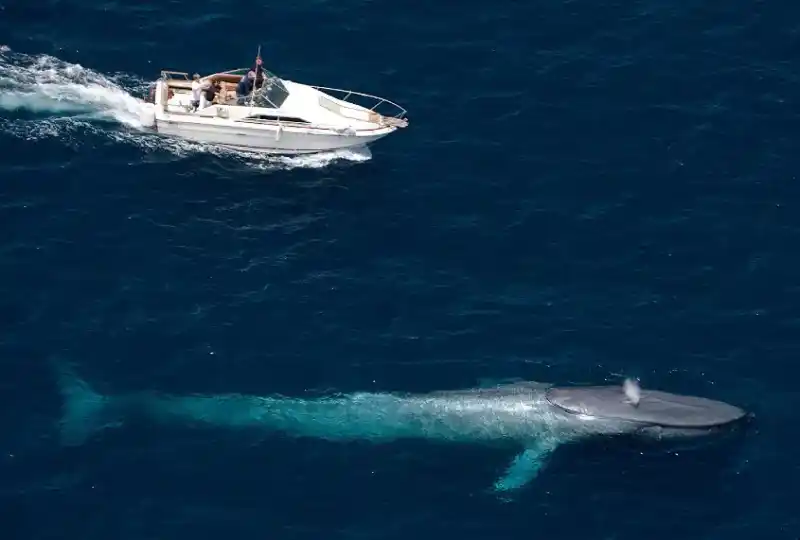
- Body length: 24–30 meters (extreme values may be even greater)
- Weight: Approximately 80–150 tons
- Lifespan: Approximately 70–90 years
Significant features
The largest animal on Earth; its infrasonic calls travel long distances; it lunges with its mouth open and filters its baleen; it migrates long distances seasonally.
Distribution and Habitat
They live in highly productive ocean areas worldwide (polar frontier, upwelling), and seasonally forage at high latitudes and reproduce at low latitudes.
Appearance
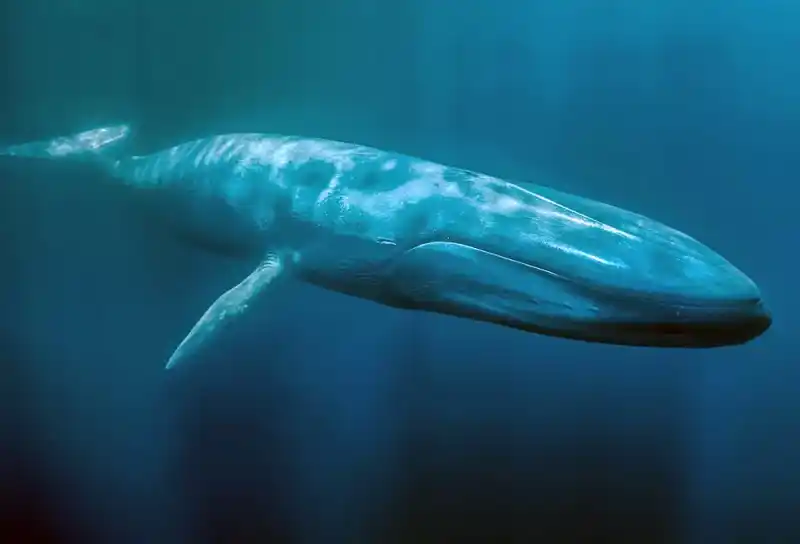
Blue-gray marbled markings; small dorsal fin located at the rear of the body; 60–90 throat folds; tall and erect jet spout.
Detailed introduction
The blue whale ( Balaenoptera musculus ) is the largest living animal on Earth, belonging to the family Balaenoptteridae and the genus Balaenoptera . They primarily feed on krill , using a high-speed lunge feeding technique combined with their expandable throat folds and baleen plates to filter their food. The blue whale's call is low-pitched, reaching infrasonic frequencies, and can travel extremely long distances in the ocean. IUCN assessment: Endangered (EN) .
Basic Information
Scientific name: Balaenoptera musculus
Body length: typically 24–30 meters (regional/sex variations, extreme values may be larger)
Weight: Approximately 80–150 tons (varies depending on the season and individual).
Ecology and Behavior
They primarily feed on Antarctic krill and krill from various ocean currents; in summer, they forage intensively in high-productivity sea areas (upwellings/polar fronts), and in winter they migrate to mid- to low-latitude breeding areas. They are mostly found singly or in small groups, but can form loose colonies when food density is high. Divings typically last 10–20 minutes, with longer dives possible; their spouts are high and vertical, visible from afar.
Morphology and Recognition
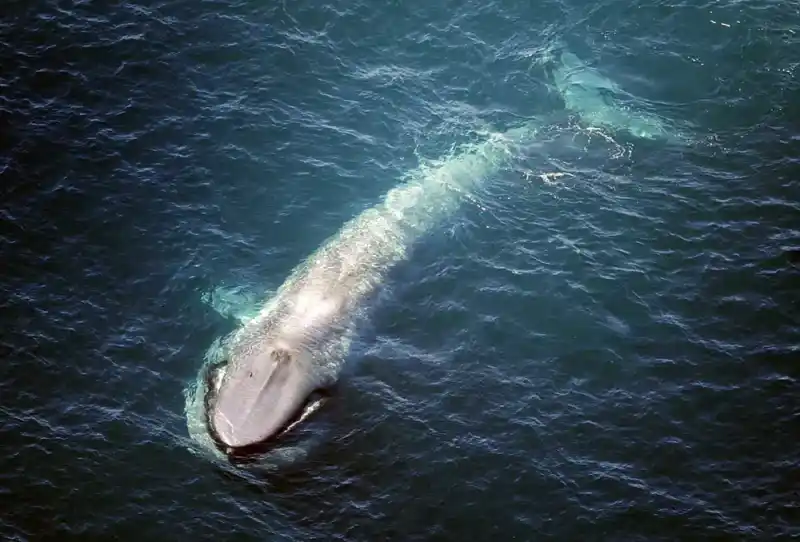
Its body is bluish-gray with irregular marble-like mottled patterns; its dorsal fin is small and located at the rear of the body ; its body is slender; it has 60–90 longitudinal throat folds on its throat and abdomen; its back forms a "long ridge" when gliding across the water. Its spout is upright and can reach a height of 9–12 meters.
Subspecies and distribution
B. m. musculus (Blue Whale of the Northern Hemisphere): North Atlantic and North Pacific Oceans.
B. m. intermedia (Antarctic blue whale): Southern Ocean, usually larger in size.
B. m. brevicauda (Pygmy blue whale): Indo-Western Pacific Ocean, relatively small in size, with its dorsal fin positioned slightly forward.
Threats and Protection
Historical whaling: Industrialized whaling in the early to mid-20th century caused a sharp decline in whaling numbers, with slow recovery.
Ship collisions and fishing gear entanglements: Busy waterways and fixed fishing gear pose a risk of death/injury.
Underwater noise and climate change: Noise affects communication and foraging; climate drives changes in krill distribution and abundance.
Key measures: speed/destination management in busy waters, pilot programs for cordless and weak-break fishing gear, quiet vessel technology, dynamic spatiotemporal protection and transoceanic monitoring based on real-time baiting grounds.
Frequently Asked Questions
Q1: What do blue whales mainly eat? They mainly feed on krill, but also consume small crustaceans; they feed by sprinting with their mouths open and filtering their food through baleen plates.
Q2: How deep and how long can you dive? The typical working diving depth is tens to hundreds of meters, and the dive time is usually 10-20 minutes. Longer dives can last even longer.
Q3: How to distinguish between blue whales and fin whales? Blue whales have a more bluish-gray body color, a smaller and more rearward dorsal fin, and a higher and straighter spout; fin whales have asymmetrical lower jaw coloration on their sides.
Q4: Do they move in groups? Mostly they are single or in small groups, but they may gather when the bait density is high.


