Basic Information
Scientific classification
- Chinese name: Humpback whale
- Scientific name: Megaptera novaeangliae
- Classification: Giant fish
- Family and genus: Baleen whales, Humpback whale
Vital signs data
- Body length: 12–16 meters (females are slightly larger)
- Weight: Approximately 25–40 tons
- Lifespan: Approximately 45–90 years
Significant features
Extra-long pectoral fins; bubble net predation and coordinated encirclement; whale songs during the breeding season; long-distance seasonal migration; high-frequency leaping and slapping behaviors.
Distribution and Habitat
Global Oceans: Forages at high latitudes and reproduces at low latitudes; commonly found in high-yield sea areas such as upwelling currents, seamounts, and tidal fronts.
Appearance
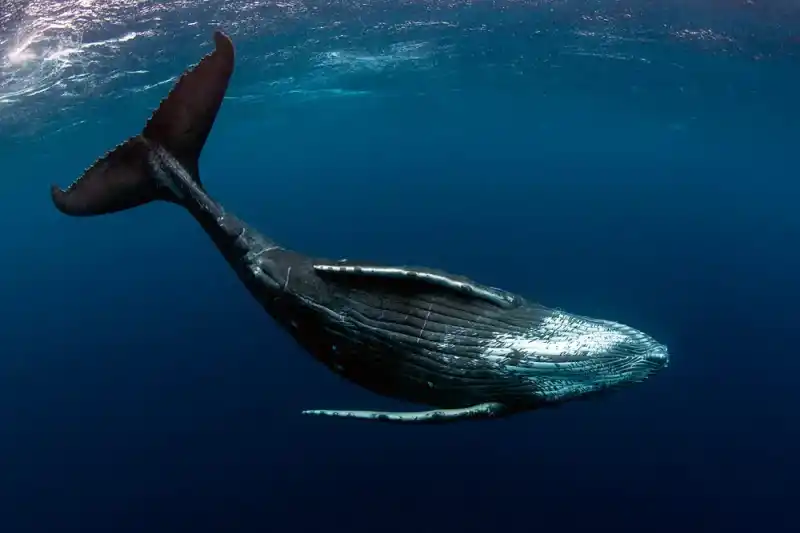
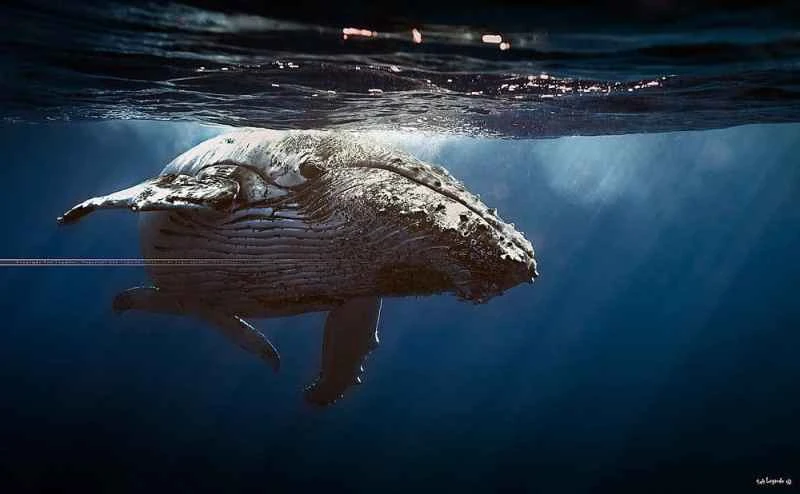
The pectoral fins reach about 1/3 of the body length and have nodules; the dorsal fin is small and positioned posteriorly; the black and white patterned tail lobes are identifiable; the head and jaws are covered with nodules.
Detailed introduction
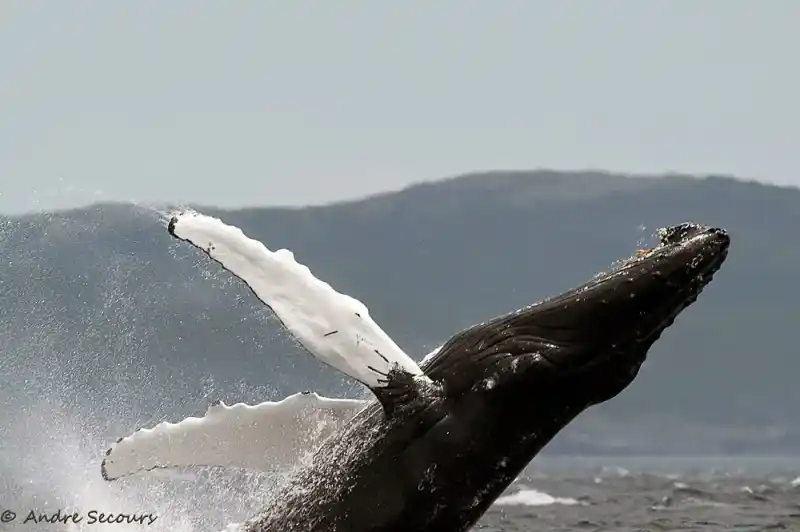
The humpback whale ( Metroptus novaeangliae ) is a medium to large baleen whale known for its exceptionally long pectoral fins and its spectacular breaching leaps . Belonging to the baleen whale family , its pectoral fins can reach up to one-third of its body length, and its back and lower jaw are covered with small tubercles . Humpback whales primarily feed on small schools of fish and krill , and are commonly seen using unique bubble nets and coordinated hunting tactics. IUCN: Least Concern (LC) (some smaller populations/regions may have higher classifications).
Basic Information
Scientific name: Megaptera novaeangliae
Body length: approximately 12–16 meters (females are slightly larger, and extreme values can be even longer).
Weight: Approximately 25–40 tons (seasonal and regional variations)
Ecology and Behavior
In summer, they intensively forage in high-latitude, highly productive waters, and in winter they migrate to tropical and subtropical breeding areas; the migration distance can reach thousands of kilometers. Male whales emit complex whale songs during the breeding season, and the patterns of these songs evolve with the seasons and spread within the group. Common behaviors include leaping, tail flapping, and pectoral fin flapping.
Morphology and Recognition
Robust build; extremely long pectoral fins with coarse, serrated leading edge nodules ; deep tail forked, with distinctive black and white markings on the tail lobes (individual identification markers); small, posteriorly positioned dorsal fin; head and lower jaw densely covered with nodules and bristles.
Threats and Protection
Fishing gear entanglement and vessel collision: securing fishing gear and busy waterways.
Noise interference: Shipping and seismic exploration affect communication and foraging.
Historical whaling impacts and climate variability: uneven recovery of some populations; potential changes in feeding grounds and migration routes.
Measures: Speed management and diversion in hotspot waters, pilot programs for ropeless or weak-break fishing gear, quiet vessel program, dynamic protection of breeding and foraging grounds, and long-term monitoring based on photographic identification.
Frequently Asked Questions
Q1: How to distinguish it from a blue whale/fin whale?
Humpback whales have exceptionally long pectoral fins and small, varied dorsal fins; their tail lobes have distinct black and white patterns; blue whales have smaller, more rearward-positioned dorsal fins and a more bluish-gray body color; fin whales have asymmetrical coloring on their lower jaws.
Q2: What is bubble net predation?
A group of individuals releasing a bubble "wall" around a school of fish and then dashing upwards to feed is a typical example of cooperative foraging behavior.
Q3: What is the purpose of whale songs?
Primarily sung by male whales during the breeding season, the music may be used for mate competition and group communication, and its form may spread and change over time within the region.
Q4: Do you often live near the coast?
They often breed and raise their young in warm, shallow seas, and forage mostly near upwelling currents and tidal fronts along high-latitude coasts, making them relatively easy to observe from near the shore.