
Basic Information
Scientific classification
- Chinese name: Malaysian Hornbill
- Scientific name: Malayan Hornbill, Buceros rhinoceros, Rhinoceros Hornbill
- Classification: Climbing birds
- Classification and Genus: Order Coraciiformes, Family Hornbillidae, Genus Hornbill
Vital signs data
- Body length: 110-122 cm
- Weight: 2.36-2.91kg
- Lifespan: Approximately 35 years
Significant features
Malaysia's national bird
Distribution and Habitat
The Malaysian hornbill was found in Brunei, Indonesia, Malaysia, and Thailand. Regionally extinct: Singapore.
The Malaysian hornbill inhabits vast areas of primary forests, relying on the height provided by tall trees to choose nesting sites. Its movements are unpredictable, and a primary environmental requirement is access to food throughout the year, with a variety of fruits and berries available. It is also found in forested areas on the slopes of hills.
Appearance
The Malaysian Hornbill measures 110–122 cm in length with a wingspan of 152 cm. Males weigh 2.91 kg, and females 2.36 kg. It has a thick, straight beak, usually topped with a casque. The casque and its strong, upward-curving tip resemble a rhinoceros horn, hence its name. It has syndactylous toes. The beak and casque of the Malayan Hornbill are white, but for most of their lives, they constantly rub glands with their beaks, secreting a fluid that appears orange and red on the lower tail. Large patches of black with a bluish tinge form the head, neck, upper body, wings, chest, and lower thighs. The thighs, lower abdomen, vent area, underside of the tail, rump, and upper tail coverts are white. The tail is pure white with broad black stripes, accounting for two-thirds of its length. The iris is red with a black ring; the eyelashes are red; the legs and tarsi are brownish-black. The female's plumage is identical to the male's, the only difference being the white iris.
Detailed introduction
The Malaysian hornbill, scientifically known as *Buceros rhinoceros*, has three subspecies: 1. Borneo subspecies *Buceros rhinoceros borneoensis*; 2. Nominate subspecies *Buceros rhinoceros rhinoceros*; 3. Java subspecies *Buceros rhinoceros silvestris*.
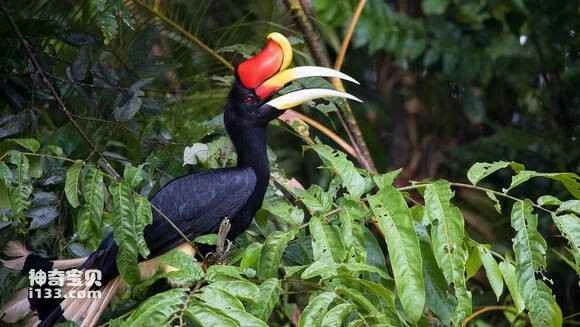
Malaysian hornbills often gather in small flocks to sing as they forage for food in large hectares of forest. Within the flock, pairs only stay together during the breeding season. During this season, both males and females exhibit strong territoriality, their powerful calls sounding like a rousing announcement of their presence. They feed on ripe fruit, insects, small lizards, and even small birds. Hornbills often follow groups of monkeys to find ripe fruit; animal matter makes up about 30% of their diet.

Malaysian hornbills place great importance on courtship; the male must gain the female's trust before mating, laying eggs, incubating, and raising the chicks. Nesting and egg-laying season is from January to April. They choose tree cavities in tall trees, approximately 16-33 meters above the ground, and do not peck at wood themselves, utilizing natural decay or termite-infested burrows. The hornbill's breeding habits are unique. After selecting a nest site, the female lays a layer of wood shavings at the bottom of the burrow and lays one or two pure white eggs inside. After laying the eggs, she remains in the nest, piling her excrement mixed with seeds and decaying wood at the entrance. The male frequently brings wet mud and fruit scraps from outside the nest to help the female seal the burrow. The sealing material is infused with the female's sticky gastric juices, making it very secure. Finally, a vertical crack is left at the entrance, allowing the female to reach out with her beak to feed the male. The female bird remains hidden in her burrow for months, only emerging when the chicks are almost ready to fly. Incubation lasts 37 to 42 days. Even after hatching, the chicks may remain hidden for up to three months. During this time, they are entirely fed by the male. The male can shed the innermost layer of his stomach wall and regurgitate a thin membrane to store fruit for the female and chicks. The female emerges from the burrow fully molted and immediately begins feeding the chicks. Inside the enclosed burrow, the female regularly cleans herself of droppings and other waste, throwing them directly out of the burrow with her beak. When defecating, she sprays her anus directly into the burrow opening. This peculiar lifestyle may be an adaptation developed to protect herself from predators and to cope with a harsh natural environment.
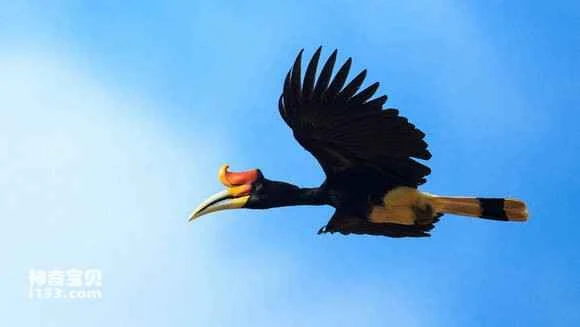
Malaysia is the home of the hornbill, and has been known as the "Land of the Hornbills" for over a century. This explains why the hornbill is Malaysia's national bird; its large population and long history with the species are well-documented. The Malaysian Olympic Committee also chose the hornbill, a critically endangered animal, as the model for its Asian Games mascot. Furthermore, the hornbill is a beautiful and brightly colored bird, deeply loved and revered by the people of Sarawak. It is considered a sacred bird and held in high esteem. Displaying as many hornbill carvings as possible in their longhouses is seen as a supreme honor, as these magnificent and vibrant sculptures are considered the best offerings to the gods. Offering hornbill carvings to the gods during the annual "Bird Festival" is an essential ritual.
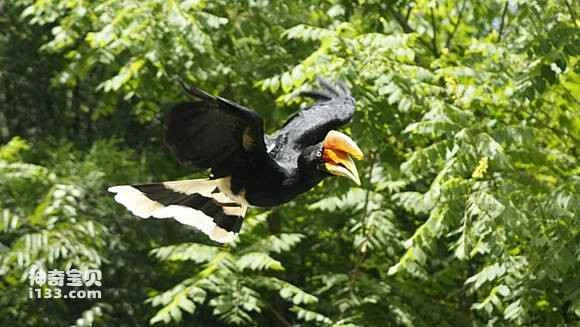
It is listed in Appendix II of the 2019 edition of the Convention on International Trade in Endangered Species of Wild Fauna and Flora (CITES).
Listed as Vulnerable (VU) in the IUCN Red List of Threatened Species ver 3.1: 2020.
Protect wild animals and ban the consumption of wild game.
Maintaining ecological balance is everyone's responsibility!


