Basic Information
Scientific classification
- Chinese name: Knife-billed hummingbird
- Scientific name: Sword-billed Hummingbird, Ensifera ensifera
- Classification: Climbing birds
- Genus and family: Apodiformes, Hummingbird family, Blade-billed Hummingbird
Vital signs data
- Body length: Approximately 14 centimeters
- Weight: About 12g
- Lifespan: No verification data available.
Significant features
The world's longest hummingbird
Distribution and Habitat
It is distributed in Bolivia, Colombia, Ecuador, Peru, and Venezuela.
It is native to the dense forests of the Andes Mountains in South America, at altitudes above 2,500 meters.
Appearance
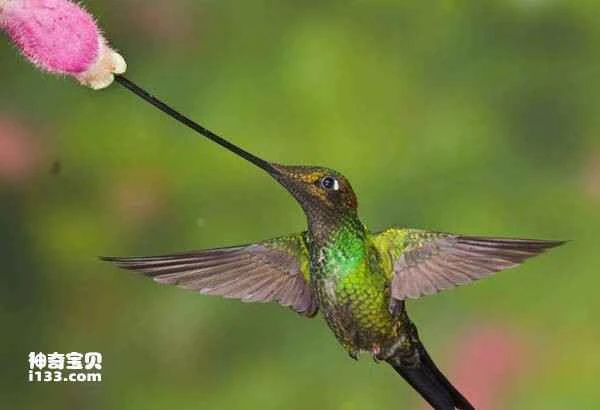
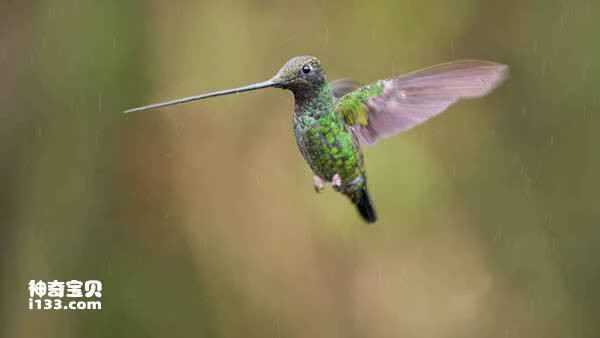
The Knife-billed Hummingbird measures 14 cm in length, with an average beak length of 8 cm and a weight of about 12 grams. It is one of the largest hummingbird species. It has vibrant plumage, a long, slender beak, large, bright eyes, a brownish-gray head, yellowish-green upper wings, and brownish-gray lower wings. The rest of its plumage is copper-green, giving it a metallic sheen. Its long, slender, sword-like tubular beak can reach up to 10.5 cm in length, more than half its body length, making it exceptionally beautiful. Furthermore, its flight is characterized by rapid wing flapping, producing a buzzing sound similar to that of a bee, hence its name, Knife-billed Hummingbird.
The razor-billed hummingbird's feathers are fine, smooth, and exceptionally beautiful, possessing a unique reflective quality. When it flies towards the sunlight, it reflects a dazzling array of colors, surpassing even the beauty of a rainbow. Especially when it performs somersaults, the changing colors due to the varying angles are even more spectacular, earning it the nickname "flying diamond."
Detailed introduction
The sword-billed hummingbird (scientific name: Ensifera ensifera) has no subspecies.
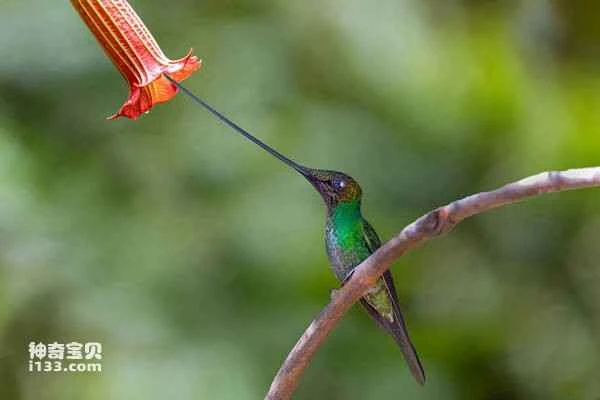
The Knife-billed hummingbird has a very unique lifestyle, differing from many other birds. Its primary food source is the nectar of the passionflower, a climbing plant native to Central America. The long beak of the Knife-billed hummingbird is perfectly suited to the 11.4 cm long corolla of the passionflower, allowing it to reach precisely into the trumpet-shaped flower to collect the nectar. When feeding, it doesn't need to land on the flower branches; instead, it uses its superb flying skills to hover in the air. Because its tongue is tubular, like a syringe, when it inserts its beak into the corolla, its tongue quickly extends from the tip, using the cilia on its tip to lick up the nectar. Once the cilia are saturated with nectar, the tongue retracts into the mouth, licking the nectar away. This method of feeding is both accurate and convenient, unparalleled in the diverse world of birds.
The Knife-billed hummingbird primarily feeds on the nectar of brightly colored, fragrant small flowers found on trees, herbs, shrubs, and epiphytes. It favors flowers with high sugar content (usually red tubular nectar) and actively seeks out and protects these high-energy nectar-bearing blossoms. Their tongues are longer than their beaks, with the hyoid bone coiled within their skulls, allowing for flexible extension and retraction. They use their long, expandable, straw-like tongues to extend and retract at a high speed of 13 times per second. Because hovering is extremely energy-consuming, the Knife-billed hummingbird must feed tens of thousands of times a day, consuming more than half its body weight in a single day.
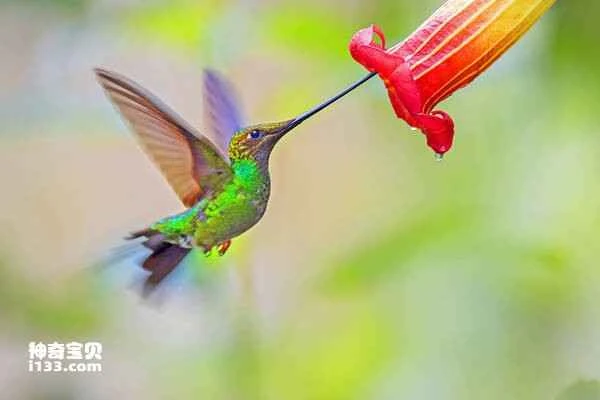
The ingenious and harmonious cooperation between the hummingbird and the passionflower flower benefits both: the hummingbird obtains food, and the passionflower is able to be pollinated. Therefore, the hummingbird is known as the "matchmaker of flowers" because it helps plants pollinate while licking nectar. It usually flies around under the flowers, searching for food, and pollen adheres to its feathers. Then, as it flies, it carries this pollen to other flowers, completing the pollination process for these plants.
Because of its unique lifestyle, the sword-billed hummingbird has an extremely rapid and prominent metabolism. Its normal body temperature is around 41°C, and its heart rate can reach over 600 beats per minute. The nectar it consumes has the advantage of being rich in glucose, which immediately enters the bloodstream and participates in energy metabolism. However, this energy is consumed very quickly. To maintain its body temperature and replenish the large amount of energy consumed during intense flight, it must feed constantly, consuming tens of thousands of meals a day. Its appetite is also astonishing; the weight of food it eats each day exceeds half its own body weight.
Although small in size, the sword-billed hummingbird is very brave and fearless. When it encounters a bird much larger than itself, it dares to fight it, circling its opponent rapidly and making a buzzing sound, often leaving the opponent dizzy and deafened, forcing it to flee in defeat.
Hummingbirds are polygynous. After mating with a male, the female builds a cup-shaped nest woven from plant fibers. The outside is camouflaged with moss and other green materials, and the nest is placed in a protected location within bushes or trees. The nest is lined with soft plant fibers, animal hair, and down, and its structure, reinforced with spiderwebs and other adhesive materials, provides sufficient elasticity. On average, each nest contains two white eggs, which the female carries and raises alone for about two weeks. She protects and feeds the chicks alone, feeding them mainly partially digested nectar and insects. The female regurgitates food directly into the chick's throat through her long beak. The chicks are sometimes left alone in the nest after 12 days, and they leave after another 7-10 days. The male then defends his territory and his flower food.
The beautiful appearance and graceful movements of the razor-billed hummingbird have also won the hearts of many artists. In the exhibition hall of the Boston Museum, there is an original of a world-famous painting entitled "Passionflower and Hummingbirds." This work by American oil painter Martin Johnson Heade depicts two lifelike razor-billed hummingbirds perched on a hanging vine, surrounded by beautiful red flowers.

Listed as Least Concern (LC) on the IUCN Red List of Threatened Species 2016 ver 3.1.
Protect wild animals and ban the consumption of wild game.
Maintaining ecological balance is everyone's responsibility!