Basic Information
Scientific classification
- Chinese name: Blind Snake
- Scientific name: Scolecophidia: blind snakes
- Classification: Squamata
- Family and genus: Family: Haematopoda, Genus: Anilios
Vital signs data
- Body length: Most blind snakes are about 10–30 cm in total length, with a few species reaching about 40 cm. Their bodies are as thin as a pencil or even thinner.
- Weight: The individual weight is extremely light, generally only a few grams or even less, which is consistent with the body size characteristics of small burrowing snakes.
- Lifespan: The lifespan in the wild is not fully understood, but it is generally believed that one can survive for several years; lifespan is even longer in environments with less disturbance and stable food.
Significant features
Small in size, burrowing, and resembling an earthworm in appearance, with degenerated eyes and extremely poor eyesight, it feeds mainly on ants and termites and is an important member of the underground ecosystem.
Distribution and Habitat
It is widely distributed in tropical and subtropical regions around the world, and mostly lives in loose and moist soil, leaf litter, and under rocks and decaying wood. It can also be found in farmland and garden soil.
Appearance
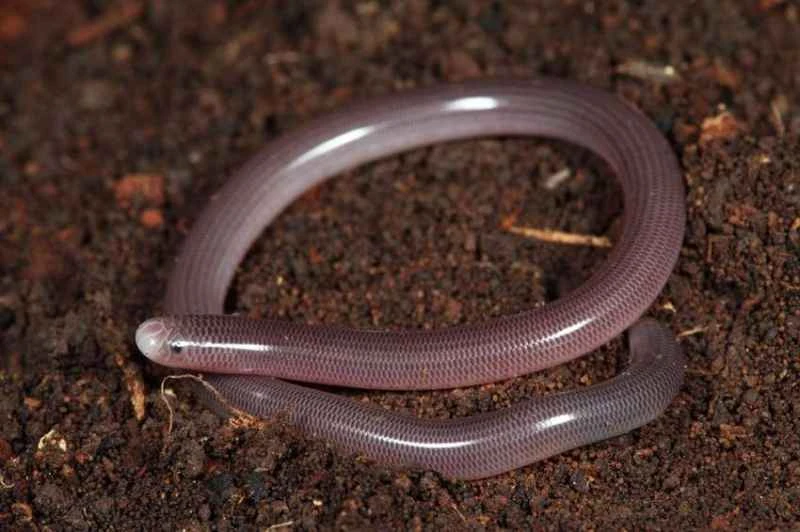
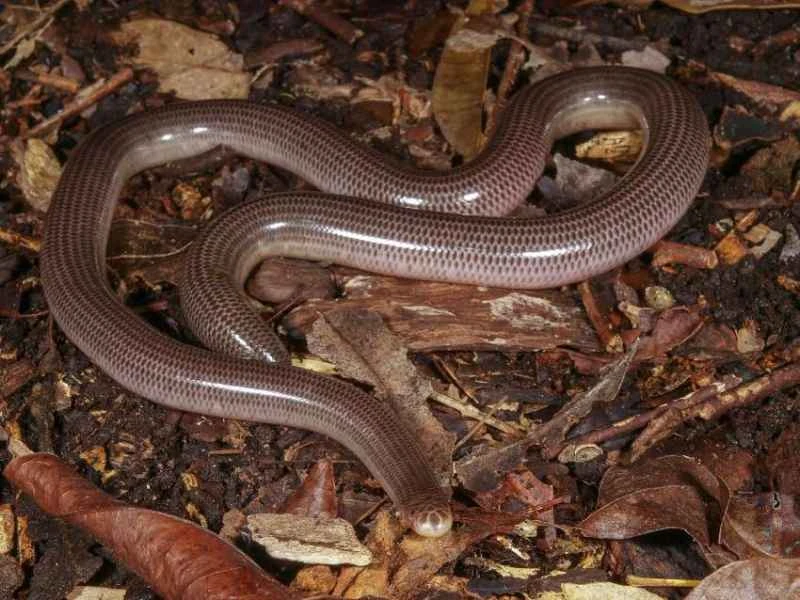
With a slender body, small and smooth scales with a glossy surface, blunt and rounded head and tail, and eyes covered by scales, its overall shape is often mistaken for a large earthworm.
Detailed introduction
Blind snakes are a general term for small, burrowing snakes that resemble earthworms. They mostly belong to the families Typhlopidae and Leptotyphlopidae within the suborder Scolecophidia. Their eyes are extremely degenerate, covered by scales, and they can only perceive changes in light and dark, hence the name "blind snake." Despite their unassuming appearance, blind snakes play a vital role in soil ecosystems and in the regulation of ant and termite populations.
Classification and nomenclature
Chinese name: Blind snake (broadly defined);
English name: Blind Snake;
Common representative groups: species from multiple families such as Typhlopidae and Leptotyphlopidae;
Example genus: Anilios (one of the common blind snake genus in Australia).
In popular science or field observation, "Blind Snake" usually refers to a whole group of small burrowing snakes that are similar in appearance and habits, rather than a single species.
Appearance features
The blind snake's overall appearance is very different from the "large snake" in people's minds; it looks more like a slender earthworm.
Size: Most species are only about 10–30 cm in total length, very few exceed 40 cm, and their bodies are as thin as a pencil or even thinner;
Body surface: The scales are small and smooth, and the body surface is shiny, looking like a glossy "rope";
Head: The head is similar in thickness to the body, with a slightly blunt tip and almost no visible "neck";
Eyes: The eyes are extremely degenerate, often covered by translucent scales, and can only perceive light and darkness, with almost no ability to form images;
Tail: The tail is short and blunt, and some species have small spiky protrusions at the end of the tail, which help with support and turning in the soil;
Body color: Mostly brown, gray, pinkish-brown or dark brown, but there are also light yellow or even pink individuals, which are suitable for camouflage in soil and leaf litter.
Distribution range and habitat
Blind snakes are widely distributed:
It is mainly found in tropical and subtropical regions of the world, including Africa, Asia, Australia, the Americas, and various islands;
Some species extend into warmer temperate regions, surviving in environments where the local climate allows.
Typical habitats include:
Loose, moist soil and underground caves;
Below the leaf litter, in the decaying wood, beneath the stones and rotten wood;
Blind snakes may be active in the soil of farmland, gardens, lawns, and urban green spaces, wherever there are ant nests or termite nests.
Lifestyle Habits and Behaviors
Blind snakes are small, burrowing snakes highly adapted to underground life.
They are mostly active at night or after rain, and during the day they mostly hide underground or under cover.
They burrow into the soil using the powerful wriggling motion of their heads and bodies, similar to earthworms.
When encountering interference, they usually choose to continue burrowing deeper into the soil rather than fleeing or attacking on the surface.
Their vision has deteriorated, but their sense of smell and ability to perceive chemical signals are strong, enabling them to track the scents left by prey and their own kind.
feeding habits
Blind snakes feed on small invertebrates, with a particular preference for ants and termites.
It mainly feeds on the eggs, larvae and pupae of ants and termites, and acts as a "cleaner" for ant nests and termite nests;
It also feeds on other small molluscs and insect larvae;
Because of their small size, they prey on small animals that lack strong defenses.
In farmland and garden ecosystems, blind snakes are sometimes seen as small "beneficial snakes" that help control ants and termites.
Reproduction and life cycle
Most blind snakes are oviparous, and their reproductive methods are relatively simple:
Female snakes lay their eggs in damp, hidden underground environments or among dead branches and fallen leaves, and the number of eggs per clutch is usually not large.
The eggs develop under relatively stable temperature and humidity conditions, and the hatchlings are similar in appearance to the adults, only smaller in size.
Because blind snakes are highly elusive and small in size, their lifespan and reproductive cycle are not easily measured accurately in the wild, but they are generally believed to live for several years.
Relationship with humans
Most blind snakes are docile, non-aggressive towards humans, and possess almost no venom that could be dangerous to humans.
Blind snakes are occasionally found while digging in residential areas, gardens, or farmland, and people often mistake them for earthworms or snake spirits.
If they are accidentally killed or their habitats are severely damaged, it may affect the balance of the local underground invertebrate community.
Protecting the status quo and threats
Currently, many blind snake species are still listed as Not Evaluated (NE) or Least Concern (LC) on the IUCN Red List, but some island or endemic species with narrow distribution ranges may face threats due to habitat destruction.
The main threats include:
Urbanization and agricultural development have led to soil compaction and cement hardening, reducing the availability of suitable loose soil layers.
The extensive use of pesticides and insecticides indirectly reduces their prey or has a toxic effect on the blind snakes themselves.
Misunderstandings and fears about small snakes lead to accidental killings.
Protecting soil ecology, reducing pesticide use, and correctly understanding "snakes that look like small earthworms" can help maintain the health of blind snakes and the underground ecosystems they depend on.
Frequently Asked Questions
Q1: Are blind snakes really "invisible"?
The blind snake's eyes are highly degenerate, only able to perceive changes in light and darkness, and almost unable to form clear images, hence the name "blind snake".
However, they can still survive well in underground environments by using their sense of smell and touch.
Q2: Are blind snakes venomous? Do they bite?
The vast majority of blind snakes are non-venomous and rarely bite humans. They mainly feed on small invertebrates such as ants and termites, and pose no direct threat to humans.
Q3: Should I deal with blind snakes if I see them in the garden?
Generally, this is not necessary. Blind snakes help control ant and termite populations and are an important part of the underground ecosystem. As long as they are not disturbed, they will usually continue to live and work in the soil.
Q4: How to distinguish between a blind snake and an earthworm?
Blind snakes have distinct scales on their surface, a shinier body, different head and tail shapes, and a clear mouth structure; earthworms are annelids, without scales, with a moist body surface and clearly segmented bodies.