Basic Information
Scientific classification
- Chinese name: Spotted Blue-tongued Lizard
- Scientific name: Tiliqua nigrolutea
- Classification: Squamata
- Family and genus: Skinkaceae, Bluetongue Skink
Vital signs data
- Body length: Adults typically reach a total length of about 35–60 cm, making them relatively large skink lizards.
- Weight: Weight is generally around 0.5–1 kg, with slight differences between individuals and geographic types.
- Lifespan: The average lifespan in the wild is about 15–20 years, and it can live to 20–30 years or more in captivity under good conditions.
Significant features
It has a robust build, a back covered with striking light-colored patches, a prominent blue tongue, a gentle temperament, and is very beneficial to farmland and gardens.
Distribution and Habitat
It is widely distributed in wet and dry shrublands, mountain forests, subalpine thickets and coastal heather thickets in southeastern Australia and Tasmania, and is also often found in human activity areas such as farmland, pastures and rural gardens.
Appearance
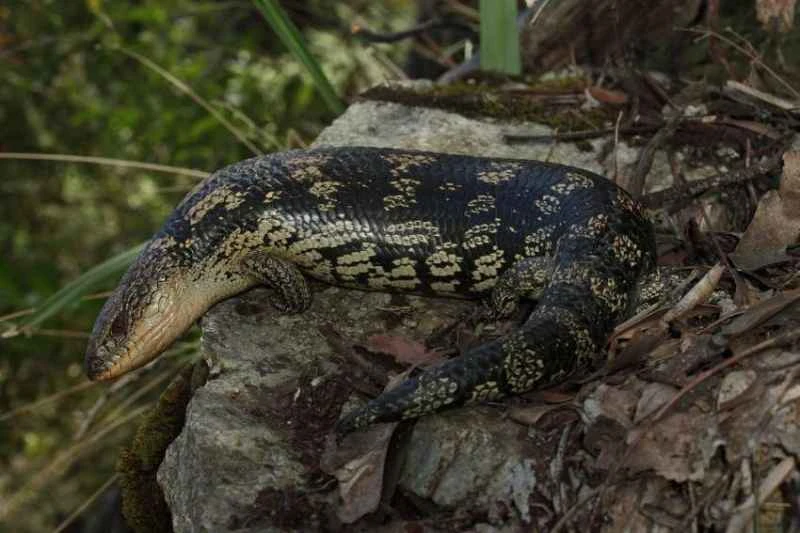
The body is short and stocky, with short, powerful limbs and a relatively short tail. Lowland breeds are mostly grayish-brown with light-colored patches, while highland breeds are predominantly black with cream or orange-pink patches, creating a striking contrast. The broad head and deep blue tongue are the most distinctive physical features.
Detailed introduction
The Blotched Blue-tongue Lizard (scientific name *Tiliqua nigrolutea *) is a large skink lizard, also commonly known as the "spotted blue-tongue skink" or "southern blue-tongue lizard." It is endemic to southeastern Australia and Tasmania, and is famous for its robust body, short, powerful limbs, and striking blue tongue. In many farms and home gardens, it is a popular "natural pest control helper," effectively controlling pests such as snails and slugs.
Classification and nomenclature
The spotted blue-tongued skink belongs to the class Reptilia, order Squamata, family Scincidae, and genus Tiliqua . This genus includes several well-known blue-tongued skinks and is one of Australia's most representative lizard groups. Due to the distinctive light-colored patches on its back, this species is called the "Blotched" blue-tongued skink to distinguish it from other closely related species such as the eastern blue-tongued skink.
Appearance features
The spotted blue-tongued lizard has a robust body, short and sturdy limbs, and a relatively short tail, giving it an overall stocky and clumsy appearance. Its body color and markings vary considerably depending on the region, generally falling into two categories: lowland and highland. The lowland type is typically gray or brown with light silver or brownish-gray patches on its back, contrasting with the surrounding darker bands. The highland type is generally darker, even approaching black, with cream, pinkish-orange, or orange-red patches on its back, creating a very strong visual contrast. Its most distinctive features are its plump head and a large, fleshy blue tongue. When threatened, it opens its mouth wide, extends its blue tongue, and hisses intimidatingly.
Distribution range and habitat
The spotted blue-tongued lizard is endemic to southeastern Australia, primarily distributed in Victoria, Tasmania, parts of South Australia, New South Wales, and the Australian Capital Territory. They inhabit a wide range of environments, including wet and dry sclerophyll forests, montane forests, subalpine scrublands, and coastal heather thickets. With the expansion of human activity, they have gradually adapted to farmland, pastures, and even rural and suburban gardens, where they can be found in piles of firewood, among rocks, in bushes, and in leaf litter.
Lifestyle Habits and Behaviors
The spotted blue-tongued lizard is a diurnal reptile, mostly active during the day, and most active in the early morning and evening when temperatures are moderate. In winter, they enter a state of brumation similar to hibernation, resuming activity and entering their breeding season in spring as temperatures rise. When threatened, they usually first try to escape by remaining still or crawling slowly. If approached, they will puff out their bodies, open their mouths wide, reveal their blue tongues, and hiss to scare away predators; they will only bite when cornered. Their bite is strong and painful, but their teeth are relatively blunt and rounded, generally not breaking the skin, making them essentially harmless to humans.
feeding habits
The spotted blue-tongued lizard is a typical omnivorous species, feeding on both animal and plant matter. Their diet includes insects such as beetles and caterpillars, mollusks such as snails and slugs, various spiders and other small invertebrates, as well as nibbling on flowers, tender leaves, wild berries, and fallen fruit. When given the opportunity, they may also consume the carcasses of small mammals (such as young mice) or other small vertebrates. Because of this broad and flexible diet, the spotted blue-tongued lizard helps control pests in farmland and gardens, and is considered a valuable "ecological helper."
Reproduction and life cycle
Like many blue-tongued skinks, the spotted blue-tongued skink is viviparous, meaning it does not lay eggs but instead develops embryos inside the mother, ultimately giving birth to live young. They typically mate in early spring, have a long gestation period, and the offspring are mostly born in autumn. Breeding strategies vary slightly depending on the geographic type: highland types tend to be larger and live in colder environments, often producing fewer offspring (around 5), but the individual offspring are larger; lowland types typically produce about 10 or even more offspring at a time. Spotted blue-tongued skinks grow slowly, taking several years to reach sexual maturity. In the wild, the average lifespan is 15–20 years, and in captivity with excellent conditions, lifespans have been recorded to approach or even exceed 30 years.
Relationship with humans
In many parts of Australia, the spotted blue-tongued lizard is a common sight in gardens and farmlands. By preying on agricultural and forestry pests such as snails and slugs, they help reduce crop and horticultural losses, indirectly lowering the need for pesticides, and are therefore often considered beneficial animals. However, because their appearance can be slightly frightening to some, they are sometimes accidentally injured or attacked by pet dogs or cats. In fact, these lizards are docile and generally will not attack humans unless deliberately scratched or pinched; maintaining a safe distance when observing them in the wild is sufficient.
Protecting the status quo and threats
Currently, the spotted blue-tongued lizard is assessed as "Least Concern" on the IUCN Red List, and its overall population is relatively stable, but it still faces multiple pressures in some areas. Major threats include habitat destruction and fragmentation due to agricultural or urban expansion, fatalities caused by road traffic, the risk of poisoning from chemicals such as pesticides and rodenticides, and predation pressure from invasive or domesticated predators such as cats, dogs, and foxes. To protect this species, many national parks and nature reserves provide habitat protection, while public education also reminds people to avoid harming blue-tongued lizards and reduce the use of highly toxic chemicals in gardens, allowing this gentle reptile to continue to maintain its ecological role in the Australian landscape.
References
Cogger, HG, 1994. *Australian Reptiles and Amphibians*. Reed Books, Sydney.
Ehmann, H. 1992. *Encyclopedia of the Animals of Australia*. Reptiles. Australian Museum and Angus & Robertson, Sydney.
Greer, AE, 1989. *The Biology and Evolution of Australian Lizards*. Surrey Beatty & Sons, Sydney.
Weigel, J. 1988. *Captive Care of Reptiles in Australia*. Reptile Breeders Association, Gosford.
Wilson, SK & Knowles, DG 1988. *Australian Reptiles: A Pictorial Guide to Terrestrial Reptiles of Australia*. William Collins Publishing, Sydney.
Frequently Asked Questions
Q1: Are spotted blue-tongued lizards poisonous? Will they attack people unprovoked?
The spotted blue-tongued lizard lacks venom glands and is not classified as a venomous lizard, posing virtually no harm to humans. They are generally docile and prefer to flee or intimidate with their blue tongues and hissing rather than actively bite. They may only bite if forcibly grasped and cornered with no way out.
Q2: What should I do if I encounter a spotted blue-tongued lizard in the garden?
If you encounter a spotted blue-tongued lizard in your garden or farmland, the best course of action is to keep your distance and let it roam freely. They will help you eat snails, slugs, and other pests, and are beneficial to your plants. Do not try to scare it away or harm it with a stick, and also keep an eye on your dogs and cats to prevent them from attacking these lizards.
Q3: Are spotted blue-tongued lizards suitable as pets?
In some areas, spotted blue-tongued lizards are legally kept as pets. They are adaptable and relatively docile, but require suitable reptile-specific lighting, temperature gradients, hiding places, and a varied omnivorous diet. Before keeping one, check local laws and regulations and obtain individuals from legal sources; never capture them illegally from the wild.
Q4: Why should we protect this seemingly common lizard?
Although the overall population of the spotted blue-tongued lizard is currently stable, some areas are facing problems such as habitat loss, road closures, and chemical pollution. Protecting common species is equally important; they play vital roles in the ecosystem, such as controlling pests and dispersing seeds, and also help the public understand and respect native wildlife.