Basic Information
Scientific classification
- Chinese name: Blue-bellied Black Snake
- Scientific name: Pseudechis guttatus
- Classification: Squamata
- Family and genus: Elapidae, genus *Symplocos*
Vital signs data
- Body length: Adults are typically about 1.2–1.5 meters in total length, with very large individuals reported to be close to or exceed 1.8–2 meters.
- Weight: Weight generally ranges from several hundred grams to over 1 kilogram, depending on individual size, sex, and nutritional status.
- Lifespan: Individuals in the wild are expected to live for more than 10 years, and may live for 15–20 years or even longer under good captive conditions.
Significant features
With a glossy black body and a bluish-grey sheen on its belly, it is one of the highly venomous black snakes endemic to the eastern inland of Australia. It is shy but extremely defensive when threatened.
Distribution and Habitat
Distributed in southeastern Queensland and northeastern New South Wales in the eastern inland of Australia, it inhabits arid and semi-arid grasslands, scrublands, open woodlands, savannas, black soil floodplains, as well as areas around streams, swamps and seasonal wetlands, often using piles of stones, fallen logs, soil crevices and animal burrows as cover.
Appearance
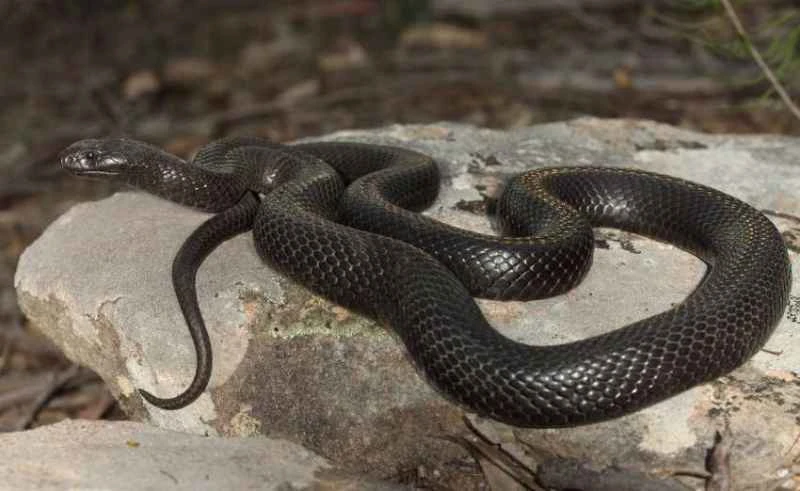
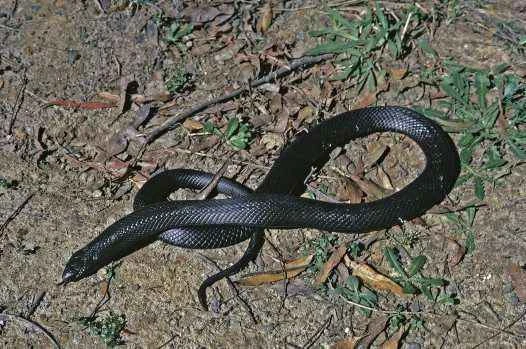
The body is slender and sturdy, with a slightly wide head that is not clearly distinguishable from the neck. The back is mostly black or dark brown with a strong sheen; some individuals have lighter-colored edges on the dorsal scales, presenting spots or mottled patterns. The ventral surface is blue-gray, dark gray, or black-gray, sometimes with light gray or cream-colored patches, creating a cool contrast with the dark back, making the name "blue-bellied black snake" truly fitting.
Detailed introduction
The Blue-bellied Black Snake ( Pseudechis guttatus ) is a medium to large-sized, highly venomous snake belonging to the genus Pseudechis in the family Elapidae. It is also commonly known as the "Spotted Black Snake." Endemic to the eastern outback of Australia, it gets its name from its glossy black body and bluish-grey or blackish-grey underside. The Blue-bellied Black Snake is generally shy and tends to avoid humans, but it will exhibit strong defensive behavior when provoked or cornered. Its venom is among the most potent of Australian black snakes, making it a medicinally significant snake in its native habitat.
Classification and nomenclature
The blue-bellied black snake belongs to the class Reptilia, order Squamata, family Elapidae, and genus Pseudechis . This genus includes several well-known Australian venomous snakes, such as the red-bellied black snake and the colette black snake, and is one of the representative groups of Australian venomous snake diversity. The scientific name of the blue-bellied black snake is Pseudechis guttatus , with the specific epithet "guttatus" meaning "spotted," reflecting the distinct light-colored spots or markings on some individuals; therefore, it is also often called the "spotted black snake" or "spotted black snake."
Appearance features
The Blue-bellied Black Snake has a slender, cylindrical body. Its head is slightly wider than its neck, forming a blunt triangle. It has small, round eyes. The back is typically dark black or blackish-brown with a high sheen, appearing as if coated with varnish. Some individuals have lighter-colored edges on the dorsal scales, giving the body a subtle mottled or "spotted" effect. The belly is mostly bluish-gray, dark gray, or blackish-gray, with some individuals showing lighter gray or cream-colored patches on the sides of the belly, contrasting with the dark back. Adults are generally 1.2–1.5 meters long, with very large individuals reportedly approaching or exceeding 1.8–2 meters. Overall, it appears more "pure black" than the Red-bellied Black Snake, lacking prominent red stripes on the belly, instead possessing a cool-toned bluish-gray sheen.
Distribution range and habitat
The blue-bellied black snake is endemic to the eastern inland region of Australia, primarily distributed in the inland plateaus, plains, and foothills of southeastern Queensland and northeastern New South Wales, often along the western slopes of mountain ranges and river plains. It adapts to a wide range of habitats, including arid or semi-arid grasslands, scrublands, open woodlands, savannas, black soil floodplains, and areas surrounding rivers, swamps, and wetlands. The blue-bellied black snake is mostly terrestrial, utilizing piles of rocks, fallen logs, crevices in the soil, animal-dug burrows, and dense surface vegetation as hiding places to avoid high temperatures and predators.
Lifestyle Habits and Behaviors
The blue-bellied black snake is primarily diurnal or twilight-active, with its activity time varying with season and temperature. In cooler or milder weather, they forage or bask during the day; in hot weather, they are more active at dawn and dusk. They are generally shy and will quickly flee or slip into nearby cover when encountering humans or large animals. If cornered, the blue-bellied black snake will flatten its forebody, raise its body, hiss loudly, and coil in an "S" shape as a show of force; if the threat persists, it may bite. Its venom is extremely potent, considered one of the most venomous of the black snakes, but actual human bites are rare.
feeding habits
The blue-bellied black snake is a carnivorous predator, primarily feeding on various small vertebrates. It commonly preys on frogs, lizards and their larvae, small mammals (such as rodents), and other snakes, and occasionally consumes the carcasses of injured or dead small animals. In some areas, it has a particular preference for frogs, and is therefore frequently found in wetlands, streams, and around seasonal waterholes. The blue-bellied black snake typically relies on sight and smell to locate its prey, striking suddenly and swiftly when it approaches, injecting venom with its fangs to quickly paralyze or kill the prey before swallowing it whole.
Reproduction and life cycle
The blue-bellied black snake is an oviparous snake, generally mating from late winter to spring. Females enter their breeding season after temperatures warm up. Egg-laying typically occurs from late spring to summer, with the number of eggs per clutch varying depending on the size and nutritional status of the snakes, generally between 5 and 17. Females lay their eggs in secluded and relatively stable environments, such as under decaying wood, in burrows, or in crevices between rocks, where the warm environment allows for natural incubation. The incubation period can last from several days to nearly three months. Once hatched, the young snakes are capable of independent survival, primarily preying on smaller frogs and lizards when still small. The blue-bellied black snake grows relatively slowly; wild individuals are expected to take several years to reach sexual maturity, and their lifespan is estimated to exceed 10 years, potentially extending even further in well-protected captive environments.
Relationship with humans
Within its distribution area, the blue-bellied black snake is mostly found in relatively remote agricultural and pastoral areas, river valleys, and shrublands, generally avoiding human habitation, thus limiting the chance of direct conflict with humans. However, due to its potent venom, accidental stepping, capturing, or provoking it can lead to severe poisoning symptoms, including intense pain, nausea, vomiting, sweating, and bleeding tendencies, requiring immediate medical attention and the administration of appropriate antivenom. For local residents, recognizing and distinguishing the blue-bellied black snake from other black snakes, maintaining a safe distance, and refraining from catching or teasing any wild venomous snakes are crucial for personal safety. The blue-bellied black snake plays an important role in controlling rodent and frog populations within the ecosystem, contributing positively to maintaining local ecological balance.
Protecting the status quo and threats
The Blue-bellied Black Snake is currently listed as "Least Concern" on the IUCN Red List. Its overall population within its range remains stable, and there is no significant risk of extinction in the near future. However, local populations are still threatened by habitat loss and fragmentation, farmland expansion, road traffic fatalities, indirect poisoning from pesticides and rodenticides, and predation pressure from invasive and domesticated predators such as cats and dogs. Protecting natural wetlands and woodlands, maintaining natural vegetation along riverbanks, reducing the use of highly toxic chemicals, and strengthening public education to help people understand and respect native snakes will help the Blue-bellied Black Snake continue its important ecological role in the Australian outback ecosystem in the long term.
References
Cogger, H. (2000) “Reptiles and Amphibians of Australia”, Reed New Holland
Greer, AE (2006) “Encyclopedia of Australian Reptiles : Elapidae”, Australian Museum
Ehmann, H. (1992) “Encyclopedia of Australian Animals : Reptiles”, Australian Museum, Angus & Robertson
Mirtshin, P. and Davis, R. (1991) “Dangerous Snakes of Australia”, revised edition, Ure Smith Press
Wilson, S. and Swan, G. (2008) “A Complete Guide to Reptiles of Australia”, Reed New Holland
Frequently Asked Questions
Q1: How venomous is the blue-bellied black snake? Is it extremely dangerous to humans?
The blue-bellied black snake is a highly venomous snake, and its venom is considered one of the most potent among Australian black snakes. A bite can cause severe symptoms such as intense localized pain, nausea, vomiting, sweating, and bleeding tendencies, requiring immediate medical attention and treatment with appropriate antivenom serum. Therefore, in its native habitat, one should remain highly vigilant and never attempt to catch or handle it if encountered.
Q2: What should I do if I encounter a blue-bellied black snake in the wild?
If you see what appears to be a blue-bellied black snake or another black snake in the wild, the safest course of action is to remain calm and slowly back away, giving the snake room to escape. Do not attempt to provoke, drive away, or capture it with sticks, and do not gather around to watch or make a scene. For most tourists and residents, avoiding contact with any snake of unknown species is the safest option.
Q3: What is the difference between the blue-bellied black snake and the red-bellied black snake?
The red-bellied black snake is easily identifiable by its distinctive red or orange-red stripes on its belly; while the blue-bellied black snake's back is more solid black or has light-colored spots, and its belly is bluish-gray or dark gray, lacking bright red stripes. Both belong to the genus *Syngonium* and are similar in size, but their distribution areas and habitat preferences differ slightly. Identification in the wild usually requires a combination of factors, including body color, belly markings, and geographical location.
Q4: Since the blue-bellied black snake is classified as "least endangered", why does it still need protection?
"Least Concern" indicates that the overall population is not currently facing an immediate risk of extinction, but it does not mean it can be ignored. Local populations may still decline due to habitat loss, road closures, chemical pollution, and the impact of invasive predators. Protecting these seemingly "common" species helps maintain the stability and integrity of ecosystems and also allows the public to remain respectful and vigilant in coexisting with native wildlife.