Basic Information
Scientific classification
- Chinese name: Broad-headed snake
- Scientific name: Hoplocephalus bungaroides
- Classification: Squamata
- Family and genus: Elapidae, genus *Broadhead snake*
Vital signs data
- Body length: Adults are generally about 60–90 cm in total length, with most individuals being less than 1 meter.
- Weight: Weight is usually between tens of grams and one or two hundred grams, depending on individual size, sex and nutritional status.
- Lifespan: Individuals in the wild are estimated to live for more than 10 years, and may live for more than 10 years in captivity under good conditions.
Significant features
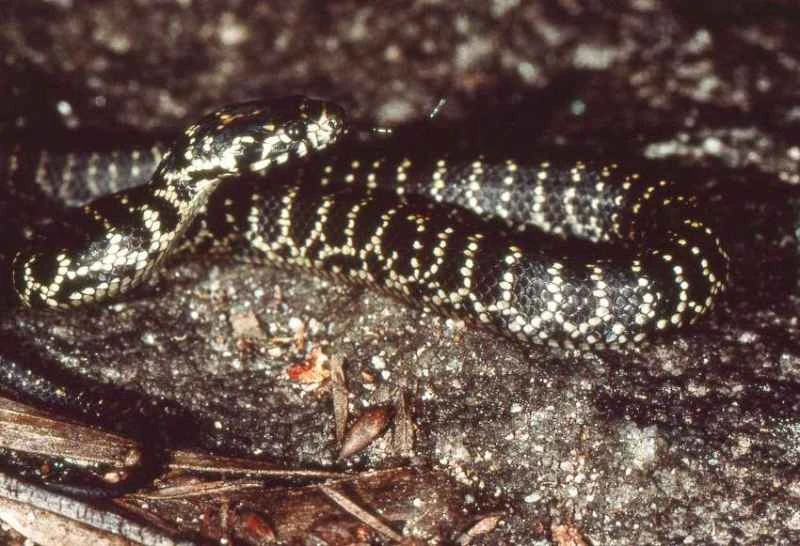
With a noticeably broad and flat head and distinct black and yellow horizontal stripes, it is one of the most representative native small venomous snakes in the sandstone rock habitat ecosystem of the Sydney Basin.
Distribution and Habitat
Its natural distribution is mainly limited to sandstone areas within a 200–250 km radius of Sydney, New South Wales, Australia, particularly relying on sandstone cliffs, rocky platforms, and adjacent open woodlands and shrublands with fissured and flaky rocks. During the cool season, it inhabits narrow rock crevices under exposed rock slabs, while during the warm season, some individuals migrate to nearby woodlands to inhabit hollow tree trunks and fallen logs.
Appearance
The body is relatively slender, with a broad, flat, triangular head that contrasts sharply with the narrow neck. The back is dark brown to black, with narrow yellow or orange-yellow horizontal bands or diamond-shaped spots, creating a strong black and yellow contrast pattern. The abdomen is mostly pale yellow to cream-colored, occasionally with dark spots. Juveniles have similar patterns to adults, but the colors are usually brighter.
Detailed introduction
The broad-headed snake ( Hoplocephalus bungaroides ) is a medium-sized, highly venomous snake with a particularly broad and flat head. Belonging to the genus Hoplocephalus in the family Elapidae, it is a rare snake endemic to the Sydney Basin in eastern Australia. It gets its name from its distinctly broad, triangular head and striking black and yellow horizontal stripes. It migrates seasonally between rock crevices and adjacent woodlands, and is extremely sensitive to habitat conditions, thus it has long been listed as a key protected species and an endangered species in its native habitat.
Classification and nomenclature
Broad-headed snakes belong to the class Reptilia, order Squamata, family Elapidae, and genus Hoplocephalus . The genus Hoplocephalus currently contains only three species, all confined to eastern Australia, and is a representative group of small arboreal/rock-dwelling venomous snakes in Australia. The scientific name * Hoplocephalus bungaroides * means "armored head," with the specific epithet derived from early naming history. Due to its broad, flat head and distinctly narrow neck, this physical characteristic is directly reflected in its English name, "Broad-headed Snake."
Appearance features
The broad-headed snake is relatively slender, typically less than 1 meter in length, but its head is noticeably wide, forming a flattened triangle that contrasts sharply with its slender neck. The base color of its back is mostly dark brown to black, covered with narrow horizontal bands or irregular diamond-shaped spots of orange-yellow or yellowish-brown. From a distance, it appears as a black background with bright yellow horizontal stripes, and its overall pattern is somewhat similar to that of juvenile diamond pythons in the same region, easily confusing non-professional observers. The underside is generally pale yellow to cream-colored, sometimes with dark spots. The scales have a medium luster, and the body surface is not as "glossy black" as the red-bellied black snake, but the pattern contrast is strong and highly recognizable. Juveniles and adults are generally similar in pattern layout, except that juveniles are usually more brightly colored.
Distribution range and habitat
The broadheaded snake has a very narrow natural distribution range, mainly confined to the Sydney Basin and adjacent mountains within a 200–250 km radius of Sydney, New South Wales, Australia. It is highly dependent on weathered sandstone terrain, particularly cliff edges and rocky platforms with fissures and thin flaky rocks. During the cooler season, the broadheaded snake primarily hides in narrow crevices beneath exposed rock slabs to maximize the warmth from sunlight; while during the warmer season, adult males and non-pregnant females migrate to nearby woodlands and thickets, inhabiting hollow tree cavities, fallen logs, and bark crevices. In contrast, juveniles and pregnant females spend more time in rocky areas, moving only between crevices of varying orientations and shade levels, depending on temperature.
Lifestyle Habits and Behaviors
Broad-headed snakes are primarily nocturnal or twilight-active snakes, mostly hiding in rock crevices or tree holes during the day, only emerging at dusk and night to hunt and forage. They move relatively cautiously, typically slithering slowly between rocky platforms and tree trunks, relying on concealment and camouflage to avoid detection by predators. When threatened, broad-headed snakes raise their forebody, flatten their necks, and significantly bulge their heads to appear larger, while hissing to intimidate; if the opponent persists, they may bite. Their venom is a neurotoxic and myotoxic combination, sufficient to cause fatal damage to small vertebrates and also posing a potential danger to humans; therefore, in their native habitat, they are considered medicinally valuable venomous snakes.
feeding habits
Broad-headed snakes primarily feed on small reptiles and small mammals, making them typical carnivorous predators. Field studies indicate that juveniles and subadults have a particular preference for certain geckos, such as the Lessou velvet gecko and other rock-dwelling lizards, which are among their most important prey. As they grow, adults also prey on other small lizards, small snakes, and mammals such as mice that enter rock crevices or tree holes. Broad-headed snakes often lie in ambush near rock crevices and tree hole entrances, striking suddenly as prey passes by, injecting venom through their upper front fangs to quickly incapacitate their prey before swallowing them whole.
Reproduction and life cycle
The broad-headed snake is a viviparous venomous snake; it does not lay eggs, but rather the embryo develops inside the female's body, eventually giving birth to live young. Males reach sexual maturity at around 5 years old, while females typically mature at around 6 years old, resulting in a relatively long reproductive cycle. Mating usually occurs between autumn and the following spring, with females often reproducing only once every two years, making it a low-reproduction species. Giving birth mostly takes place from late summer to early autumn, with each litter containing approximately 4–12 young snakes. Although newborn snakes are small, they already possess patterns similar to adults and a complete fang system, enabling them to live and hunt independently from birth. Broad-headed snakes grow slowly, and wild individuals are estimated to live for over 10 years, potentially even longer under good captive conditions.
Relationship with humans
Historically, broadheaded snakes were common in rocky areas around Sydney, but their numbers have declined significantly due to urban expansion and the theft of rocks for landscaping. Because their markings resemble those of some non-venomous pythons, some people mistake them for juvenile diamond pythons and attempt to capture them, increasing the risk of being bitten. In fact, broadheaded snakes are relatively elusive and do not actively attack humans; the vast majority of bites are related to human capture or provocation. In their native habitat, the correct approach is to maintain a safe distance when you see what appears to be a broadheaded snake or other wild snake, do not attempt to capture or move rocks to search for the snake, and especially do not damage rock slabs or crevices.
Protecting the status quo and threats
The broadheaded snake is classified as "Vulnerable" (VU) on the IUCN Red List globally, and is listed as threatened or endangered on the Commonwealth and New South Wales state lists. Its main threats include: the large-scale removal of sandstone slabs for landscaping, leading to the loss of classic rock-dwelling habitats; habitat fragmentation due to urbanization and road construction; illegal capture for the pet trade or hoarding; and changes in the frequency and intensity of habitat fires. Many conservation programs are attempting to restore suitable micro-habitats for the broadheaded snake and its supporting species, such as the rock-dwelling gecko, through the establishment of nature reserves, restrictions on "bushrock" excavation, restoration of rock platform structures, and the artificial addition of "simulated slabs." Public education is equally important; by raising awareness of the broadheaded snake's ecological value and endangered status, and encouraging reduced rock destruction and illegal capture, this unique native venomous snake population can help continue to thrive in the sandstone landscapes surrounding Sydney.
Frequently Asked Questions
Q1: How venomous is the broadhead snake? What happens if you get bitten?
The broadheaded snake is a highly venomous snake belonging to the Elapidae family. Its venom contains neurotoxins and myotoxins, making it extremely lethal to small vertebrates. If bitten, humans may experience symptoms such as localized pain, swelling, weakness, nausea, and difficulty breathing, requiring immediate medical attention and evaluation by a professional veterinarian to determine if antivenom is necessary. In its native habitat, any suspected broadheaded snake bite should be treated as a medical emergency.
Q2: Why are broadheaded snakes often mistaken for juvenile diamond pythons?
The black and yellow stripes on the back of the broadhead snake can appear somewhat similar to those of a juvenile diamond python from a distance, and since both may inhabit rocky areas, it can easily lead to confusion for non-experts. However, the broadhead snake has a flatter head, a thinner neck, and a relatively smaller body, and it is a front-fanged venomous snake; the diamond python, on the other hand, is a non-venomous python, and its head shape and body texture are also different. When unable to accurately identify a snake in the wild, the safest approach is to "not touch it at all."
Q3: What should I do if I encounter a broadheaded snake or what appears to be a broadheaded snake?
The safest approach is to remain calm, slowly back away, leaving the snake an escape route, and do not attempt to catch, provoke, or attack it with stones or sticks. If snakes frequently appear near residential areas or farms, contact local wildlife rescue or snake catchers. The general public should not attempt to catch or move snakes themselves.
Q4: Why should we give special protection to this kind of venomous snake with a very small distribution range?
The broadhead snake is highly dependent on the sandstone slabs of the Sydney Basin and its microhabitat, forming a unique and fragile ecosystem along with rock-dwelling geckos and small rodents. Protecting the broadhead snake is not only crucial for maintaining biodiversity but also a key step in protecting the entire sandstone landscape and related species. By reducing rock damage, limiting illegal capture, and protecting and restoring rock-dwelling habitats, this distinctive native venomous snake can continue to survive in the wild.