Basic Information
Scientific classification
- Chinese name: Blue Fairy Jade
- Scientific name: Tanysiptera carolinae, Numfor Paradise Kingfisher
- Classification: Climbing birds
- Family and Genus: Order Coraciiformes, Family Kingfisher, Genus Kingfisher
Vital signs data
- Body length: Approximately 26 centimeters
- Weight: No verification information available.
- Lifespan: No verification data available.
Significant features
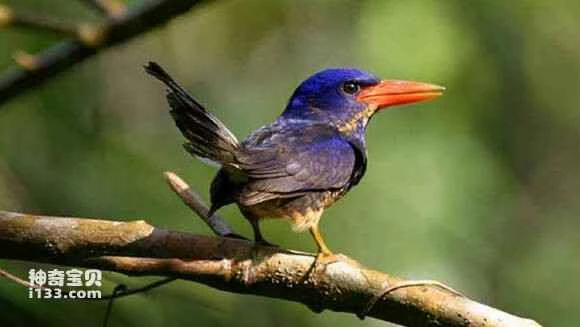
The head, body, and wings are all purplish-blue, but the colors are not uniform.
Distribution and Habitat
Blue Fairy Jade is found on Nongfuel Island in Indonesia and Geelvink Bay in northwestern New Guinea.
Blue fairy jade is a common species that lives in all lowland habitats, including vegetated and forested areas along the coast, where its habitat has been severely damaged due to human overexploitation.
Appearance
The Blue Fairy Kingfisher is 26cm in body length, and 36-40cm including its tail feathers and plumes. It is sexually identical. The head, body, and wings are all purplish-blue, but the colors are not uniform; the upper body and wings are more vibrant, while the shoulders, lower back, tail, and cape are almost black. The tail is white. It has two 12cm long, deep blue, plumes that tip into a large, white, racket-like shape. The wing coverts are black. The beak is red, and the iris is dark brown. The legs are olive-brown.
Young birds differ from adults in many ways. Like their parents, they have the deepest bluish-purple on their heads and white tails with red and black stripes. On the other hand, the tails of some adults are black with bluish-white markings. The underparts also differ: cinnamon-colored chin and throat, and some reddish-purple feathers on the chest and abdomen.
Detailed introduction
The scientific name of the blue fairy jadeite is Tanysiptera carolinae, and its foreign name is Numfor Paradise Kingfisher. It has no subspecies.
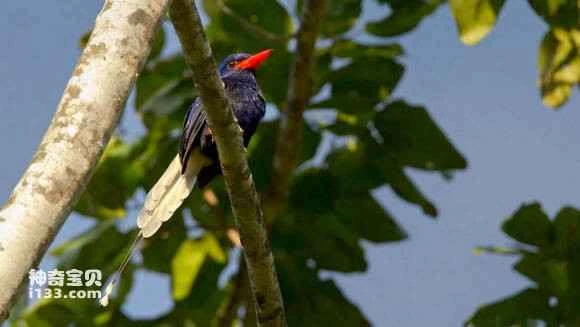
The Blue Fairy Kingfisher enjoys preening its feathers in ponds. It is a completely carnivorous kingfisher, and its hunting techniques are largely similar to other kingfisher species. Solitary, it usually perches alone on branches or rocks near water, waiting for its prey. It often perches upright on low branches and reeds near the water, or on rocks, waiting to catch fish and shrimp. Even when submerged, the kingfisher maintains excellent vision because its eyes can quickly adjust to the visual contrast caused by light underwater. Therefore, its fishing skills are almost always accurate. It often hides in the shade of trees near the water, waiting to catch fish and shrimp. When standing, its head is almost still, while its tail occasionally sways. It spends most of its time foraging on the ground, digging in the soil with its beak to catch insects, including snails, beetles, grasshoppers, caterpillars, centipedes, and earthworms, as well as small reptiles such as lizards. Sometimes it gets its feathers very dirty.
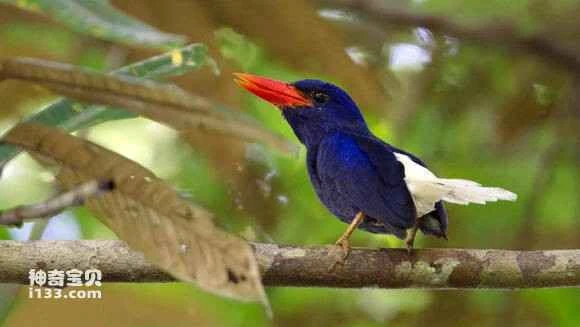
The Blue Fairy Kingfisher, in pairs, will work together to dig a termite-eaten hole in a tree about 1.2 meters above the ground as their nest. The nest measures 15 cm x 13 cm. The female typically lays 5 eggs, and both parents help raise the chicks.
Listed as Near Threatened (NT) on the IUCN Red List of Threatened Species 2013 ver 3.1.
Protect wild animals and ban the consumption of wild game.
Maintaining ecological balance is everyone's responsibility!