Basic Information
Scientific classification
- Chinese name: Grey-headed Albatross
- Scientific name: Thalassarche chrysostoma, Grey-headed Albatross
- Classification: Waterfowl
- Family and genus: Procellariiformes, Albatrossidae, Albatross spp.
Vital signs data
- Body length: Approximately 81 cm
- Weight: 2.8-4.4kg
- Lifespan: Approximately 47 years
Significant features
Its upper and lower beaks are orange-yellow and it has a gray head.
Distribution and Habitat
Grey-headed albatrosses are found on sub-Antarctic islands.
Petrel Peak on Macquarie Island is the only known breeding ground for grey-headed albatrosses in Australia. It is home to a breeding population of approximately 80 pairs of grey-headed albatrosses. However, the area is severely threatened by an overpopulation of hares.
Appearance
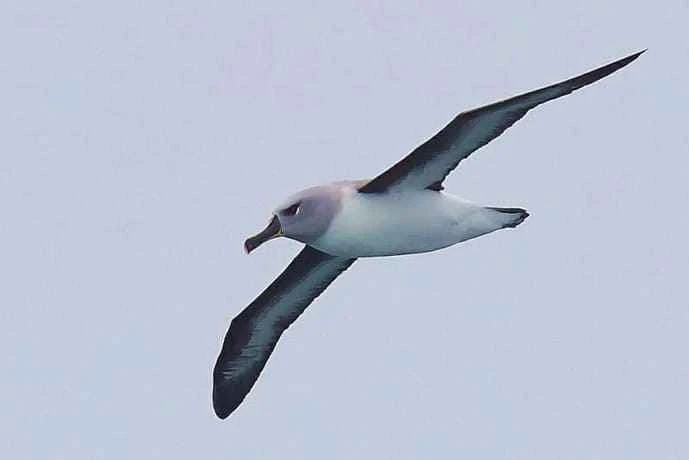
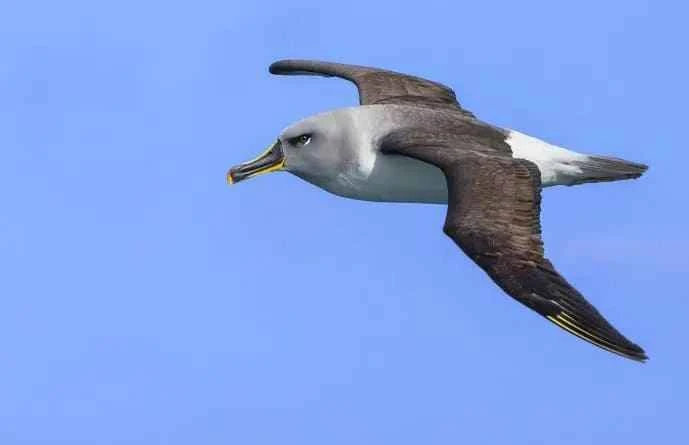
Grey-headed albatrosses have narrow, long wings and a relatively long, powerful beak, with the upper beak ending in a downward hook. They can reach a height of about 63 centimeters and a wingspan of 2.2 meters. Their upper and lower beaks are orange-yellow, and they have a grey head. Male albatrosses are generally larger than females.
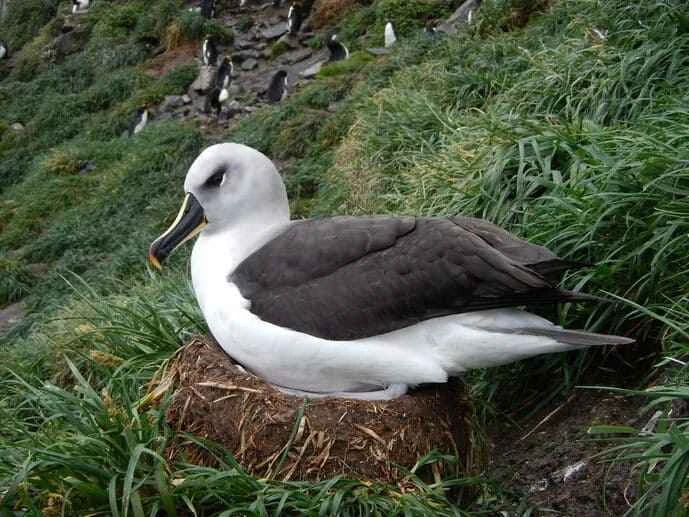
The Grey-headed Albatross is also a large bird, averaging 81 cm (32 inches) in length, with a wingspan of 220 cm (7.2 feet), and a weight ranging from 2.8 to 4.4 kg (6.2 to 9.7 lbs), with an average weight of 3.65 kg (8.0 lbs). Its head, throat, and upper neck are dark grey, while its forewings, tunic, and tail are almost black. It has a white rump, underparts, a white crescent-shaped marking behind the eye, and a black beak with bright yellow ridges that gradually turn pinkish-orange at the tip. Its underwings are white with significant black along the leading edge and less black along the trailing edge. Juveniles have black beaks and heads, as well as darker napes. Its crescent-shaped eye is indistinct, and its underwings are almost entirely dark. The Grey-headed Albatross has a maximum lifespan of approximately 47.2 years in the wild.
Detailed introduction
The Grey-headed Albatross, scientifically known as *Thalassarche chrysostoma*, is a species of bird in the genus *Thalassarche*.
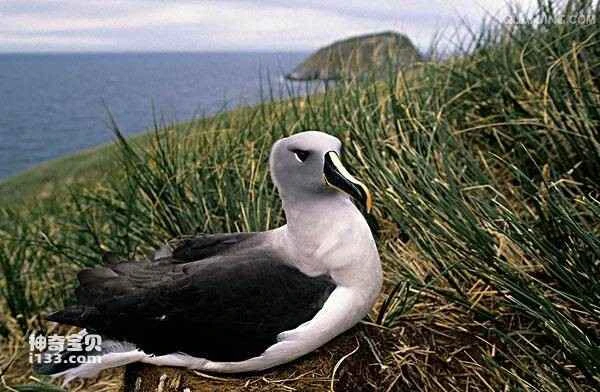
Grey-headed albatrosses can fly over the sea for extended periods, gliding across the surface with remarkable aerodynamic efficiency, sometimes for hours without flapping their wings. They can travel up to 5,000 kilometers in 12 days. Grey-headed albatrosses typically only come ashore to raise their young, and they can even sleep on the sea surface.
Near Antarctica, their main food sources are fish, squid, and shrimp. They also feed on shipwrecked waste, which is why they sometimes fly alongside ships.
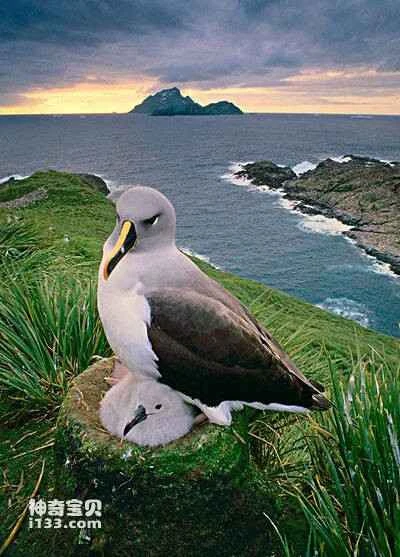
Grey-headed albatrosses come ashore to build nests and lay eggs during the breeding season, and they do not shy away from people at this time. Albatrosses reach sexual maturity relatively late, starting to breed at 5-8 years old. Females lay one or two eggs. Albatrosses are monogamous, and both parents take turns incubating the eggs. Grey-headed albatrosses often nest on rocky cliffs, and the incubation period is about 70 days. Both parents take turns incubating the eggs and raising the chicks, which mature and become independent in about 4 months. Grey-headed albatrosses can live for 40-60 years.
Due to the rapid decline in population on South Georgia Island in sub-Antarctica, the International Union for Conservation of Nature (IUCN) listed the Grey-headed Albatross as an endangered species on August 7, 2018. The total population size is estimated to be around 250,000. The main driver of the decline is likely the incidental mortality rate from longline fishing.
Protect wild animals and ban the consumption of wild game.
Maintaining ecological balance is everyone's responsibility!


