Basic Information
Scientific classification
- Chinese name: African savanna elephant
- Scientific name: Loxodonta africana
- Classification: Proboscidea
- Family and genus: Proboscis, Elephantidae, African elephant
Vital signs data
- Body length: Males 3.0–4.0 m at the shoulder, females 2.5–3.4 m.
- Weight: Males 4,000–7,000 kg (some older males can weigh even more), females 2,500–3,500 kg
- Lifespan: 60–70 years
Significant features
The largest living land animal on Earth
Distribution and Habitat
savanna, open woodland, arid grassland and seasonal wetlands
Appearance
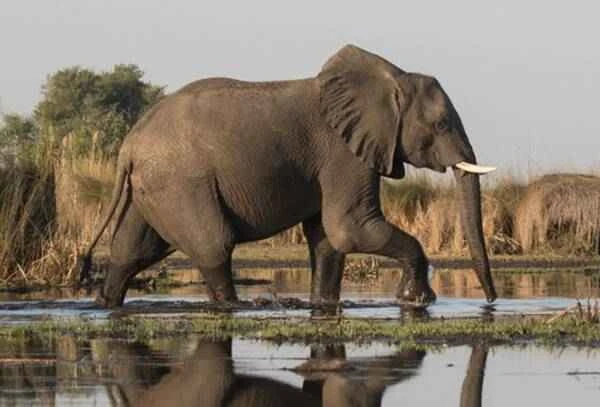
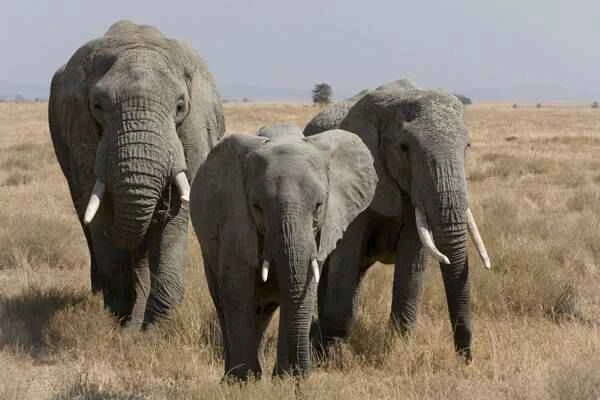
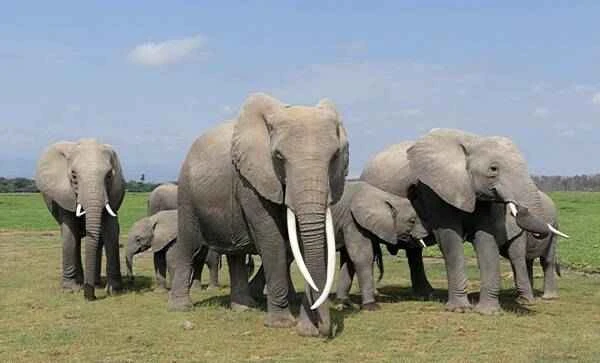
Large in size, with gray fur, its hindquarters are as high as its shoulders, and its tusks are extremely long and curve upwards. The longest recorded tusk weighed 102.7 kg. Its ears are large, pointed at the bottom, and can reach up to 1.5 meters in length, with abundant blood vessels for heat dissipation and keeping the body cool. The tail is not long, with a brush at the tip. The long trunk is used not only for smelling, breathing, blowing a horn, and drinking water, but also for grasping things, especially food. The trunk has approximately 100,000 muscles. The African savanna elephant has two highly sensitive and dexterous finger-like projections at the end of its trunk, which it uses to grasp small objects.
Detailed introduction
I. External Features
The African savanna elephant is the largest living land mammal . Compared to forest elephants (who have rounder ears, straighter and pinker tusks), savanna elephants have larger, triangular, fan-shaped ears and a slightly arched back and shoulders . Males have significantly thicker and longer tusks and higher shoulder ridges, with two "fingers" protruding from the tip of their trunks for gripping grass and bark.
II. Distribution and Habitat
They are mainly distributed in the savanna-shrub-wetland mosaic landscape of sub-Saharan Africa , from the East African savanna to the arid grasslands of southern Africa . Between the rainy and dry seasons, the population migrates between water sources and foraging grounds, and in some areas there is cross-border seasonal migration (such as the Kavango-Zambezi cross-border conservation network in Botswana-Namibia-Zambia-Zimbabwe).
III. Social Behavior and Ecological Role
Steppe elephants live in matrilineal family groups , led by older females (chiefs). Adult males often live alone or in loose herds. Elephant herds shape the savanna structure through trampling and foraging : clearing grasslands, dispersing seeds, digging waterholes, and maintaining the key species (ecosystem engineer) role of the ecosystem.
IV. Reproduction and Life Cycle
Female elephants reach sexual maturity at 10–12 years of age; the gestation period is about 22 months , usually with a single birth , and the lactation period can last for more than 2 years. Calves grow up in a " collective upbringing " environment within the herd. Long lifespan and low reproductive rate mean that the population is very sensitive to the loss of adult individuals (especially older males with large tusks) and recovers slowly.
V. Population Size and Trends
Since the mid-to-late 20th century, African elephants have experienced a significant overall decline due to poaching and habitat loss. Since the 2010s, some countries have seen progress in anti-poaching and community conservation efforts, resulting in localized population recovery , but significant regional disparities exist : some hotspots still show decline or high fragmentation in assessments. Before publication, it is recommended to verify the estimates and trend maps in the latest IUCN Red List: Loxodonta africana and the IUCN/AfESG Status of African Elephants Report.
VI. Major Threats
Poaching and the illegal ivory trade are particularly prevalent among large male elephants, leading to an imbalance in their sex age structure.
Habitat loss and fragmentation : Agricultural expansion and infrastructure construction cut off migration routes.
Human-elephant conflict : crop damage and security risks trigger retaliatory culling.
Climate change and drought : Extreme weather increases water resource pressure, affecting reproduction and the survival of calves.
Disease and inadequate cross-border management : Insufficient cross-border law enforcement and data sharing affect the overall management effectiveness.
VII. Current Status and Measures for Protection
Law and enforcement : Most countries classify it as a first-level protected item ; cross-border cooperation is needed to combat illicit trade.
Protected area networks : National parks/nature reserves and transboundary protected areas (such as KAZA TFCA) maintain migration corridors.
Community co-management : Ecotourism revenue sharing and compensation mechanisms, along with conflict reduction measures such as "smart fences/beehive fences," reduce agricultural losses.
Monitoring and research : aerial surveying, collar satellite tracking, fecal DNA assessment , and camera traps .
Public education and demand-side governance : reducing ivory consumption, promoting legal alternatives, and cultural advocacy.
VIII. Interesting Facts
Elephants' memory and social learning abilities enable them to transmit migration routes and water source information across generations.
Elephant herds communicate using infrasound , which can travel distances of several kilometers.
The auricle acts as a "radiator" : its rich network of blood vessels helps cool the body in high-temperature environments.
Frequently Asked Questions
Q1: What is the difference between the African savanna elephant and the African forest elephant?
A: Steppe elephants are larger with wider ears and live in open savannas; forest elephants are smaller with rounder ears and straighter, pinker tusks, and mainly inhabit the tropical rainforests of Central and West Africa. IUCN classification: Steppe elephant EN, Forest elephant CR (please refer to the latest list).
Q2: Will elephants attack people on their own initiative?
A: Conflicts are generally avoided, but they may clash when protecting young or when provoked. Human-elephant conflicts often occur when they are feeding on crops or competing for water. Early warning and mitigation measures (such as beehive fencing, patrols, and compensation) should be adopted.
Q3: Is the ivory trade legal?
A: Most countries impose strict restrictions or bans on the commercial international ivory trade . Enforcement efforts and market regulation directly impact the pressure on poaching.
Q4: How long does it take to conceive and how often do babies are born?
A: Pregnancy lasts about 22 months , usually a single birth; the interval between two pregnancies is 3–6 years (affected by environmental and nutritional status).


