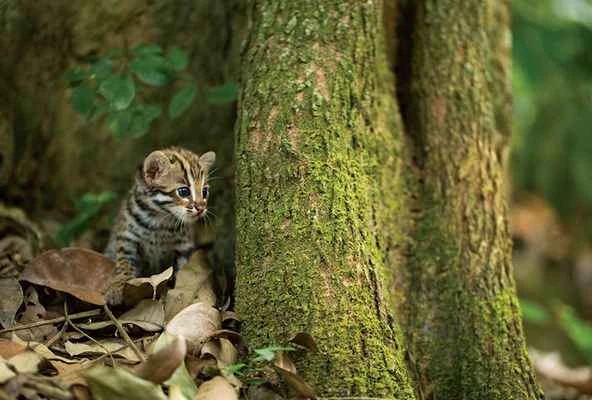
Basic Information
Scientific classification
- Chinese name: Leopard cat
- Scientific name: Civet cat, raccoon dog, leopard cat, spotted raccoon, mountain raccoon, wildcat, money cat
- Order: Carnivora
- Family and genus: Felidae, Felinae, Leopard cat
Vital signs data
- Body length: 36-66 cm
- Weight: 1.5-5kg
- Lifespan: 4 years in the wild, up to 20 years in captivity.
Significant features
Wild felines covered in "copper coins"
Distribution and Habitat
Origin: Afghanistan, Bangladesh, Bhutan, Brunei, Cambodia, China, India, Indonesia (Java, Sumatra, Kalimantan), Ryukyu Islands, South Korea, North Korea, Laos, Malaysia, Myanmar, Nepal, Pakistan, Philippines, Russia, Singapore, Thailand, and Vietnam.
Uncertainty exists regarding: China (Macau)
It is widely distributed in my country (except for the arid areas in the north and west); from Afghanistan, through the Indian subcontinent, to Southeast Asia, Russia and North Korea.
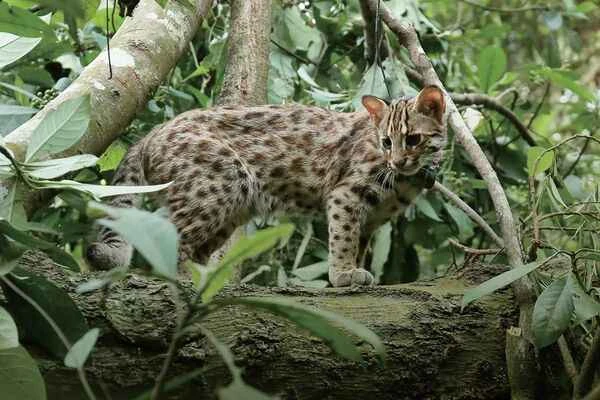
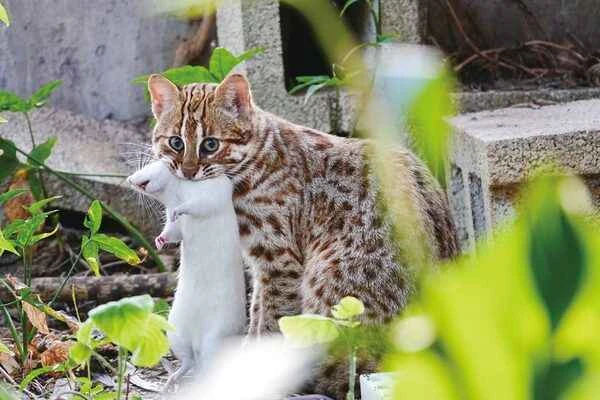
Leopard cats primarily inhabit mountainous forests, suburban scrublands, and areas near villages on forest edges. Their distribution ranges from low-altitude coastal zones to high-altitude forests up to 3000 meters. Leopard cats typically burrow in tree hollows, earthen burrows, under rocks, or in crevices. They are mainly terrestrial, but possess strong climbing abilities and move nimbly and freely in trees. They are nocturnal, with increased activity at dawn and dusk. They are solitary or live in pairs. They are good swimmers and prefer to forage near water, such as ponds, streams, and rice paddies. Their diet consists mainly of rodents, squirrels, flying squirrels, rabbits, frogs, lizards, snakes, small birds, and insects. They sometimes sneak into villages to steal chickens, ducks, and other poultry.
Appearance
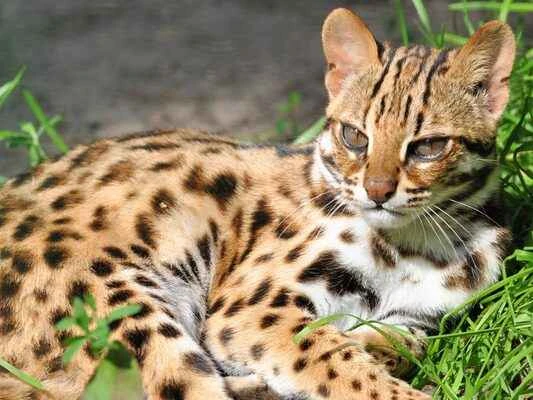
Similar in size to a domestic cat, but more slender with longer legs. Southern breeds have a light brown or pale yellow base coat, while northern breeds have a grayer base coat with dark spots all over. The pattern is always unique, typically featuring four wide, distinct stripes running from head to shoulders, disappearing at the spine. Spots are present on the sides, but never forming vertical stripes. A prominent white stripe extends from the nose to between the eyes, often reaching the top of the head. The ears are large and pointed, black behind the ears with white spots. Two distinct black stripes extend from the inner corner of the eye to the base of the ear. A white stripe runs from the inner corner of the eye to the nose, which is white. The tail is long (approximately 40-50% of head-body length), ringed, and reaches a black tip. Regarding the skull, the nasal bones are not everted; the upper jaw has a concave beak, and the postorbital ring is sometimes complete in mature individuals. The width of the median pterygoid bone is approximately equal to its length, and the papillae are flattened, close to the surface of the auditory bullae. P1 is often absent, and P2 is degenerate.
Detailed introduction
The leopard cat is a beautiful small wild cat named for its leopard-like markings. Although similar in size to a domestic cat, its slender body and longer legs are a result of its long-term survival in the wild.
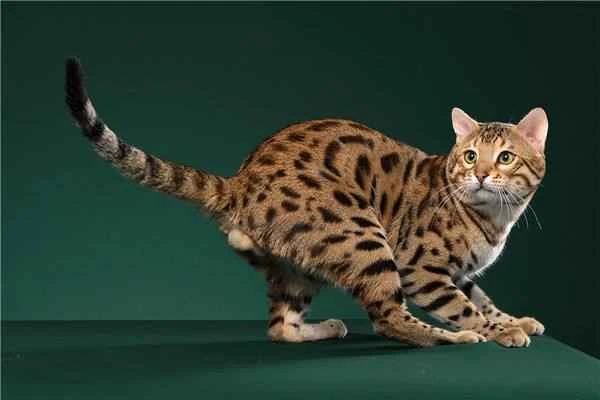
In China, the leopard cat is also known as the "money cat" because its spots resemble Chinese copper coins. There are 12 different subspecies of leopard cats, four of which are found in my country. While not as powerful as larger animals, leopard cats are still formidable fighters and possess exceptional survival skills.
Leopard cats are the most widely distributed and numerous feline species in my country. They used to be very common, though often mistaken for wild cats. However, nowadays, leopard cats are mainly found in southwestern my country, and are rarely seen in other regions.
Leopard cats were once one of China's traditional export furs. In the 1960s and 70s, China purchased about 200,000 to 250,000 leopard cat pelts annually, and the estimated number of leopard cats in the country was no less than 1 million. After the 1970s, the number of leopard cats declined in most provinces and regions, and in some provinces (such as East China), leopard cats almost became an endangered species. After the 1980s, the annual purchase volume was about 1/2 to 1/3 of that in the 1960s.
The leopard cat is listed as Least Concern (LC) on the IUCN Red List of Threatened Species (IUCN 2014 ver 3.1).
The Philippine leopard cat is listed as Vulnerable (VU) on the IUCN Red List of Threatened Species (IUCN 2008 ver 3.1).
The Iriomote subspecies of leopard cat is listed as Critically Endangered (CR) on the IUCN Red List of Threatened Species (IUCN 2014 ver 3.1).
Leopard cats are listed in Appendix II of the Convention on International Trade in Endangered Species of Wild Fauna and Flora (CITES).
Leopard cat populations in Bangladesh, India, and Thailand are also listed in Appendix I of the Convention on International Trade in Endangered Species of Wild Fauna and Flora (CITES).
The leopard cat is listed in the "List of Terrestrial Wild Animals of Beneficial or Important Economic and Scientific Research Value under State Protection" issued by the State Forestry Administration of China on August 1, 2000.
It is listed as a Class II protected wild animal in the "List of Key Protected Wild Animals in China".
Protect wild animals and ban the consumption of wild game.
Maintaining ecological balance is everyone's responsibility!
Frequently Asked Questions
What are the differences between a leopard cat and a regular domestic cat?
Leopard cats resemble small leopards in appearance, with unique spots or marbled patterns. They are lively, active, and energetic, and prefer interaction and play more than ordinary domestic cats.
Are leopard cats suitable as pets?
Bengal cats are very suitable for family life, but owners need to have enough patience and energy to provide them with ample companionship and space for interaction.
Do leopard cats destroy furniture?
Because leopard cats are energetic, they may scratch furniture or climb, so it is recommended to provide them with special toys or cat trees to release their energy.
Are leopard cats docile?
Leopard cats are generally friendly and affectionate, but each leopard cat has a different personality. Early socialization training can effectively enhance their friendliness.
How long do leopard cats live?
Leopard cats typically live for 12-16 years. A good diet, sufficient exercise, and regular healthcare can help them live longer and healthier lives.