


Basic Information
Scientific classification
- Chinese name: Capybara
- Scientific name: Capibara, Paraguayan capybara, Uruguayan capybara
- Order: Cetacea
- Family and genus: Eutheria, Rodentia, Caviidae, Capybara
Vital signs data
- Body length: 106-134 cm
- Weight: 35-66kg
- Lifespan: 6-12 years
Significant features
The world's largest rodent
Distribution and Habitat
Originally distributed in South America, capybaras primarily inhabit various lowlands near water, including rivers, lakes, rainforests, swamps, brackish wetlands, seasonally flooded grasslands, and savannas. They also thrive in dry grasslands and pastures with a certain level of moisture.
Appearance
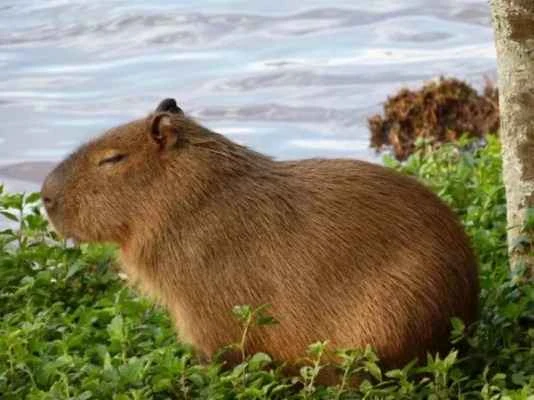
Adult capybaras have a head-body length of 106-134 cm, a shoulder height of 50-62 cm, and a weight of 35-66 kg, with females being slightly larger. Capybaras are the largest rodents in the world, with a robust, barrel-shaped body and a vestigial tail. Their fur is coarse and sparse, ranging in color from yellowish-brown, reddish-brown, and dark brown to dark gray on the back, yellowish-brown on the belly, and sometimes with black hair on the face, outer edges of the limbs, and rump. Their lower jaw cannot move vertically, so they can only chew forward and backward. Like other rodents, capybaras' incisors (two pairs) continuously grow to compensate for wear and tear from grazing. Their hind legs are slightly longer than their forelegs, with three toes on one leg and four on the other. Capybaras are excellent swimmers, possessing webbed feet like duck feet that help them paddle quickly. Their relatively blunt snout and the placement of their eyes, nose, and ears close to the top of their heads make them well-adapted to a semi-aquatic lifestyle, allowing them to better observe their surroundings and breathe fresh air in the water.
The biggest difference between them and other rodents is that their sweat glands can be found on the hairy parts of their bodies.
Capybaras have a high fat content, giving them some buoyancy in water. Male capybaras typically have a more developed scent gland area (a raised, bare area containing enlarged fatty glands) on the top of their noses than females. This raised area, called Morillo, is dark black or reddish-brown and secretes a large amount of white, viscous liquid that emits a scent signal, believed to play a role in signaling dominance. Therefore, the sex of a capybara can be easily identified by the glands on its nose. Capybaras are herbivores, primarily feeding on grasses, aquatic plants, bark, and fruits. They are social animals, generally living in groups of 10-30 individuals, but more commonly in groups of 10. However, they sometimes live alone. Mostly males, they are active at dawn and dusk, but due to hunting and other human activities, they have become more nocturnal.
Detailed introduction
Although capybaras are not commonly seen, they are very cute and friendly to humans. Capybaras prefer to live in relatively humid places because they cannot live without water, and their adorable appearance has attracted the attention of many people, especially girls, who may like this little animal.
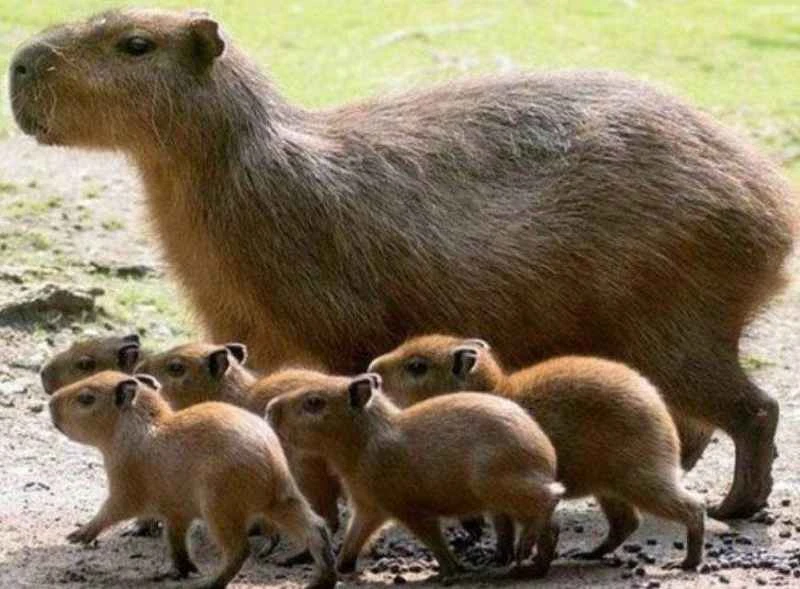
Capybaras give off a harmless and gentle vibe, making everyone who sees them want to give them a comforting hug. They truly are the "central air conditioner" of the animal kingdom; everyone wants to befriend them. Cats want to rub against them comfortably, monkeys want to surround and pet them, and even crocodiles often get along well with them.
However, in the harsh natural world, cuteness won't save you. Even such gentle and adorable animals as capybaras often face threats from predators like jaguars, pythons, and even crocodiles. Capybaras must rely on their own strength to survive. Therefore, beneath the capybara's gentle and cute appearance lies a level of adaptability stronger than any other rodent.
Capybaras are undoubtedly swimming champions among mammals. They move swiftly in water or swamps, and often, even crocodiles are no match for them. They can even sleep in the water.
Despite their stocky build, capybaras are just as agile on land as they are in water when escaping. Their short-distance running speeds can reach 35 kilometers per hour, roughly as fast as a human. The faster they can get into the water, the greater their chances of escaping predators.
Besides the advantages mentioned above, capybaras have a special "secret weapon"—their feces. Capybara feces are highly nutritious, containing 14% to 17% crude protein, as well as a significant amount of vitamins. They also serve as a supplement to the gut microbiota of animals, and crocodiles may even forgo hunting them for these nutrients. Like plovers, capybaras often form a symbiotic relationship with crocodiles. Biologists also believe that capybaras are considered the "central air conditioner" of the animal kingdom not only because of their good temperament but also because they provide other animals with highly nutritious feces. For other animals, capybaras are essentially mobile snack vending machines.
As early as the 18th century, capybaras were highly prized for their fur and meat, leading to hunting that nearly drove the animal to extinction. Later, as more people recognized the animal's charm, hunting was banned, and capybaras began appearing in zoos around the world, becoming stars and quickly escaping the threat of extinction.
Listed as Least Concern (LC) on the IUCN Red List of Threatened Species 2008 ver 3.1.