Basic Information
Scientific classification
- Chinese name: Red-crowned Woodpecker
- Scientific name: Melanerpes rubricapillus, Red-crowned Woodpecker
- Classification: Climbing birds
- Family and genus: Order Piliformes, Family Pilidae, Genus *Pterygota*
Vital signs data
- Body length: Approximately 22 centimeters
- Weight: No verification information available.
- Lifespan: No verification data available.
Significant features
Distribution and Habitat
The Red-crowned Woodpecker is found in Colombia, Costa Rica, Guyana, Panama, Suriname, Trinidad and Tobago, the Bolivarian Republic of Venezuela, and the northern and southern Carolina and Florida in the United States.
The red-crowned woodpecker inhabits low mountains below 1500 meters in altitude, mainly living in pine forests, but also appearing on forest edges and in sparse forests.
Appearance
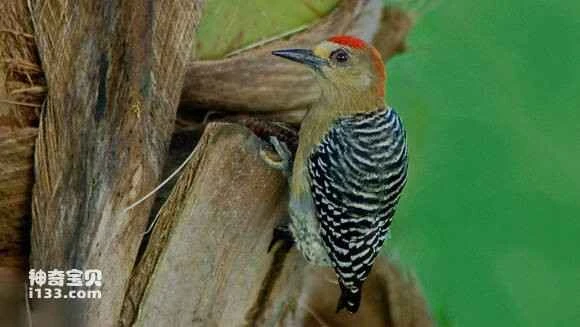
The Red-crowned Woodpecker is 22 cm long. It has a strong, straight, wedge-shaped beak with a chisel-like tip, and exposed nostrils. The hyoid bone extends in a ring-like shape, running from the throat around the occiput to the base of the upper mandible. The tongue is long and retractable, with short hooks at the tip. The legs are relatively short, with four toes; there are nine primary flight feathers. The skull is salicylic, with the vomer replaced by paired bones. The palatine bones are small and far to the sides. The sternum has two notches on each side at the posterior end, and the manubrium is forked. The leg muscles lack the pelvic and parafemoral muscles. The tail is wedge-shaped, with mostly twelve tail feathers; the feather shafts are stiff and flexible, supporting the body while pecking.
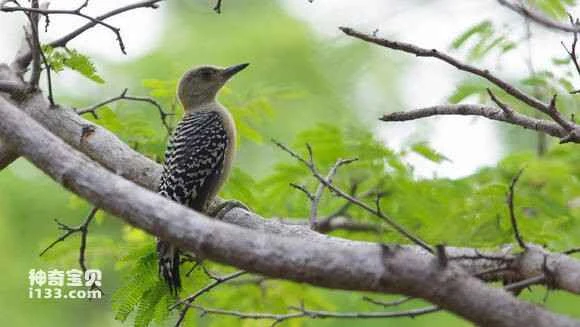
The black crest contrasts sharply with the white cheeks, and the back and wings are black with numerous dirty white spots. The underparts are usually dirty white. Only the male Red-crowned Woodpecker has a small patch of red feathers on the back of its head; this tuft of feathers is rarely seen and is thought to resemble a hood badge (the ribbon knot on a hooded wreath).
Detailed introduction
The Red-crowned Woodpecker, scientifically known as Melanerepes rubricapillus, has four subspecies.

The red-crowned woodpecker is a very diligent little bird. While working, it constantly moves up and down the tree trunk, frequently changing trees along branches, showing a preference for larger trees. It uses its chisel-like beak to pry open pieces of bark, searching for insects underneath. Sometimes it will also descend to the forest floor, carefully observing the traces of insects among the bark fragments that fall to the ground during short distances.
The red-crowned woodpecker's lifestyle differs significantly from other North American woodpeckers. Its unique characteristic lies in its social nature; they live in groups of two to five. Each family group roosts together, typically in the hollows of ancient pine trees, often exceeding 100 years in age. The female lays eggs in the tree hollows from late April to early June, producing two eggs per clutch. All members of the family catch insects to help feed the chicks.
Listed as Least Concern (LC) on the IUCN Red List of Threatened Species 2013 ver 3.1.
Protect wild animals and ban the consumption of wild game.
Maintaining ecological balance is everyone's responsibility!