Basic Information
Scientific classification
- Chinese name: Eastern Banjo Frog
- Scientific name: Limnodynastes dumerilii
- Order: Anura
- Family: Limnodynastes dumerilii Eastern Banjo Frog
Vital signs data
- Body length: Adults are about 6–8 cm in length, which is a medium to small size terrestrial frog. Females are usually slightly larger than males.
- Weight: Individual weight is usually several tens of grams, but varies depending on sex, body condition and region.
- Lifespan: In the wild, it is estimated that individuals can live for several years and experience multiple breeding seasons; lifespan may be even longer under captive conditions.
Significant features
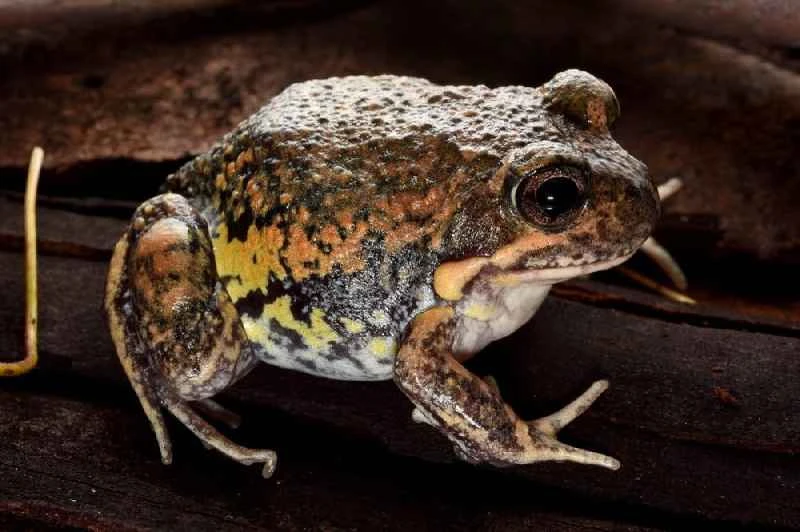
A common burrowing frog in southeastern Australia, it has a robust body, a brownish-brown back with markings, and often yellow or orange patches on its thighs. The male frog makes a "bonk" call similar to banjo strings and is a well-known member of the wetland "chorus".
Distribution and Habitat
Native to parts of southeastern Australia, including New South Wales, Victoria, Tasmania, and South Australia, it is widely found in environments with water and loose soil, such as swamps, ponds, riverbanks, farmland dams, urban park water bodies, and ditches.
Appearance
The body is stout and slightly flattened, with a brown, grayish-brown or olive back with irregular dark patches, yellow or orange spots commonly seen on the sides and thighs, and a lighter-colored belly; the hind limbs are well-developed and adapted for digging and burrowing in the soil.
Detailed introduction
The Eastern Banjo Frog ( Limnodynastes dumerilii ) is a medium-sized, native Australian frog with a distinctive call. Because the male's "bonk… bonk…" call sounds very much like the plucking of a banjo string, it is also known as the "Pobblebonk" in English.
Classification and nomenclature
Commonly used Chinese name: Eastern Banjo Frog (also translated as Eastern Bob Frog, etc., there is no unified Chinese name yet)
English name: Eastern Banjo Frog, Pobblebonk
Scientific name: Limnodynastes dumerilii
Family and Genus: Limnodynastidae ( Limnodynastes )
Appearance and Identification Features
The Eastern Banjo frog is sturdy and adept at digging, making it a typical terrestrial "burrowing frog."
Size: Adults are generally about 6–8 cm long, with females usually being slightly larger than males;
Body shape: Sturdy body, broad but not protruding head, strong limbs, especially the hind limbs which are good for digging soil;
Back color: The back is mostly brown, grayish brown, olive or dark brown, often with irregular dark patches or cloud patterns;
Sides of the body and thighs: Yellow or orange patches are often visible on the sides of the body and the back of the thighs, which are one of the important clues for identification in the field;
Abdomen: The abdomen is white or cream-colored, and may have fine gray or brown spots;
Skin texture: The back is slightly rough but not as wart-like as a toad, and the overall texture is between smooth and rough.
Compared to some brightly colored tree frogs, the Eastern Banjo frog has a more understated camouflage coloration, making it better suited to hiding among mud, fallen leaves, and riverside vegetation.
Distribution range and habitat
The Eastern Banjo Frog is a common frog species in southeastern Australia .
Its distribution area includes New South Wales, Victoria, Tasmania, and parts of South Australia;
Its traces can be found from coastal plains to foothills and hills.
It is highly adaptable to different habitats, but generally prefers humid environments.
Natural environment: marshes, streams, floodplains, lake and pond shores;
Artificial environments: farmland ponds, pasture dams, urban park ponds, roadside ditches, and garden water features;
Any body of water with persistent or seasonal flooding, along with surrounding mud or sandy loam that can be dug out, can become its habitat.
Habits and calls
The Eastern Banjo frog is a burrowing, nocturnal frog .
During the day, they hide in self-dug holes, under rocks, or in thick layers of fallen leaves to avoid moisture evaporation;
They are most active at dusk and night, especially before and after rainfall;
Male frogs call out at the edge of the water or in shallow water, making a distinctive "bonk… bonk…" or "pobble-bonk" sound, as if someone is gently plucking the strings of a banjo, hence the name.
During the breeding season, dense banjo choruses can often be heard around ponds and farmland dams, but because they are mostly hidden near waterside vegetation and soil, they are not always easy to spot visually.
feeding habits
The Eastern Banjo Frog is a typical small carnivorous predator, primarily feeding on invertebrates:
Insects such as beetles, crickets, cockroaches, and moths on the ground and in low vegetation;
Small arthropods and mollusks such as ants, spiders, and slugs;
Occasionally, they will also eat small frogs or tadpoles of suitable size.
They often move slowly at night or lie in ambush near the water, using their keen eyesight to catch moving prey, and then quickly extend their sticky tongues to capture them.
Reproduction and Development
The reproduction of the eastern banjo frog is closely related to rainfall and water bodies:
The breeding season mostly occurs in warm, humid months, and after rainfall, male frogs will gather around the water to call out.
Female frogs lay their eggs in still or slow-moving water.
The eggs are encased in unique foam nests (foam egg clusters) and float on the water surface or attach to waterside vegetation;
Tadpoles develop in water, are relatively large in size, and have a certain tolerance to temperature and dissolved oxygen.
After transforming into tadpoles, they will go ashore to find suitable soil areas and enter the terrestrial life stage.
Protecting the status quo and threats
The Eastern Banjo Frog is currently assessed as Least Concern (LC) on the International Union for Conservation of Nature (IUCN) Red List, indicating that it has a wide distribution, a large population, and remains relatively stable in most areas.
Local populations may be affected by the following factors:
Wetland landfilling, water pollution, and pesticide use;
Habitat fragmentation caused by urban sprawl and land development;
Climate change is causing changes in rainfall patterns and the risk of prolonged drought.
Maintaining diverse and clean ponds, farmland dams, and wetlands, as well as preserving natural vegetation along waterfronts and excavable soil environments, contributes to the long-term survival of the eastern banjo frog and other waterfront frogs.
Frequently Asked Questions
Q1: Why is the Eastern Banjo Frog called "Pobblebonk"?
The name comes from its distinctive call—a series of sounds similar to "pobble-bonk".
It sounds like someone repeatedly plucking the strings of a banjo, hence the name Eastern Banjo Frog / Pobblebonk.
Q2: Are eastern banjo frogs poisonous? Are they dangerous to humans?
Unlike the sugarcane toad, it does not have strong venom glands and is generally not considered a small frog that is seriously toxic to humans.
For brief observation in the wild, simply wash your hands after gently picking up the secretions to avoid contact with your eyes and mouth.
Q3: Why do we often hear their calls but rarely see them?
The eastern banjo frog's body color resembles that of mud and withered grass, and it likes to hide in waterside vegetation, mud burrows, and under rocks.
Moreover, they are mostly active at night, so although their calls are very loud, the actual individuals are not easily seen.
Q4: What is the role of the Eastern Banjo Frog in the ecosystem?
They feed on large numbers of invertebrates, which helps control insect populations;
They are also preyed upon by birds, snakes, and small mammals, and are an important part of the food web of wetland and farmland ecosystems.