Basic Information
Scientific classification
- Chinese name: Cross Frog
- Scientific name: Notaden bennettii
- Order: Anura
- Genus and species: Notaden bennettii Crucifix frog
Vital signs data
- Body length: Adults are generally about 4–6 cm long, with a short, round, and slightly plump body shape.
- Weight: Individual body weight is usually around several tens of grams, but varies depending on gender and nutritional status.
- Lifespan: It is estimated that it can survive for several years in the wild, and in arid environments, it can survive unfavorable seasons by long periods of dormancy and hibernation.
Significant features
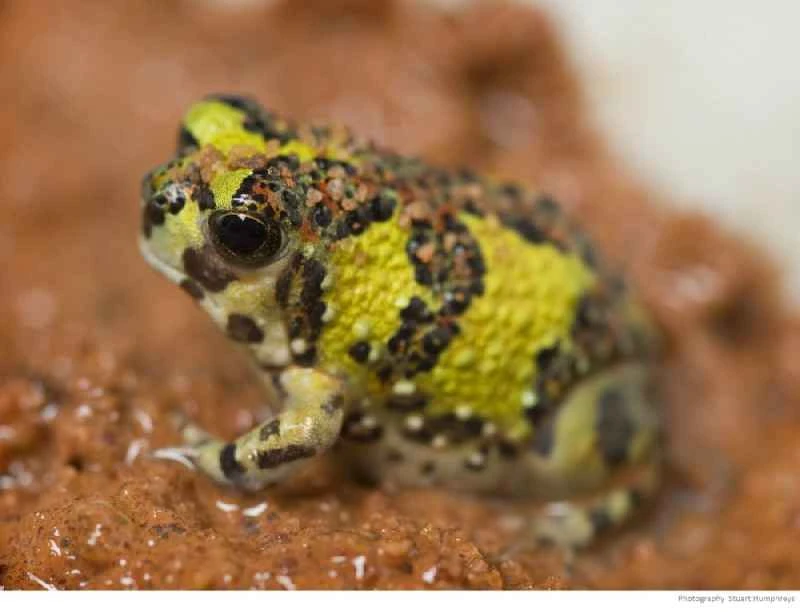
A small frog native to the arid and semi-arid regions of Australia, with a bright yellow back and cross-shaped reddish-brown markings. It secretes a sticky substance for defense when threatened and remains underground for extended periods to adapt to the arid environment.
Distribution and Habitat
It is native to the arid and semi-arid regions of the Australian outback and eastern parts, and is often found in grasslands, shrublands and red plains where temporary puddles and moist soil can form during the rainy season. It spends most of its time underground.
Appearance
Its body is short and round, with a bright yellow or yellowish-green back covered with reddish-brown or orange-red patches that form a cross-like pattern; its belly is pale, and its limbs are short and stout, making it suitable for digging and lurking in the soil.
Detailed introduction
The Crucifix Frog is a uniquely shaped native Australian frog, named for the cross-like pattern formed by its bright yellow and reddish-brown markings on its back. Its scientific name is * Notaden bennettii *, and it is a terrestrial frog native to Australia, inhabiting arid and semi-arid grasslands, scrublands, and muddy environments.
Classification and nomenclature
Common Chinese names: Cross Frog, Cross Frog (both are common translations)
English name: Crucifix Frog, Crucifix Toad
Scientific name: Notaden bennettii
Genus and family: (in a broad sense) Australian ground frogs, belonging to the genus Notaden.
Appearance and Identification Features
The cross frog is not large, but its striking colors make it one of the most recognizable frogs in Australia's arid regions.
Size: Adults are generally about 4–6 cm long, with a short, round or nearly spherical body that looks chubby;
Body color: The base color of the back is usually a bright yellow or yellowish-green, covered with reddish-brown, orange-red to dark brown patches. Some of these patches combine in the center of the back to form a cross-like pattern, which is the origin of its name.
Skin: The skin on the back is relatively smooth or slightly grainy, while the skin on the abdomen is pale or milky white;
Physical structure: short and stout body, head not very prominent, limbs relatively short but thick, suitable for digging soil;
Eyes: The eyes are located near the top of the head, allowing the person to observe the outside world even when most of their body is buried in the ground.
The vibrant yellow and red color scheme, along with the cross-shaped markings, gives the cross frog a visually "warning" appearance, alerting potential predators that it may not be easy to deal with.
Distribution range and habitat
The cross frog is endemic to the inland and eastern parts of Australia , primarily found in arid and semi-arid areas with unstable rainfall.
Commonly found in inland plains, red soil areas, and gently undulating grasslands and shrublands;
Prefers areas with thicker soil and where temporary puddles can form during the rainy season;
It may also occur on the edges of inland farmland and pastures far from the coast.
They spend most of their time underground , only appearing on the surface to be active and reproduce when heavy rains come, the ground is wet, and temporary puddles form.
Life habits: burrowing, hiding, and "drought adaptation"
The cross frog is highly adapted to arid environments and is a typical burrowing, hiding frog .
During long dry seasons, they dig downwards, burrowing deep into the moist soil.
To reduce water loss, the body forms a layer similar to a "keratinous cocoon" on its outer surface, and enters a low-metabolic dormant state, waiting for the next heavy rain.
Local indigenous people would dig up a type of frog called "water frog" during droughts to quench their thirst with the water stored in its body. The ecological group to which the cross frog belongs is related to this "water storage capacity" (this is not an encouragement to imitate, but only an introduction to ecological habits).
Once seasonal heavy rains arrive and the ground becomes flooded and muddy, the cross frog will break out of its "cocoon" and emerge from the ground to complete a series of activities such as foraging, mating, and laying eggs in a short period of time.
Defense strategy: sticky secretions
Another distinctive feature of the cross-shaped frog is that it secretes a sticky substance from its skin when threatened:
This secretion acts like glue, allowing it to stick to small predators or other objects that try to bite it.
For some natural enemies, this slime is difficult to get rid of and has a certain defensive effect;
According to traditional knowledge, local indigenous people used this "natural adhesive" to help fix ornaments such as feathers.
The bright warning colors and sticky secretions make the cross frog more difficult to prey on in its ecological niche.
feeding habits
Like most terrestrial frogs, the cruciform frog feeds on a variety of small invertebrates:
Ants, beetles, termites, and other surface insects;
Spiders, small centipedes, and other arthropods;
When the weather is humid after rain and insects are active, they will move slowly on the ground or lie in ambush waiting for prey to approach.
They use sight and the perception of ground vibrations to locate their prey, then quickly extend their sticky tongues to capture it.
Reproduction and Development
The reproduction of the cross frog is highly dependent on the "rainy season window":
After continuous heavy rain, temporary puddles and mud ponds of various sizes appear on the ground, and male frogs will call out by the water to attract female frogs.
The eggs are laid in shallow water or puddles, usually attached to aquatic plants or submerged objects.
Tadpoles must complete their development and transform into small frogs before the puddle dries up; therefore, their development speed is limited by water temperature and the time it takes for the water to disappear.
The transformed frog will leave the water as soon as possible and find a suitable muddy area to hide and grow.
Protecting the status quo and threats
The cross frog is currently assessed as Least Concern (LC) on the International Union for Conservation of Nature (IUCN) Red List, indicating that its overall distribution range is relatively wide and its population has not shown signs of rapid decline.
Potential threats include:
Large-scale land development and agricultural and pastoral expansion have led to changes in the Earth's surface structure;
Pesticides and pollutants entered temporary water bodies, affecting tadpoles and larvae;
Climate change is causing changes in rainfall patterns, and unstable rainy seasons may affect their reproductive success.
The key to protecting the cross frog is to preserve enough natural or semi-natural land, especially areas that can form temporary puddles and moist soil during the rainy season.
Frequently Asked Questions
Q1: Why is it called "Crucifix Frog"?
Its name comes from the bright yellow base color on its back, where several reddish-brown spots combine to form a cross-like pattern.
It is very conspicuous when viewed from above, hence the name Crucifix Frog or Crucifix Toad.
Q2: Are cross frogs poisonous? Are they dangerous to humans?
Cross frogs secrete a sticky defensive substance to deal with potential predators.
There is currently no evidence that it is as deadly to humans as the cane toad.
However, it is not recommended to rub or touch the eyes and mouth with bare hands for a long time. Wash your hands after observing in the wild.
Q3: Why do we rarely see cross-shaped frogs?
Because they spend most of their time underground dormant or lurking.
They only appear on the surface in large numbers to reproduce and forage after heavy rains and when temporary puddles form.
Therefore, it is almost impossible to see during the dry season.
Q4: What is the role of the cross frog in the ecosystem?
The cross frog feeds on a large number of small insects and arthropods, helping to regulate the population of invertebrates on the ground.
It also provides food for some predators and is an important part of the food web in arid and semi-arid regions of Australia.


