Basic Information
Scientific classification
- Chinese name: Eastern dwarf tree frog
- Scientific name: Litoria fallax
- Order: Anura
- Family: Litoria fallax Eastern dwarf tree frog
Vital signs data
- Body length: Adults are about 2–3 cm in length, making them small tree frogs.
- Weight: Individual weight is only a few grams, and varies depending on gender and nutritional status.
- Lifespan: It is estimated that they can survive for several years in the wild, and can go through multiple breeding seasons in suitable environments.
Significant features
The small, bright green tree frog, common in eastern Australia, is petite with suckers on its fingers and toes. It often makes a clear call around ponds and garden water features on summer nights and is one of the most familiar native tree frogs to residents.
Distribution and Habitat
It is widely distributed in various aquatic environments, including natural wetlands, swamps, lake shores, urban garden ponds, and farmland ditches, from Queensland to New South Wales and parts of Victoria.
Appearance
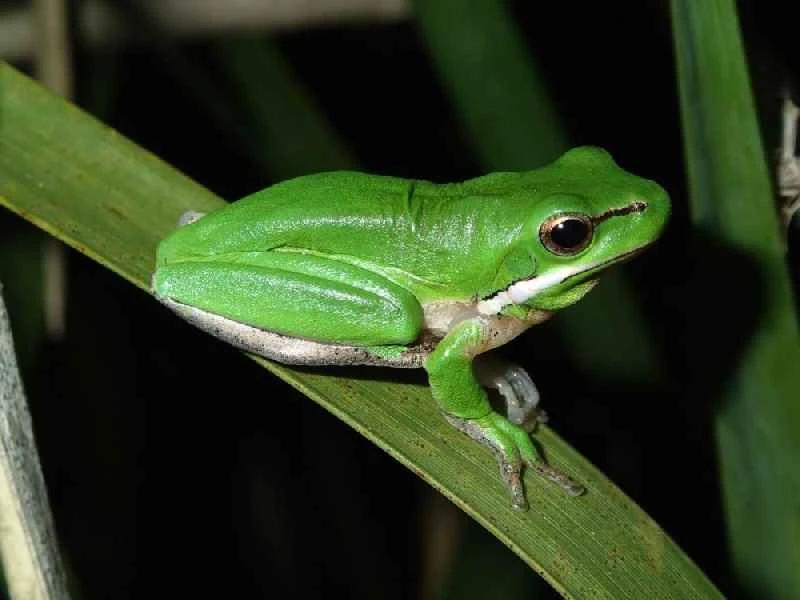
Its back is bright green or yellowish-green, and its sides are often covered with light brown or gold stripes that extend from the snout to the sides. Its belly is white or cream-colored. Its fingers and toes have obvious suction cups and some webbing. Its limbs are slender and its overall appearance is light.
Detailed introduction
The Eastern Dwarf Tree Frog ( Litoria fallax , sometimes written as Ranoidea fallax ) is a small, bright green tree frog native to Australia. It belongs to the Australian tree frog family. Widely distributed along the eastern coast and inland of Australia, it is one of the most common small tree frogs found in urban gardens, ponds, and wetlands.
Classification and nomenclature
Commonly used Chinese translations: Eastern dwarf tree frog, Eastern short tree frog (both are common translations, and there is currently no completely unified Chinese name).
English name: Eastern Dwarf Tree Frog
Scientific name: Litoria fallax (also known as Ranoidea fallax )
Family and genus: Australian tree frogs → traditionally classified under the genus Litoria
Appearance and Identification Features
The Eastern Dwarf Tree Frog is small in size, but its bright colors give it a "tropical" feel.
Size: Adults are typically about 2–3 cm in length, making them a typical small tree frog;
Body color: The back is mainly bright green, sometimes with a slight yellowish-green or olive green tinge. Some individuals have narrow light-colored stripes or irregular spots on their backs.
Lateral stripes: Light brown or gold stripes extending from the snout along the back of the eye toward the side of the body are common and are a major feature for identification in the wild.
Abdomen: The abdomen is mostly white or cream-colored, and the throat may have slightly light-colored spots;
Fingertip structure: The tips of the fingers and toes have obvious circular suction cups, and there is a certain degree of webbing between the toes, which is conducive to climbing on aquatic plants, reeds and small shrubs;
Overall appearance: Light and slender body, typical "tree frog body shape", excellent camouflage effect in green vegetation.
If you see a small, bright green tree frog perched on reeds or leaves in a city garden or by a pond, it is very likely an Eastern Dwarf Tree Frog.
Distribution range and habitat
The Eastern Dwarf Tree Frog is a common tree frog in eastern and northeastern Australia .
They are distributed along the east coast from Queensland, through New South Wales to parts of Victoria;
It appears not only in natural wetlands, but also extensively in urban and agricultural environments.
They prefer warm, humid environments with abundant vegetation and the presence of water.
Natural habitats include marshes, lake and riverbanks, wetland meadows, reed beds and forest edge puddles;
In areas of human activity, they are commonly found in garden ponds, farmland irrigation ditches, roadside ditches, artificial wetlands, and urban parks;
As long as there is a long-term or seasonal still/slow-flowing body of water and enough herbaceous and aquatic plants, it is often suitable for them to settle.
Habits and calls
The Eastern Dwarf Tree Frog is a small , nocturnal frog that relies heavily on water and vegetation .
During the day, they mostly inhabit grassy areas, reed leaves, or shrubs near water, and sometimes hide on the back of leaves, in crevices, and in man-made structures.
They come out to move and forage at dusk and night, and are most active in summer and after rain.
During the breeding season, male frogs call out at the edge of the water, on floating leaves, or on reeds. Their calls are a series of short and clear "trik… trik… trik…" or "creek… creek…" sounds, which often form a dense "nocturnal frog chorus".
In many residential areas of Dong'ao, you can hear the clear calls of these small tree frogs on summer nights, as long as there is a small pond or water tank nearby.
feeding habits
The Eastern Dwarf Tree Frog primarily feeds on various small invertebrates:
Flying insects such as mosquitoes, small flying insects, and moths;
Insects on land or plants, such as ants, small beetles, and aphids;
Small spiders and other arthropods that inhabit leaves and stems.
They mostly move slowly among the vegetation or wait for prey to approach, using their keen eyesight to lock onto their target before quickly extending their sticky tongues to capture it.
Reproduction and Development
The reproduction of the Eastern Dwarf Tree Frog is closely related to temperature and rainfall:
The breeding season mostly occurs in warm and humid seasons, especially in summer and after rain;
Male frogs gather at the edge of the water and call out to attract female frogs.
Female frogs lay their eggs in still or slow-moving water. The eggs are often found in small clusters or thin layers floating on the surface or attached to aquatic plants.
Tadpoles develop in water and are quite sensitive to water temperature and quality. It is especially important for them to complete their metamorphosis before the temporary water body dries up.
After metamorphosis, the young frogs will climb onto the shore and into the grass, gradually transitioning to an arboreal and herbaceous lifestyle.
Protecting the status quo and threats
The Eastern Pygmy Tree Frog is currently assessed as Least Concern (LC) on the International Union for Conservation of Nature (IUCN) Red List, indicating that it is widely distributed, its population is generally stable, and it remains very common in many areas.
However, some local populations may still face some pressure:
Wetland reclamation, riverbed hardening, and pond clearing have led to a reduction in small water bodies and aquatic plants;
Pesticides and urban pollutants enter water bodies, affecting the health of tadpoles and adult frogs;
The introduction of alien fish and aquatic predators increases the risk of tadpoles being preyed upon.
Preserving small ponds in cities and suburbs, planting native aquatic and riparian plants, and reducing the use of chemical pesticides will not only benefit the Eastern Pygmy Tree Frog but also help many native amphibian species.
Frequently Asked Questions
Q1: Can the Eastern Dwarf Tree Frog climb trees? Why is it often seen in grass?
It belongs to the tree frog family and has obvious finger and toe suckers, which allows it to climb shrubs and tall grass.
However, it is more commonly found in low grass, reeds, and aquatic plants, so many people see it more often in grass than in trees.
Q2: Is the Eastern Dwarf Tree Frog poisonous? Is contact with it dangerous?
Unlike the cane toad, it does not possess potent venom glands and is generally not considered a small tree frog that poses a significant danger to humans.
If you need to observe briefly in the wild, you can gently lift it up, being careful to avoid squeezing it, and then wash your hands.
Q3: Why can we always hear their calls near the pond on summer nights?
Because they breed during the warm and humid season, the male frogs will continuously call out in the water and on vegetation to attract the females.
When multiple male frogs croak at the same time, they create a distinct "frog chorus," which is especially easy to hear at night.
Q4: What is the role of the Eastern Dwarf Tree Frog in the ecosystem?
They prey on large numbers of mosquitoes and small insects, which helps control the population of some pests;
It also provides food for birds, snakes and other predators, and is an important part of wetland and garden ecosystems.


