Basic Information
Scientific classification
- Chinese name: Owl Parrot (Kākāpō)
- Scientific name: Strigops habroptilus
- Classification: Climbing birds
- Family and genus: Kakapoidae (species of the kakapo)
Vital signs data
- Body length: 58–64 cm (individual variation)
- Weight: Female 1.3–2.0 kg; Male 2.0–4.0 kg
- Lifespan: Up to 40–60+ years
Significant features
A flightless nocturnal parrot; males use lek for courtship; reproduces in sync with the abundant fruiting of trees; long-lived.
Distribution and Habitat
Historically distributed in the forests of New Zealand's North and South Islands; now mainly found in native forests and shrublands on islands without natural predators and in enclosed protected areas.
Appearance
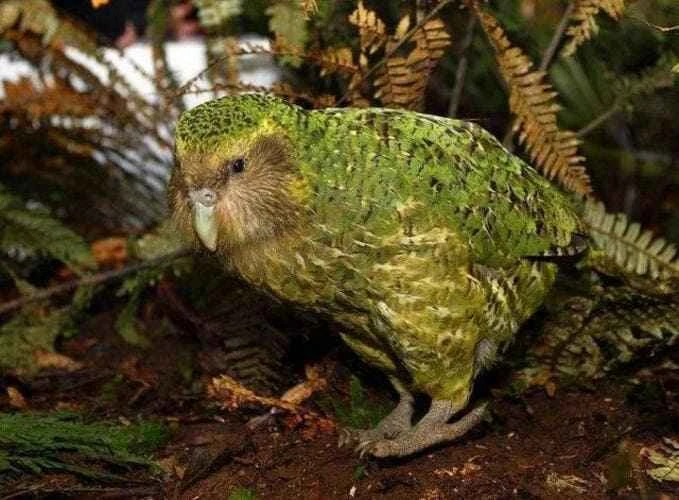
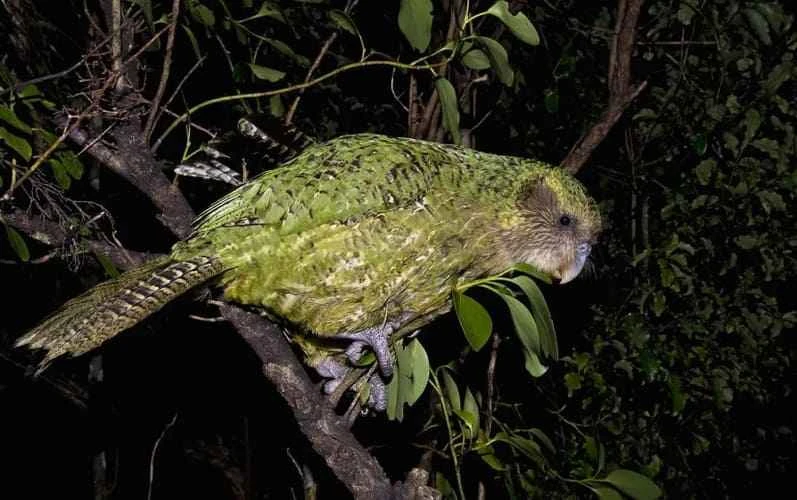
Mossy green mottled plumage; distinct facial disc and whisker-like antennae; stout limbs, short wings and long tail.
Detailed introduction
The kakapo ( Strigops habroptilus ) is a flightless nocturnal parrot endemic to New Zealand and one of the largest and longest-living parrots in the world. It gets its name from its owl-like facial disc. Historically widespread in the native forests of New Zealand's North and South Islands, it now survives only on a few remote islands without natural predators and in enclosed protected areas , relying on intensive management. It is assessed as Critically Endangered (CR) by the IUCN.
Ecology and Behavior
Nocturnal and terrestrial, adept at climbing and gliding short distances, it primarily feeds on the leaves, stems, roots, and fruits of native plants. Its reproduction is closely linked to the peak fruiting season of trees , especially coinciding with the peak fruiting period of Araucaria species such as the rimu . During the breeding season, males establish a "lek" (collective call area), emitting low-frequency "rumbling" courtship calls at night to attract females; females incubate and raise their chicks alone.
Morphology and Recognition
Its body feathers are moss-green with yellow and black spots, and it has a distinct facial disc and whisker-like antennae; short wings and a long tail; stout legs and a well-developed horny beak; dark brown iris. It has a stocky build, walks slowly but is good at climbing trees.
Reproduction and lifespan
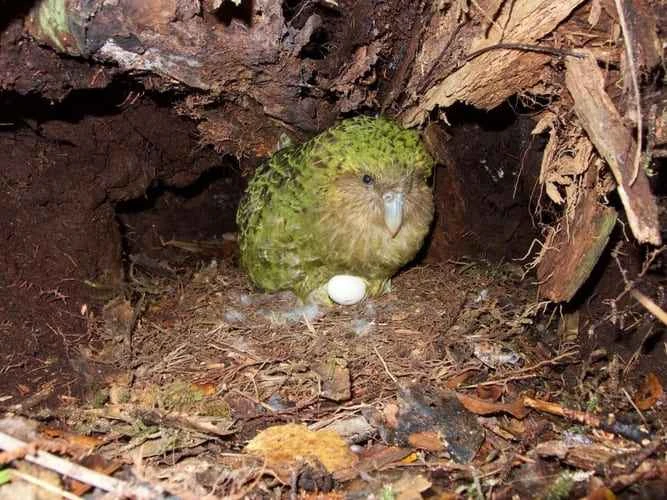
They breed only once every 2–4 years or even longer (depending on the fruitfulness of the trees); each clutch contains 1–4 eggs. Chicks have a long fledging period and reach sexual maturity relatively late. Records show they can live for 40–60+ years.
Threats and Protection
Invasive predators such as badgers, minks, cats, and rats cause high mortality rates among adult chicks.
Small population effect: inbreeding and low genetic diversity.
Habitat loss: historical clearing and logging.
New Zealand's "Kakapo Restoration Program" has gradually increased the population through methods such as predator elimination, artificial breeding, individual health monitoring, radio/satellite tracking, supplementary feed, and genetic management, but it still requires long-term, high-intensity investment.
Frequently Asked Questions
Q1: Why is it called a "kakapo"?
It is similar to an owl because of the round disc formed by its facial feathers, and it is mainly nocturnal.
Q2: Can it fly?
It cannot actually fly, but it can climb trees and use its wings to help with short descents.
Q3: Why is reproduction unstable?
Reproduction occurs in sync with a bountiful harvest in the forest, as there is enough high-energy food to feed the chicks during a good harvest.
Q4: What is the current state of conservation?
Intensive management (predator control, artificial breeding, health and genetic management) was implemented on several islands and enclosed areas without natural predators, resulting in a slow overall recovery.