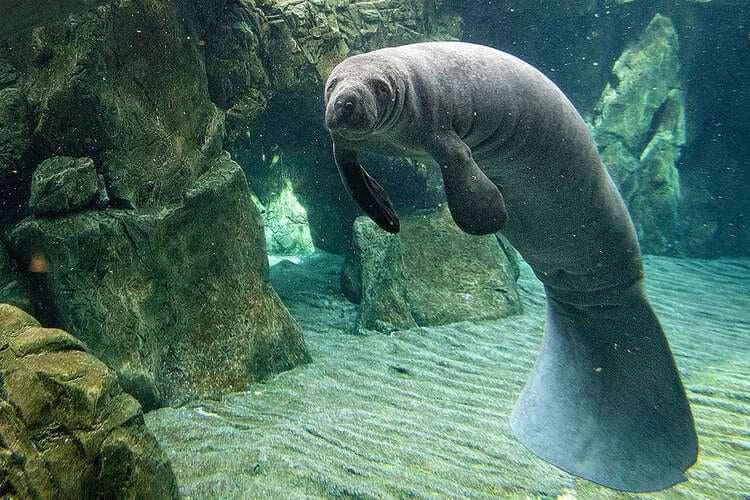
Basic Information
Scientific classification
- Chinese name: Dugong
- Scientific name: Dugong dugon
- Classification: Mammals
- Family and genus: Dugongaceae, Dugong
Vital signs data
- Body length: 2.5–3.3 meters
- Weight: 230–420 kg (individual variation)
- Lifespan: 50–70 years (in the wild)
Significant features
Seagrass-eating species; nearshore shallow waters; horizontal tail lobes; downward-curved snout; engineer species.
Distribution and Habitat
The shallow seagrass beds of the western Pacific Ocean: East Africa/Red Sea—Indian Ocean—Southeast Asia—Northern Australia.
Appearance
Spindle-shaped thick-skinned body; flippers; horizontally forked tail lobes; perioral bristles; males have short tusks.
Detailed introduction
The dugong ( Dugong dugon ) is a large, seagrass-eating mammal belonging to the family Dugongidae . It is widely distributed in the shallow waters of the Indo-western Pacific , from East Africa and the Red Sea to seagrass beds in Southeast Asia and northern Australia. As an "engineering species" of seagrass beds, the dugong promotes seagrass renewal and nutrient cycling by grazing on and disturbing sediments. It is assessed as Vulnerable (VU) by the IUCN.
Basic Information
Scientific name: Dugong dugon
Size: Length 2.5–3.3 meters; Weight 230–420 kilograms
Lifespan: 50–70 years in the wild; sexual maturity around 6–17 years; birth interval 3–7 years.
Ecology and Behavior
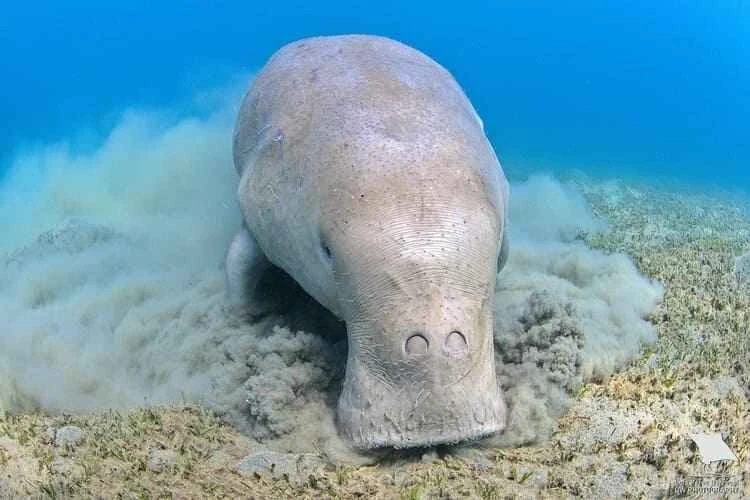
They feed exclusively or partially on seagrass , moving slowly across shallow seagrass beds in the subtidal zone to feed, leaving behind "feeding traces." They are usually solitary or in pairs, or live in small groups.
Morphology and Recognition
The body is spindle-shaped, with flippers forelimbs; the tail is horizontally forked ; the snout is curved downwards for easy feeding; there are bristles around the mouth; adult males have short tusks .
Threats and Protection
Habitat loss/degradation: turbidity of seagrass beds, land reclamation, and damage from storms and heat waves.
Human activities: ship collisions, fishing net entanglement and accidental catches, pollution and noise.
Hunting/Conflict: Traditional hunting or conflict still exists in some areas.
Protection measures include speed limits and fishing gear restrictions on important seagrass beds, seagrass restoration, stranding rescue networks, and long-term monitoring.
Frequently Asked Questions
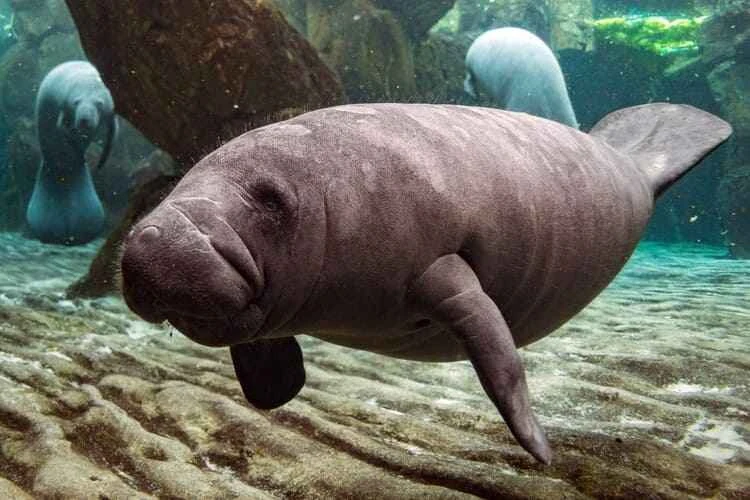
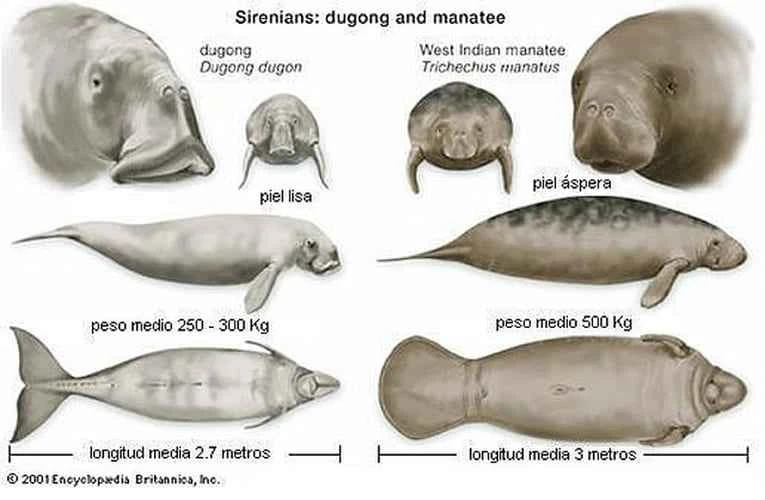
Q1: How to distinguish it from a manatee?
The dugong's tail is horizontally forked (similar to a whale's tail), while the manatee's tail is mostly round and fan-shaped; the dugong's snout is more downward-curved.
Q2: What to eat?
They mainly eat seaweed leaves and tender shoots, and prefer species with high nutritional value.
Q3: Why is it rated as "Vulnerable (VU)"?
The populations in many areas have declined and become fragmented. The combined pressures of ship collisions, accidental fishing, and seagrass degradation have made recovery slow.