Basic Information
Scientific classification
- Chinese name: Collette snake
- Scientific name: Pseudechis colletti
- Classification: Squamata
- Family and genus: Elapidae, genus *Symplocos*
Vital signs data
- Body length: Adult snakes are generally 1.2–1.8 meters in total length, while larger male snakes can reach or exceed 2 meters.
- Weight: Weight typically ranges from several hundred grams to over 1 kilogram, depending on the individual's sex, body length, and nutritional status.
- Lifespan: There is no precise data on lifespan in the wild, but it is generally estimated to be over 10 years, and may live even longer under good artificial breeding conditions.
Significant features
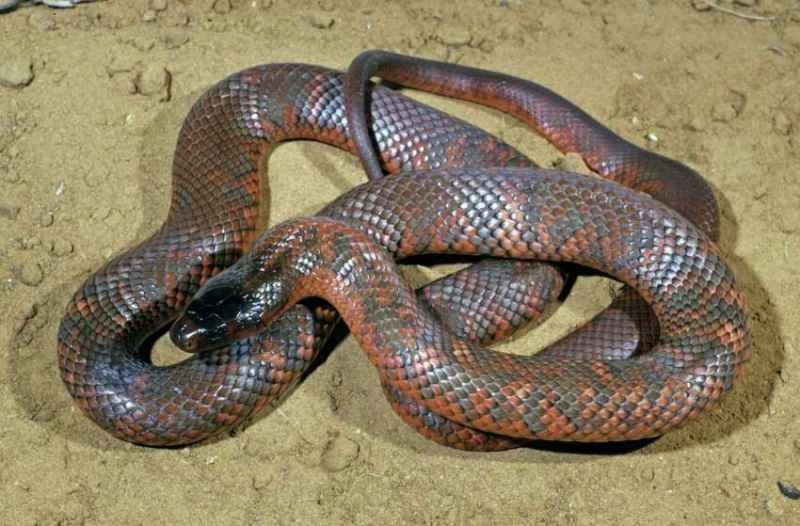
With its vibrant colors, black base with pink or orange-red horizontal stripes, it is one of the most visually appealing and highly venomous snakes in the genus *Syngonium*. Its venom can cause severe hemolysis and muscle damage.
Distribution and Habitat
They are mainly distributed in the arid and semi-arid plains of central and western Queensland, Australia. They inhabit dry grasslands, savannas, open scrubland and fissured black soil plains, and often use soil cracks, animal burrows, fallen trees and surface rocks as sheltered habitats and places to escape the heat.
Appearance
The body is robust and slightly elongated, with a slightly wide head that transitions smoothly into the neck, and round pupils. The back is dark brown to black, with irregular horizontal bands and patches of pink, cream, or orange-red on the sides and back. The belly is mostly yellow to orange-yellow, with more pronounced color contrasts in juveniles. The overall appearance combines the body shape of a black snake with striking "ribbon" patterns.
Detailed introduction
The Collett's Snake (scientific name *Pseudechis colletti* ) is a medium-sized to large, highly venomous snake belonging to the genus *Pseudechis* in the family Elapidae. It is a relatively rare and brightly colored native species found in the arid plains of central Queensland, Australia. Also known as the "Collett's Black Snake" or "Collett's Cobra," it is one of the most visually striking members of the genus *Pseudechis*. Although individuals are generally elusive and do not actively provoke humans, its venom can cause severe poisoning and even death, making it of significant importance in snake medicine and venom science.
Classification and nomenclature
The colletti snake belongs to the class Reptilia, order Squamata, suborder Serpentes, family Elapidae, and genus Pseudechis . This genus includes several well-known Australian venomous snakes, such as the red-bellied black snake, the blue-bellied black snake, and the Murga snake. The colletti snake's scientific name is *Pseudechis colletti* , formally described in 1902 by the Belgian-British zoologist Boulenger. The specific epithet "colletti" is in honor of the Norwegian zoologist Robert Collett. Molecular systematic studies show that it is closely related to the blue-bellied black snake, belonging to a unique branch within the "black snake" group.
Appearance features
The Colette snake has a robust yet slightly elongated body. The head and neck are not clearly distinguishable, but the head is slightly wider than the neck. Its eyes are medium-sized with round pupils. It is considered one of the most brightly colored species in the genus *Cyprinus*: its back is typically dark brown to black, with pink, cream, or orange-red horizontal bands and patches of varying widths covering its sides and back. These colorful bands merge near the midline of the back to form irregular cross-shaped or net-like patterns. The underside is mostly pale yellow, orange-yellow, or reddish-orange, sometimes similar in color to the bands on its sides. Juveniles resemble adults in pattern layout, but their colors are often more vibrant and have higher contrast. The overall appearance is that of a black snake, with "tiger stripes" and "coral" effects, making it highly recognizable among snake enthusiasts.
Distribution range and habitat
The Colette snake is endemic to Australia, with its natural distribution primarily concentrated in the arid and semi-arid regions of central and western Queensland, roughly in the inland warm temperate to subtropical grasslands, savannas, and open shrublands. It particularly prefers plains or gentle slopes with well-developed soil fissures, such as black soil plains, dry grasslands, and low shrublands. Field observations indicate that the Colette snake is mostly terrestrial, frequently using deep soil crevices, animal burrows, fallen logs, and surface rocks as hiding places to avoid high temperatures, drought, and predators. Compared to some coastal black snakes, it is more adapted to arid inland environments and is rarely seen in humid forests or coastal areas.
Lifestyle Habits and Behaviors
The Colette snake is primarily diurnal, being more active during the day in warmer seasons, with peak activity at dawn and dusk. In hot weather, they may briefly emerge during cooler periods of the day or after dusk. This species is relatively elusive, typically hiding in crevices and surface concealments, and will quickly retreat when disturbed by vibrations or disturbances. However, if cornered or handled/provoked, it will raise its forebody into an "S"-shaped defensive posture, ready to strike swiftly and powerfully if necessary. Its venom is mainly composed of hemotoxic, myotoxic, and neurotoxic components, capable of causing severe systemic poisoning; therefore, in its native habitat, it is considered a venomous snake requiring high vigilance.
feeding habits
The Colette snake is a typical carnivorous predator, with a diet primarily consisting of amphibians, other reptiles, and small mammals. Wild records indicate that it preys on frogs, various lizards, and small snakes, as well as small mammals such as rodents that enter crevices or burrows. When food resources are scarce, cannibalism may occur among Colette snakes. It often employs a "sneak and ambush" hunting method, frequently lying in wait near the entrance to crevices or fissures, striking swiftly with its fangs to inject venom, incapacitating the prey for a short time before slowly swallowing it.
Reproduction and life cycle
The Colette snake is an oviparous venomous snake, with its breeding season typically lasting from late winter to late spring (roughly equivalent to August–October in the Southern Hemisphere). During this period, males are more active, moving between suitable habitats in search of females, and brief male-female fighting may occur. After mating, the female completes egg development and lays the eggs within several weeks, in concealed burrows, crevices, or under fallen logs. The number of eggs per clutch varies depending on the female's size and health, generally ranging from 1 to 20, with most clutches containing around a dozen. The eggs incubate naturally at ambient temperature, with an incubation period of nearly three months. Newly hatched snakes possess fully developed fangs and vibrant markings, and can live independently immediately, primarily feeding on small frogs and lizards. Precise lifespan in the wild is unknown, but it is generally estimated to exceed 10 years, and may live even longer in captivity.
Relationship with humans
The Colette snake is relatively rare in the wild, mostly inhabiting remote, arid plains and scrubland areas, with limited opportunities for direct contact with humans. However, it is quite popular among reptile enthusiasts and zoos, its vibrant coloration making it one of the most sought-after venomous snakes for display and captivity. In the past, its venom was underestimated, considered relatively harmless to humans; however, clinical cases show that Colette snake bites can cause severe hemolysis, muscle damage, and acute kidney injury, requiring the use of black snake or tiger snake antivenom and aggressive supportive treatment. Therefore, whether in the wild or in captivity, this species should be treated with professionalism and caution, avoiding direct contact with non-professionals.
Protecting the status quo and threats
According to current assessments, the Colette snake is currently listed as "Least Concern" on the IUCN Red List, and its overall population is not considered to be significantly declining. Its main distribution areas have low human density, and vast arid plains still provide usable habitat. However, local populations may be affected by land clearing, overgrazing, road traffic fatalities, and fear-driven hunting. Furthermore, the illegal collection of venomous snakes for the pet trade may also put pressure on small populations. Protecting typical grassland and scrub habitats, controlling unnecessary hunting, regulating snake husbandry and trade, and strengthening public education will help maintain the long-term stable position of this colorful member of the Colette genus in the Australian outback ecosystem.
Frequently Asked Questions
Q1: How venomous is the Colette snake? Is it dangerous to humans?
The colette snake is a highly venomous snake. Its venom is primarily hemolytic and myotoxic, and may also contain neurotoxins. Human bites can cause serious consequences such as nausea, vomiting, abdominal pain, diarrhea, headache, muscle aches, abnormal blood clotting, rhabdomyolysis, and acute kidney injury. All suspected colette snake bites should be considered a medical emergency, requiring immediate medical attention, and a specialist will determine whether antivenom should be administered.
Q2: Are Colette snakes common in the wild? Are they easy to encounter?
The Colette snake has a relatively narrow distribution, mainly found in remote, arid plains and scrubland areas in central and western Queensland, and is rarely seen by the average person in daily life. They mostly live in hiding on the ground, preferring to hide in crevices and burrows, so even within their distribution area, they are not considered "common snakes".
Q3: Why are Colette snakes so popular in snake keeping circles?
The striking contrast of black and pink/orange-red stripes on the back of the Colette snake makes it one of the most visually striking members of the black snake genus, making it a popular choice for zoo displays and professional venomous snake keeping. While captive breeding has been relatively successful, its potent venom makes it suitable only for experienced, legally qualified breeders and institutions, and not as a pet for ordinary families.
Q4: In areas where the Colette snake is found, how can ordinary people reduce the risk of being bitten by venomous snakes?
Basic principles include: avoiding moving stones with bare hands or reaching into crevices and burrows in dry grasslands and scrub areas; wearing closed-toe shoes and long trousers when walking in the wild; using a flashlight when going out at night; and keeping a distance from any snake of unknown species, without attempting to catch or strike it. If a suspected venomous snake is found in a residential area, contact local professional snake catchers or wildlife rescue organizations for assistance.