Basic Information
Scientific classification
- Chinese name: Common Death Snake
- Scientific name: Acanthophis antarcticus
- Classification: Squamata
- Family and genus: Elapidae, genus *Death Snake*
Vital signs data
- Body length: Adults are usually about 40–100 cm in total length, with most individuals between 60–80 cm. Although they are not long, they are very robust.
- Weight: Weight varies greatly depending on individual size and nutritional status, with most adults weighing several hundred grams.
- Lifespan: Lifespan recorded under captive conditions can reach about 9 years, while the lifespan of mature individuals in the wild is generally considered to be around 10 years, and may be longer when the environment is stable.
Significant features
With a short, stocky body, a broad, triangular head, and a long, thin tail, it is adept at "tail-luring" prey. It attacks with extremely fast speed and its venom contains potent neurotoxins, making it a highly representative ambush venomous snake of Australia.
Distribution and Habitat
They are mainly distributed in forests, woody thickets, heather thickets, grasslands, and open woodlands in eastern and southern Australia, and are also found in parts of Papua. Their typical microhabitat is a ground covered with fallen leaves, dead branches, and debris, where the dead snake lies tightly coiled, blending into its surroundings with its body color.
Appearance
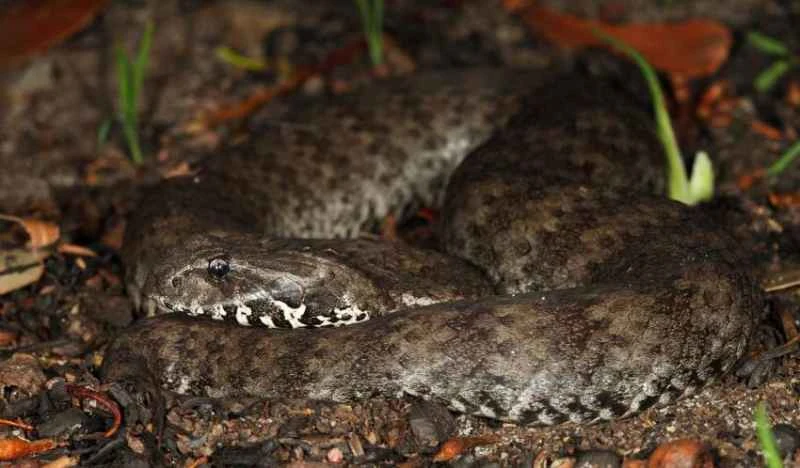
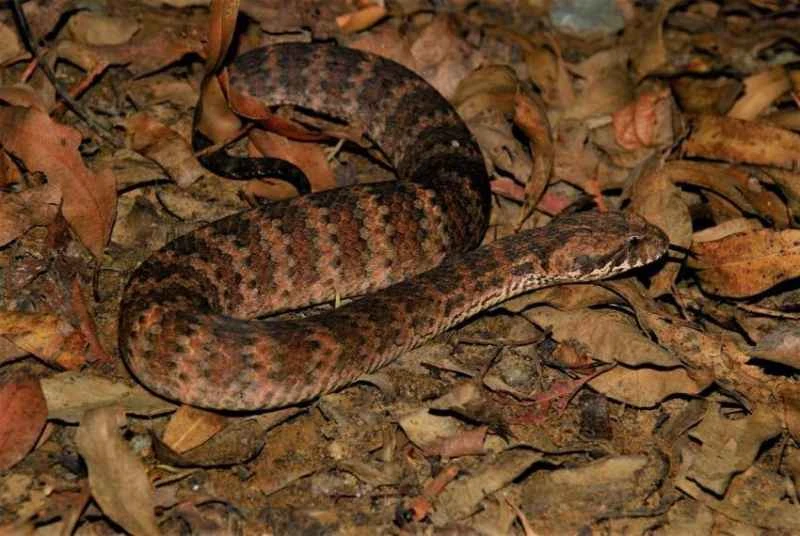
It has a robust but relatively short body, a flat, broad, triangular head, and a noticeably narrower neck. The back is typically sandy brown, grayish-brown, reddish-brown, or dark brown with alternating light and dark horizontal bands or ring-like markings. The underside is lighter in color, often grayish-white, cream, or pinkish-brown, speckled with fine spots. The tail is short and tapering to a point, its color often contrasting with the body, used to entice prey. Its overall appearance is remarkably similar to many vipers.
Detailed introduction
The Common Death Adder (scientific name Acanthophis antarcticus ) is a robust, highly venomous, and extremely camouflaged front-fanged venomous snake belonging to the genus Acanthophis in the family Elapidae. It is widely distributed in parts of eastern and southern Australia and Papua, and is one of the most venomous and fastest-attacking terrestrial snakes in the world. Unlike most Australian venomous snakes that actively hunt for prey, the Death Adder is more like an ambush hunter, lying in wait in piles of leaves and grass, luring prey close with a flick of its tail before launching a lightning-fast attack.
Classification and nomenclature
The common death snake belongs to the class Reptilia, order Squamata, suborder Serpentes, family Elapidae, and genus Acanthophis . Several species have been identified in the genus Acanthophis, collectively known as "death snakes" or "death serpents," all famous for their short, stout bodies, broad triangular heads, and highly neurotoxic venom. The common death snake is the most widespread species in this genus. Its scientific name, *Acanthophis antarcticus*, was first described by George Shaw in 1802, and its naming and classification have undergone several revisions since then. Unlike vipers common in Europe, the death snake is not a member of the viperidae family, but rather a "viper-like" venomous snake within the Elapidae family, a classic example of convergent evolution.
Appearance features
The common death snake is medium to short in size but very stout. Its head is flat, broad, and typically triangular, with a noticeably narrower neck that forms a clear "neck-shoulder line," giving it an overall appearance very similar to many vipers. Its eyes are small, with vertically elliptical pupils adapted to low-light conditions. The back's coloration varies greatly, ranging from light sandy brown and grayish-brown to reddish-brown, dark brown, and even slightly reddish, covered with alternating light and dark horizontal bands or dark rings of varying widths. The belly is generally lighter, mostly gray, cream, or pinkish-brown, and may have small spots. The tail is extremely short and thick, often ending in a contrasting light or dark tip, resembling a small "worm," used to wag its prey. Overall, this snake looks like a short, thick twig or a piece of wood in a pile of leaves, making it difficult to identify without close observation.
Distribution range and habitat
The common death snake is mainly distributed across large areas of eastern and southern Australia, including coastal and inland areas of Queensland, New South Wales, and South Australia. It has also been recorded in the Northern Territory, Western Australia, and parts of further west in South Australia, though it has become rare or even disappeared in some areas. Outside of Australia, it is also found in Papua and surrounding regions. It inhabits a variety of environments, including coastal and inland forests, woody thickets, heather thickets, grasslands, and open woodlands. Its most typical microenvironment is a ground covered with loose leaves and dead branches. The death snake is adept at camouflage itself using fallen leaves and debris, often coiling tightly in a ball with only a slight twitch of its tail, making it extremely difficult to spot in its natural environment.
Lifestyle Habits and Behaviors
The common death snake is primarily active at dusk and night (twilight to nocturnal), mostly hiding in leaf litter, grass, or under ground debris during the day. Unlike most roaming Australian venomous snakes, it is an almost "pure" ambush predator, often remaining motionless for hours or even days, patiently waiting for its prey to approach. When it detects a potential threat, the death snake usually doesn't slither away quickly like many snakes, but instead relies on camouflage to remain still or move only slightly, which inadvertently increases the risk of humans accidentally stepping on or touching it. Once forced or stepped on, it can raise its head, aim, and bite in an extremely short time; experimental records show that its attack speed can be on the order of 0.1 seconds, thus being considered an "extremely difficult bite to dodge" in the wild.
feeding habits
The common death snake is a typical carnivorous ambush predator, primarily feeding on small mammals, birds and their larvae, lizards, and frogs. One of its most unique hunting strategies is "tail-luring": the snake coils its body tightly, concealing its head above its body, while the tip of its tail wiggles slightly near its head like a small worm. When a small bird, lizard, or small mammal is attracted by the tail's movement and approaches, attempting to peck at or capture this "worm," the death snake instantly raises its head to bite its prey, injecting a highly toxic neurotoxin. It then releases its grip, waiting for the prey to become incapacitated before tracking and swallowing it whole.
Reproduction and life cycle
Unlike many oviparous snakes, the common dead snake is ovoviviparous (broadly defined viviparous), meaning the young snakes complete most of their embryonic development inside the female's body and are ultimately born as live offspring. The breeding season typically occurs around the warmer months, varying depending on the region and climate. A female typically gives birth to 3–20 offspring per litter, with some records exceeding 30. Newborn juveniles are about ten centimeters long, with a coloration similar to adults, but smaller in size. They are born with fully functional fangs and venom glands, enabling them to independently prey on small lizards and frogs. Precise data on their lifespan in the wild is limited, but captive individuals can live for over nine years, and mature wild individuals are believed to live up to ten years or more.
Relationship with humans
In Australia's snake "danger" rankings, the deadly snake consistently ranks high. In the past, before the availability of antivenom and modern medicine, the mortality rate from bites by the common deadly snake was extremely high. Its venom is primarily a potent neurotoxin, rapidly causing progressive paralysis and respiratory failure; without timely treatment, death could occur within hours. In modern conditions, with proper first aid and timely administration of appropriate antivenom, most patients can survive, but all suspected deadly snake bites are still considered serious medical emergencies. Because deadly snakes prefer to lurk in piles of leaves, bushes, and near paths, relying on camouflage rather than actively fleeing, people hiking, camping, or clearing debris in the wild can easily approach or step on them unknowingly, increasing the risk of conflict.
Protecting the status quo and threats
Globally, the common dead snake is currently classified as "Least Concern" on the IUCN Red List, with a wide distribution and remaining relatively common in some areas. However, habitat destruction and invasive alien species are putting pressure on its population in some regions, particularly the venomous cane toad: cane toads prey on juvenile dead snakes, and adult dead snakes may also die from poisoning due to the toad's venom glands after ingesting it. Furthermore, land clearing, roadside fatalities, and deliberate hunting of snakes out of fear by humans can also impact local populations. Conservation measures include maintaining natural woodland and shrub habitats, controlling the spread of cane toads, increasing public awareness of snake ecology and safety, and promoting non-lethal handling of human-snake conflicts by professionals whenever possible.
Frequently Asked Questions
Q1: Is the common death snake really as dangerous as legend says?
The venom of common dead snakes is primarily composed of potent neurotoxins, and historically, in the absence of antivenom, bites from them had an extremely high mortality rate. Today, with modern medical facilities and the aid of antivenom, most patients who receive timely medical attention can survive. However, any suspected dead snake bite should still be considered a serious medical emergency and requires immediate medical attention.
Q2: Will the Death Snake actively attack or chase humans?
Generally, the death snake does not actively pursue humans; it relies more on camouflage and immobility to avoid detection. The problem is that its reluctance to flee makes it easier for humans to unknowingly get too close or even step on it, triggering a defensive bite. Therefore, when in its habitat, appropriate footwear should be worn, and care should be taken to avoid piles of leaves and dense vegetation.
Q3: What are the differences between a common death snake and a viper? Why do they look so similar?
The common death snake is remarkably similar in appearance to vipers (such as the European viper): both have broad, triangular heads, short, stout bodies, and ambush lifestyles. However, taxonomically, the death snake belongs to the Elapidae family, while the viper belongs to the Viperidae family—two distinct snake families. Their similarities are a result of convergent evolution, where similar body sizes and ecological strategies have evolved within similar ecological niches.
Q4: How can humans reduce the risk of conflict with deadly snakes?
When in areas where common dead snakes are found, avoid walking barefoot or in sandals in bushes and leaf litter; clear the ground around your tent before camping and avoid staying in thick leaf litter for extended periods; do not disturb piles of leaves, wood, or stones with your hands; if you find a suspected dead snake or other venomous snake, maintain a safe distance and let the snake leave on its own or contact a local professional snake catcher and wildlife agency for handling.