Basic Information
Scientific classification
- Chinese name: Green Forest Hoopoe
- Scientific name: Phoeniculus purpureus, Green Wood hoopoe
- Classification: Climbing birds
- Family: Hornbills, Forest Hoopoe, Collin Hoopoe
Vital signs data
- Body length: No verification information available.
- Weight: No verification information available.
- Lifespan: Approximately 20 years
Significant features
Distribution and Habitat
It is found only south of the Sahara in Africa.
Appearance
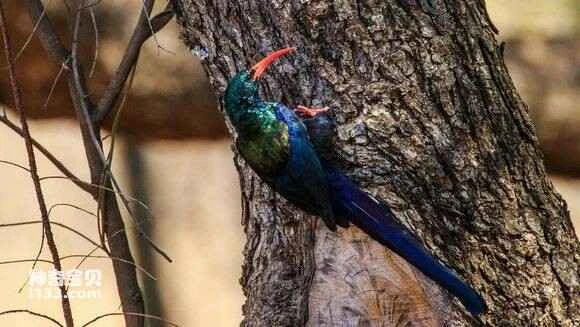
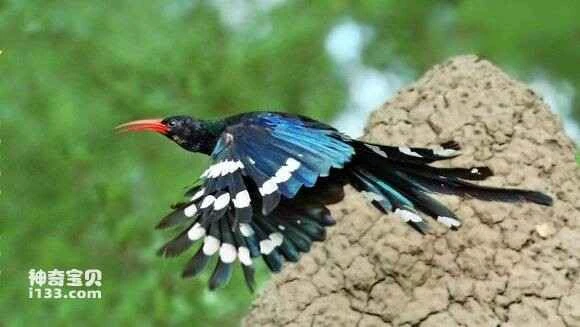
The head has a phoenix-shaped crest; the beak is slender and slightly curved downwards from the base; the wings are short and rounded, with 10 primary flight feathers; the tail is of moderate length and nearly square, with 10 tail feathers; the tarsi are short but not weak, with shield-like scales on both the front and rear edges; the toe bases are not completely fused, with the middle and outer toes only joined at the base, while the inner toe is free. The plumage of the two sexes is similar.
The coracoid bone exists only on the left side, with a deep incision behind the sternum and a wide, flat xiphoid process. The deep plantar tendons are separated to branches of the flexor digitorum longus muscle, but a ligament extends from the flexor hallucis longus muscle to the muscle plate connected to the tendon of the middle digitorum, with the connection point below the toe root.
Detailed introduction
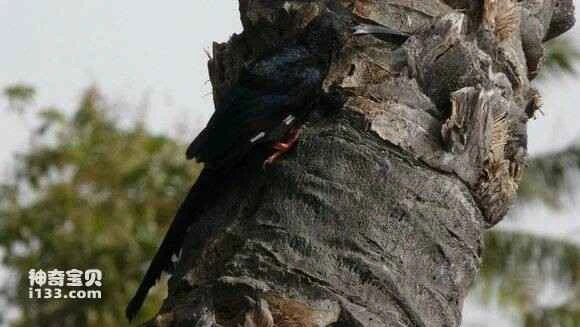
The green wood hoopoe, scientifically known as *Phoeniculus purpureus*, is also called the Green Wood hoopoe, but its specific habits are unknown.
Protect wild animals and ban the consumption of wild game.
Maintaining ecological balance is everyone's responsibility!