Basic Information
Scientific classification
- Chinese name: Osmanthus Red Duck
- Scientific name: Cinnamon Teal (Anas cyanoptera)
- Classification: Waterfowl
- Family: Anseriformes, Anatidae, Anatidae
Vital signs data
- Body length: 36-43 cm
- Weight: 280-500g
- Lifespan: Approximately 12 years
Significant features
Feather coloration varies with age and sex, and also differs slightly between different subspecies.
Distribution and Habitat
Origin: Argentina, Bahamas, Barbados, Belize, Bolivia, Brazil, Canada, Cayman Islands, Chile, Colombia, Costa Rica, Cuba, Ecuador, El Salvador, Falkland Islands, Guatemala, Mexico, Nicaragua, Paraguay, Peru, United States, Uruguay, Venezuela, Bolivarian Republic. Migratory birds: Antigua and Barbuda, Honduras, Jamaica, Panama, Puerto Rico, Turks and Caicos Islands, Virgin Islands.
Origin uncertain: Anguilla.
They prefer to inhabit and move in inland waters such as rivers, lakes, reservoirs, river bends, ponds and marshes, and especially like to move in open waters rich in aquatic plants. They also occasionally appear in coastal marshlands.
Appearance
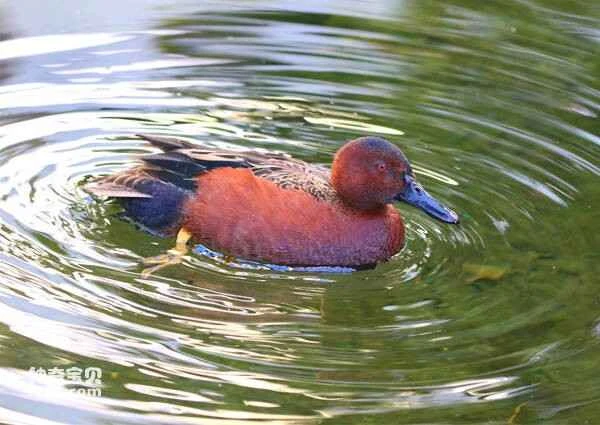
The Common Red-tailed Duck measures 36-43 cm in length, weighs 280-500 grams, and has a lifespan of 12 years. Plumage characteristics vary with age and sex, and there are slight differences between subspecies. Common features include a purplish-chestnut head, chest, and lower body in adult males, a dark brown belly, a greenish-brown lower back and the back of the head, and blue wing coverts. There are variations in shoulder feather color, with varying central yellow and green stripes. The eyes are red. From spring to autumn, the male's forewings are more vibrant. In autumn, the tail coverts turn black.
Young ducks resemble adult females in appearance, with white heads and green speculum, and light blue coverts.
Detailed introduction
The Cinnamon Teal (scientific name: Anas cyanoptera) has five subspecies.
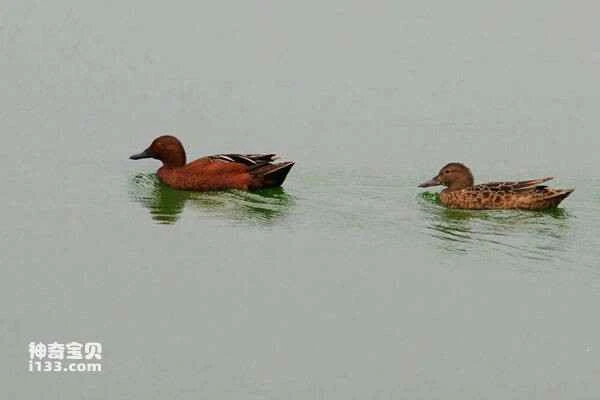
The Common Ruddy Shelduck typically lives in small flocks or pairs. During spring migration, flock sizes increase to up to 20 individuals. Spring migration generally occurs in March and April. Common Ruddy Shelducks winter in the southwestern United States or in Mexico and South America. They form flocks of around 20 individuals during breeding and migration. They also mix with other species such as the Common Teal, Teal, Shovel, Ruddy Shelduck, Red Shovel, and the South American Spotted Mudskipper.
Although the Common Ruddy Shelduck is primarily aquatic, it can also walk and run on land. It is a very agile bird, capable of making sudden sharp turns and flying very low, even taking off directly from the water. It is a clean bird, frequently preening its feathers both in the water and on land. When sleeping or resting, they look after each other; the males often remain alert while the females sleep. They typically rest more at midday than in the morning or evening. Generally, they are more lethargic and sleepy before spring arrives, becoming more active as time progresses, swimming, walking, or flying.Female ducks consume more food than males, primarily feeding on rooted or aquatic arthropods found in marshlands and lakes. They eat the flowers, leaves, fruits, and roots of plants, as well as invertebrates and arthropods.
The breeding season for the Red-eared Duck is in winter. Their nest is constructed from plant stems in a crescent shape. Each nest contains 4 to 16 eggs. Incubation lasts 21 to 25 days. The chicks leave the nest at 49 days old and are usually incubated solely by the female. After hatching, the female continues to care for the chicks, who follow her to forage. By the eighth week, the chicks' eyes turn red. They reach sexual maturity and are able to reproduce after one year.
Listed as Least Concern (LC) on the IUCN Red List of Threatened Species 2013 ver 3.1.
Protect wild animals and ban the consumption of wild game.
Maintaining ecological balance is everyone's responsibility!