Basic Information
Scientific classification
- Chinese name: Great Horizontal Frog
- Scientific name: Mixophyes fasciolatus
- Order: Anura
- Family: Myobatrachidae Mixophyes fasciolatus
Vital signs data
- Body length: Adults typically measure 7–9 cm in length, with some females reaching even greater dimensions. Among native Australian frogs, they are considered relatively large terrestrial species.
- Weight: Individual weight can reach tens of grams, depending on gender, physical condition and region.
- Lifespan: It is estimated that they can survive for many years in the wild and can participate in reproduction repeatedly in multiple breeding seasons; their lifespan may be even longer under suitable conditions.
Significant features
A typical large ground frog of the rainforests and valleys of eastern Australia, with a broad body and distinct horizontal stripes on its hind legs. The male frogs make a deep call by streams and puddles, and are one of the representative species of nocturnal frog calls in valleys of high-rainfall areas.
Distribution and Habitat
It is mainly distributed in high-rainfall areas such as southeastern Queensland and eastern New South Wales in eastern Australia. It inhabits rainforests, humid eucalyptus forests and valley environments, and is mostly active and breeds near mountain streams, waterfalls, pools and temporary waterholes in the forest.
Appearance
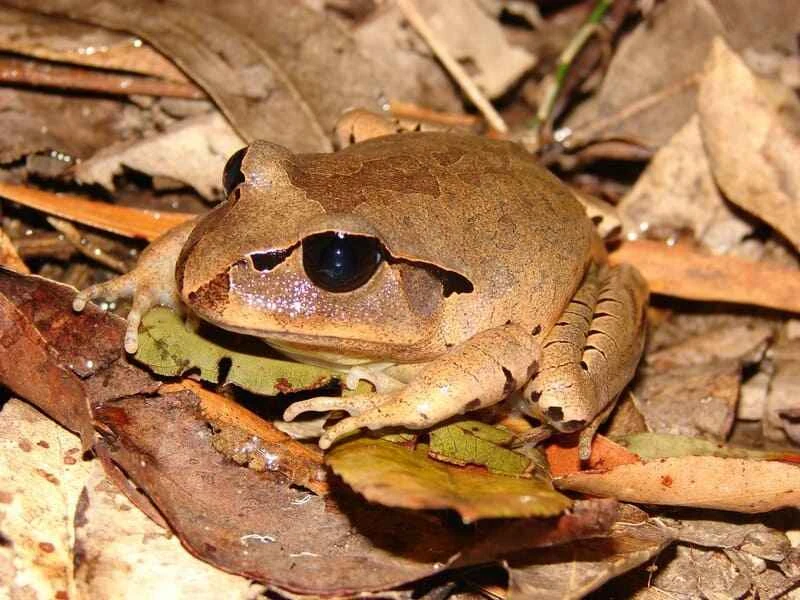
The body is sturdy and broad, with a brown or olive-brown back with dark cloud-like markings, and prominent dark horizontal bands on the hind legs; the abdomen is light-colored and may have markings, the eyes are large, the head is broad, the limbs are well-developed, and the skin is slightly rough with small warts.
Detailed introduction
The Great Barred Frog ( Mixophyes fasciolatus ) is a large, deep-voiced native Australian frog, typically found in eastern rainforests, damp eucalyptus forests, and near stream valleys. It is classified as a "terrestrial, near-water, high-rainfall frog" and is one of the most representative frogs found along many streams in eastern Australia.
Classification and nomenclature
Common Chinese name: Large Horizontal Striped Frog (based on a direct translation from the English name; the Chinese name is not yet fully standardized).
English name: Great Barred Frog
Scientific name: Mixophyes fasciolatus
Family: Myobatrachidae → Genus: Mixophyes (Large Australian ground frog)
Appearance and Identification Features
The Great Barred Frog has a robust body, well-developed limbs, and highly distinctive body markings.
Size: Adults are typically 7–9 cm long, with a few females being larger, making them medium to large-sized among native Australian frogs;
Body type: The body is broad and sturdy, with a wide head and particularly strong hind limbs, making it suitable for jumping and climbing along streams;
Back color: mostly brown, olive brown or golden brown, with scattered dark patches and cloud-like patterns;
Limb markings: There are distinct dark horizontal bands on the hind legs (from which the name "barred pattern" comes);
Abdomen: The abdomen is mostly light-colored, milky white or light yellow, and some individuals have spots or marble-like patterns;
Head features: Large eyes, often with a dark "mask" or stripes behind the eyes, and the tympanic membrane is clearly visible;
Skin texture: The skin on the back is slightly rough and has small warts, while the sides and limbs have glandular bulges.
Large body size, prominent horizontal stripes on the hind limbs, and a broad and thick body are key characteristics for identifying the large striped frog in the wild.
Distribution range and habitat
The Great Barred Frog is a native frog species of the high-rainfall region of eastern Australia .
Its distribution ranges roughly from southeastern Queensland, through eastern New South Wales, to parts of further south with high rainfall.
It is commonly found in rainforests, moist eucalyptus forests, and valleys in coastal mountain ranges and hilly areas.
It prefers woodland streams and humid environments:
Typical habitats include mountain streams, pools below waterfalls, forest valleys, and rainforest edges;
They are mostly active near streams, drainage ditches, damp hillsides, and temporary water pits, and dig shallow pits to lay their eggs.
During the day, they often hide under rocks, around fallen logs, in thick layers of fallen leaves, and in caves by streams.
Lifestyle Habits and Behaviors
The Great Barred Frog is a nocturnal, near-aquatic, terrestrial frog .
During the day, they often hide in cool, damp places by the stream, such as under rocks, between tree roots, or deep in the layer of fallen leaves, to keep their bodies moist.
They are active at dusk and night, foraging and moving about along stream banks or in woodlands.
When threatened, they will quickly jump into the water or leap up the slope to hide in rock crevices and vegetation.
Cry
During the breeding season, male giant striped frogs emit a deep, rhythmic call:
The call is usually described as "wark... wark..." or a deep bark, with a rich tone and a slow rhythm;
They often call at night near streams, ponds, or puddles in the forest.
When multiple male frogs sing together, the entire valley is often filled with rhythmic croaking.
feeding habits
The great barbel frog is carnivorous, primarily preying on various invertebrates, but also consuming small amounts of small vertebrates.
Surface insects such as beetles, crickets, and cockroaches;
Spiders, slugs, and other arthropods and mollusks;
They occasionally prey on smaller frogs or other palatable small vertebrates.
It moves slowly along the edges of streams and woodlands at night, using its vision and sensitivity to movement to catch prey that passes by.
Reproduction and Development
The reproduction of the Great Barred Frog is closely related to rainfall and stream water levels :
The breeding season usually occurs during warm and rainy periods, especially before and after heavy rains;
Male frogs croak loudly by streams, ponds, and puddles formed after rain to attract female frogs.
Female frogs will dig shallow pits or use small depressions in the damp ground near the water to lay their eggs in shallow water or at the water's edge.
Egg masses often adhere to the water surface or the boundary between fallen leaves and shallow water. After hatching, the tadpoles enter the water to develop.
Tadpoles grow in slow-moving streams or ponds, and after metamorphosis, they leave the water and begin a near-aquatic terrestrial life.
Protecting the status quo and threats
The Great Barred Frog is currently assessed as Least Concern (LC) on the International Union for Conservation of Nature (IUCN) Red List, indicating that its population is relatively stable within its overall distribution range.
However, local populations are still affected by the following factors:
Deforestation, road construction, and farmland expansion have led to the fragmentation of valley forests;
The hydrology and water quality of streams have been altered by dam construction, drainage projects, and pollution;
Direct threats from increased human activity include trampling, being run over by vehicles, and predation by pets.
Potential fungal amphibian diseases and the impacts of climate change.
Protecting the great barbel frog requires maintaining the native vegetation and rainforest along the streams, keeping the water clean, and minimizing damage to the valley habitat in road and development projects.
Frequently Asked Questions
Q1: Why is the Great Barred Frog called "Great Barred Frog"?
The "Barred" in its English name refers to the distinctive dark horizontal stripes (barks) on its hind legs.
The word "Great" emphasizes its relatively large size compared to many native frogs, hence the name Great Barred Frog.
Q2: Is the Great Barrier Frog poisonous? Is it dangerous to humans?
There is currently no evidence that the Great Barrier Frog is highly toxic to humans, and it is generally not considered a dangerous species.
If you need to make a brief observation in the wild, handle the items gently to avoid squeezing them, and wash your hands afterward.
Q3: Why are the great barbel frogs often heard in valleys but not easily seen?
They are mostly active at night and like to hide among rocks, fallen logs, and thick layers of fallen leaves.
Even during the breeding season when they make loud calls, frogs often hide in secluded spots near the water's edge, so it's common to hear their calls but not see them.
Q4: What is the role of the Great Barred Frog in the ecosystem?
The great barn frog preys on a large number of invertebrates and some small vertebrates.
It helps regulate animal populations in forest and streamside ecosystems;
At the same time, it is a food source for snakes, birds and large fish, and is an important part of the valley food web.


