Basic Information
Scientific classification
- Chinese name: Green Bell Frog
- Scientific name: Litoria aurea
- Order: Anura
- Family: Litoria aurea Green and golden bell frog
Vital signs data
- Body length: Adults are generally about 5–8 cm in length, which is medium to large for tree frogs. Females are usually slightly larger than males.
- Weight: Individual weight is usually within tens of grams, varying with individual size, sex, and nutritional status.
- Lifespan: It is estimated that they can live for several years in the wild and can experience multiple breeding seasons in stable habitats; their lifespan may be even longer under captive conditions.
Significant features
The medium-sized tree frog with bright green body and golden spots, found in the wetlands of southeastern Australia, often basks in the sun by the water during the day. When disturbed, it quickly jumps into the water and is one of the most representative colorful frogs in the area.
Distribution and Habitat
Historically, they were widely distributed in the coastal and inland lowland wetlands of southeastern Australia. Currently, they are mostly confined to a few reserved wetlands, protected areas, and artificial water bodies, and mainly inhabit sunny shallow ponds, swamps, farmland dams, and canals.
Appearance
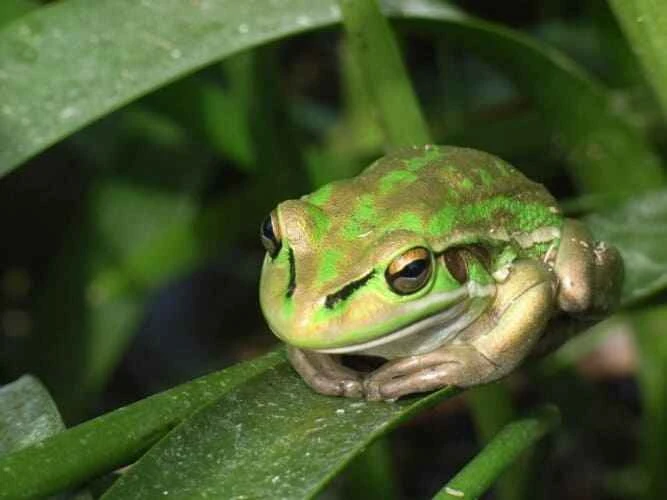
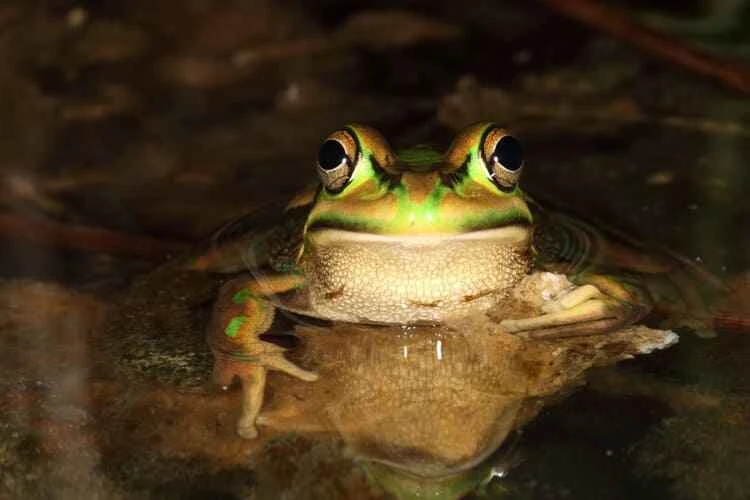
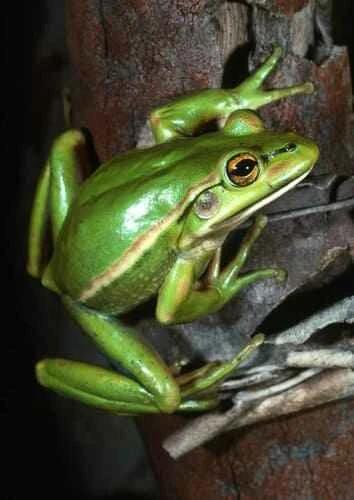
It is medium to large in size, with a bright green back interspersed with gold or bronze spots and stripes, dark stripes on the sides, and a cream or yellow belly. It has strong limbs, obvious webbed hind feet, and suckers on its fingers and toes, adapted to a semi-aquatic and climbing lifestyle.
Detailed introduction
The Green and Golden Bell Frog ( Litoria aurea ) is a brightly colored, medium-sized native Australian frog. Originally widely distributed in the wetlands and ponds of southeastern Australia, it was one of the most representative colorful frogs in the region. However, due to habitat loss, disease, and invasive species, its wild population has significantly declined.
Classification and nomenclature
Common Chinese names: Green Bell Frog, Green Golden Bell Frog (both are translations of the English name)
English name: Green and Golden Bell Frog
Scientific name: Litoria aurea
Family and genus: Tree frogs → Litoria
Appearance and Identification Features
The green bell frog is a very striking frog with intense colors and distinct patterns:
Size: Adults are generally about 5-8 cm long. Females are usually slightly larger than males, and they are considered medium to large tree frogs.
Back color: The back is mainly bright grass green, often mixed with gold or bronze spots and stripes;
Sides and markings: Brown or dark stripes are often found on the sides of the body, from behind the eyes to the sides of the body, interspersed with golden spots.
Underside: The abdomen is mostly cream or yellow, while the throat is often a deeper yellow in calling male frogs;
Skin texture: The skin on the back is relatively smooth, but a few small warts are visible;
Limbs: The limbs are strong, the hind limbs are relatively long, the hind feet have obvious webbing between the toes, and the fingers and toes have suction cups, which is conducive to movement near plants and water surfaces.
The green and gold body color, the distinct dark stripes on the sides, and the yellow underside are typical characteristics for identifying the Green Bell Frog in the wild.
Distribution range and habitat
The green bell frog is a species endemic to southeastern Australia .
Historically, they were widely distributed in the coastal plains and inland lowland wetlands of New South Wales, Victoria, and other states.
Many of the original populations have now disappeared or shrunk significantly, with only relatively stable populations remaining in some wetlands, protected areas and artificial water bodies.
It prefers warm, sunny, shallow wetlands:
Habitats include marshes, reed beds, farmland dams, lake edges, and slow-flowing canals;
They prefer environments with open water surfaces and floating or aquatic plants, which provide a good place to sunbathe and hide.
Sometimes artificial water bodies in urban and industrial areas are also utilized, such as abandoned brick pits, water treatment ponds, and landscape ponds.
Lifestyle
The green bell frog is a semi-aquatic tree frog that is very active both in water and on land.
During the day, they often bask in the sun on rocks, dead wood, or aquatic plants at the edge of the water.
When startled, it will quickly jump into the water to escape;
They are active at night in waterside vegetation, along the shore, and in shallow waters, foraging for small invertebrates.
feeding habits
The green bell frog is carnivorous, primarily feeding on various small animals.
Mosquitoes, moths, and other flying insects;
Beetles, crickets, ants, and insects that live near water;
They may occasionally prey on small frogs and other palatable small vertebrates.
They typically capture their prey by moving slowly or waiting for it to approach, then suddenly extending their sticky tongues.
Vocalizations and Reproductive Behavior
The rhythmic call of the green bell frog is one of the "background sounds" in many wetlands:
During the breeding season, male frogs emit loud, slightly metallic "crawk… crawk…" or "tok… tok…" sounds.
The calls are mostly made at dusk and night, originating from vegetation, rocks, or floating objects near the water;
When multiple male frogs call at the same time, they create a continuous chorus.
Reproduction is typically associated with warm, rainy seasons:
Female frogs lay their eggs in shallow waters that are still or have slow-moving flow. The egg masses are mostly attached to aquatic plants or sink into shallow water.
Tadpoles develop in water and are sensitive to water quality and temperature, requiring sufficient dissolved oxygen and a suitable water level.
After the tadpoles complete their metamorphosis, they leave the water and begin a lifestyle dominated by waterside and wetland vegetation.
Protecting the status quo and threats
The green bell frog is assessed as Endangered (EN) on the International Union for Conservation of Nature (IUCN) Red List, with populations in many historical distribution areas significantly reduced or disappeared.
The main threats include:
Wetlands are being filled in, drained, or converted into farmland and urban land, resulting in severe habitat loss and fragmentation.
Invasive species such as alien fish and bullfrogs that prey on tadpoles and tadpoles;
Pollutants such as pesticides and heavy metals enter water bodies, affecting the survival of eggs, tadpoles, and adult frogs;
The spread of fungal chytriditis and other diseases;
Climate change is causing extreme droughts and changes in rainfall patterns, which further affect the quantity and stability of suitable wetlands.
Currently, some regions are helping the green bell frog population recover by establishing protected areas, preserving and restoring wetlands, and building suitable artificial breeding and release projects.
Frequently Asked Questions
Q1: Why are the green bell frogs so brightly colored?
The green bell frog has a bright green back with golden spots, which helps it camouflage itself among aquatic plants and grasses.
On the other hand, it is also very conspicuous in sunlight, which is believed to be related to its sunbathing, body temperature regulation and intraspecific signaling.
Q2: Is the green bell frog dangerous to humans?
It is a medium-sized insectivorous frog, unlike the cane toad which has strong venom glands, and is generally not considered a dangerous species.
If a short observation period is required, handle the item gently to avoid squeezing the body, and wash your hands afterward.
Q3: Why can the green bell frog be found in some cities and industrial areas?
With the large-scale disappearance of natural wetlands, some populations have turned to artificial water bodies (such as old brick pits and water treatment ponds) as habitats and breeding grounds.
Provided the water quality is acceptable and there is adequate vegetation, they have the opportunity to establish new populations in these environments.
Q4: What role does the green bell frog play in the ecosystem?
The green bell frog preys on large numbers of aquatic insects and other small animals, which helps control the population of invertebrates such as mosquitoes.
At the same time, it is a food source for birds, snakes and fish, and is an important part of the food web of wetland and shallow water ecosystems.