Basic Information
Scientific classification
- Chinese name: Green Creek Frog
- Scientific name: Litoria phyllochroa
- Order: Anura
- Family: Litoria phyllochroa Green stream frog
Vital signs data
- Body length: Adults are generally about 3-5 cm in length, belonging to the small to medium-sized stream tree frogs. Females are usually slightly larger than males.
- Weight: Individual weight is only a few grams, varying with size, sex, and nutritional status.
- Lifespan: It is estimated that they can survive for several years in the wild, and can go through multiple breeding seasons in suitable habitats.
Significant features
The small to medium-sized green frog, common in the forest streams of eastern Australia, is slender with distinct dark stripes on its sides. It relies heavily on clear mountain streams and moist valleys and is a typical stream-dwelling tree frog.
Distribution and Habitat
It is mainly distributed in the high-rainfall areas of eastern New South Wales and southeastern Queensland in eastern Australia. It inhabits mountain streams, waterfalls, pools, and valleys in rainforests and humid eucalyptus forests, and is highly dependent on clean water quality and good valley vegetation.
Appearance
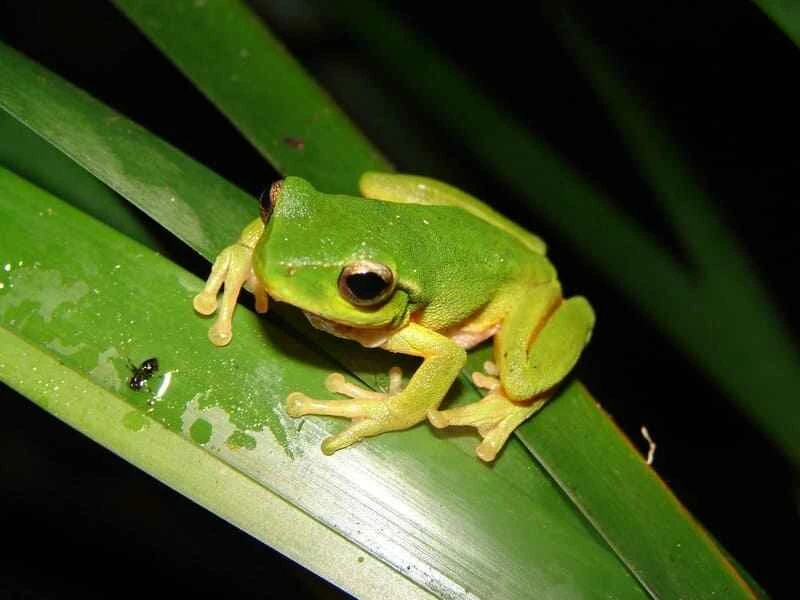
Its back is olive green, grass green, or brownish, with dark stripes along its sides from the snout through the eyes to the tympanic membrane, and a light-colored belly. It has slender limbs, well-developed hind legs, and webbed toes with small suckers at the tips, making it suitable for perching on slippery rocks and waterside vegetation.
Detailed introduction
The Green Stream Frog is a small to medium-sized, multicolored frog native to Australia, commonly found in forest streams in the eastern coastal mountains. Most sources refer to it as * Litoria phyllochroa *, a typical stream-dwelling tree frog that is adept at moving among rocks, fallen leaves, and waterside vegetation.
Classification and nomenclature
Common Chinese name: Green Stream Frog (based on the direct translation of the English "Green Stream Frog", the Chinese name is not yet completely standardized)
English name: Green Stream Frog
Scientific name: Litoria phyllochroa
Family and genus: Tree frogs → Litoria
Appearance and Identification Features
The green stream frog is small in size and has a simple appearance, but it has typical characteristics of a stream frog:
Size: Adults are generally about 3-5 cm long, with males being slightly smaller than females and generally slender.
Back color: mostly olive green, grass green or brownish, sometimes slightly mottled or with light dark spots;
Side stripes: From the tip of the snout through the eye to the tympanic membrane and side of the body, there are often obvious dark stripes, and the upper edge or surrounding area of the stripes may be interspersed with light-colored or gold edges;
The abdomen is mostly light-colored, white or pale yellow, and some individuals have fine cloud-like patterns on the throat or abdomen;
Skin texture: The skin on the back is relatively smooth, with occasional small warts, and the glands on the sides of the body are not particularly prominent;
Limbs and toes: The limbs are relatively long, the hind legs are well-developed, the toes have a certain degree of webbing, and the tips of the fingers and toes have small suction cups, which makes it easy to squat on slippery rocks and vegetation by the water.
Overall, the green stream frog gives the impression of being light-bodied and with understated colors that blend well with the valley environment. Its dark side stripes and translucent light-colored belly help it to be identified in the wild.
Distribution range and habitat
The green stream frog is a native species of the mountainous and hilly regions of eastern Australia .
It is mainly distributed in the high-rainfall areas of eastern New South Wales and southeastern Queensland;
They are commonly found in forest streams and humid canyons in coastal mountains and inland mountainous areas.
Habitat is closely related to streams:
They typically live in clear, fast-flowing mountain streams, pools below waterfalls, and forest valleys;
They inhabit the rocks, fallen trees, leaf litter, and riverside vegetation on both sides of the stream;
They are sensitive to water quality and prefer relatively unpolluted natural valley environments with good vegetation.
Lifestyle
The green stream frog is a nocturnal frog that lives near water .
During the day, they mostly hide under rocks, fallen trees, moss, and thick layers of fallen leaves to avoid strong sunlight and moisture evaporation;
They move along both sides of the stream at dusk and night, often leaping between rock surfaces, bank vegetation, and shallow water areas;
When threatened, they will quickly jump into the water or retreat along slippery rocks and vegetation.
Cry
The male green stream frog's call during the breeding season is clear and slightly short and rhythmic:
The call is often described as a series of short "reek... reek" or "chirp" syllables;
It is often found on stream banks, on top of rocks, or on vegetation close to the water surface;
On rainy nights or when the stream's water level rises, multiple male frogs will form a chorus, their calls echoing through the canyon along with the sound of the stream.
feeding habits
Like most small tree frogs, the green stream frog primarily feeds on small invertebrates:
Small flying insects, midges, moths, and other flying insects near the stream;
Small beetles, ants, spiders, and other arthropods that inhabit rock crevices and vegetation;
They occasionally prey on other small invertebrates.
They often perch on rocks or leaves, waiting for prey to approach before quickly extending their tongues to catch it.
Reproduction and Development
Green stream frog breeding is typically associated with the rainy season and rising stream water levels.
The breeding season is concentrated in the warm, rainy months;
Male frogs call out near streams and waterfall pools to attract female frogs;
The eggs are laid in slow-moving areas of streams, shallow pools along streams, or small bodies of water connected to streams.
Tadpoles mostly develop in slow-moving streams or pools, and are quite sensitive to water quality and dissolved oxygen.
After the tadpoles complete their metamorphosis, they climb onto the shore and begin a lifestyle that mainly involves living near water and short-distance climbing.
Protecting the status quo and threats
In the IUCN Red List, the green stream frog ( Litoria phyllochroa ) is usually assessed as Least Concern (LC) , indicating that there is no evidence of a large-scale rapid decline in its overall population.
However, some threats still exist in certain areas:
Deforestation and road construction have led to the fragmentation of valley habitats;
Stream pollution, increased sediment, and pesticide inflow are affecting water quality;
Climate change-induced extreme droughts or altered rainfall patterns can affect stream flow and reproductive success rates.
Factors such as potential fungal amphibian diseases.
The key to protecting the green stream frog lies in maintaining clean mountain stream water quality and a well-maintained valley vegetation buffer zone, and reducing human interference with the forest stream ecosystem.
Frequently Asked Questions
Q1: What are the differences between the green stream frog and other green tree frogs?
The green stream frog is relatively small and slender, with a body color that is usually olive green or grass green, and has distinct dark stripes on its sides.
It is more understated than the typical bright green "garden tree frog" and its color is similar to that of the rocks and fallen leaves in the valley.
Q2: Do green stream frogs only live near streams?
Most of the time, they are indeed closely associated with streams and moist canyons. Tadpoles develop in the streams, and adult frogs are also highly dependent on the moist environment along the streams.
However, during the rainy season or when humidity is high, individuals may sometimes leave the stream and venture short distances into the woodland to forage.
Q3: Are green stream frogs dangerous to humans?
It is a small insectivorous frog that is not highly toxic and generally poses no danger to humans.
If a short observation period is required, handle the items gently and avoid having chemicals on your hands. Wash your hands afterward.
Q4: How can we more easily spot green stream frogs in the wild?
The best way is to take a quiet walk along a forest stream on a warm, humid night.
Use a flashlight to search the rocks, leaf litter, and low vegetation along the stream, while keeping an eye out for the clear croaking of frogs.
However, when looking at frogs in the wild, one should pay attention to safety and avoid trampling on their habitat.