Basic Information
Scientific classification
- Chinese name: Australian Green Tree Frog
- Scientific name: Litoria caerulea
- Order: Anura
- Family: Litoria caerulea Green tree frog
Vital signs data
- Body length: Adults typically measure 7–11 cm in length, making them one of the larger tree frogs in Australia. Females are generally slightly larger than males.
- Weight: Individual weight can reach tens of grams, depending on the size, sex, and nutritional status of the individual.
- Lifespan: It is estimated that they can live for several years in the wild; under good captive conditions, their lifespan can be even longer, with records showing it can exceed 10 years.
Significant features
The large green tree frog, a well-known species in Australia, has a rounded body and an adorable "expression." It is often found near houses, water tanks, and bathrooms. It has a strong ability to adapt to human environments and is one of the most commonly encountered native frog species.
Distribution and Habitat
They are mainly distributed in rainforests, humid woodlands and around water bodies in northern and eastern Australia, and are also widely found around farms, gardens and residential buildings. They prefer warm, humid, sheltered environments rich in insects.
Appearance
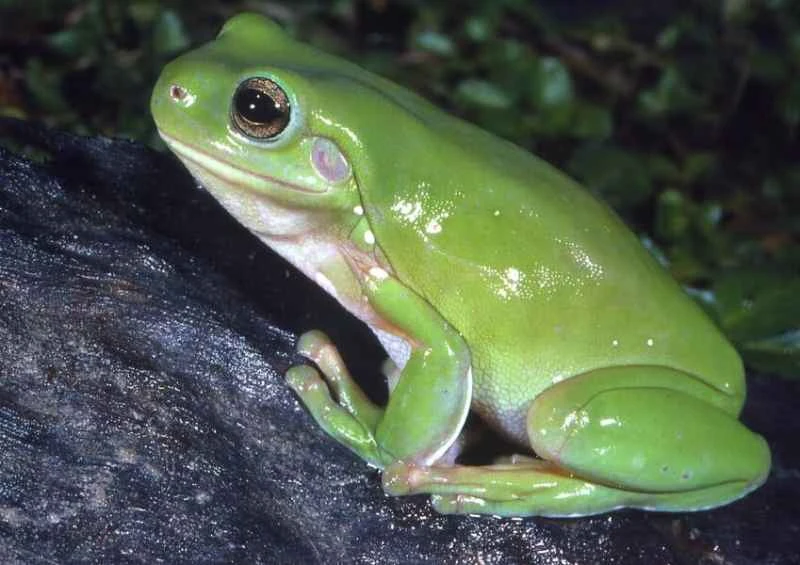
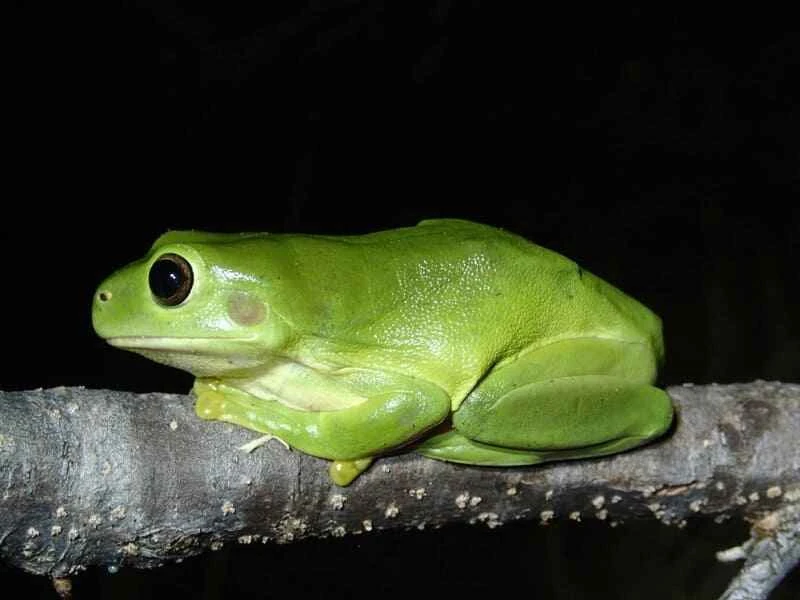
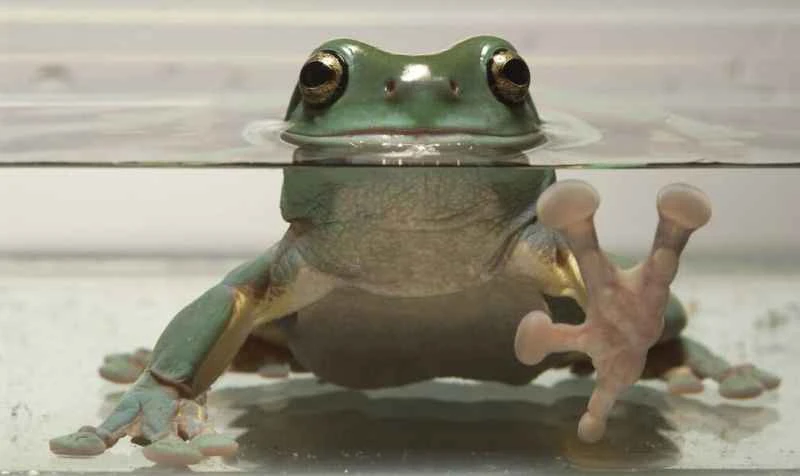
The body is plump and rounded, with a bright green, blue-green or olive green back, and some individuals have small white spots; the abdomen is white or cream-colored, the skin is relatively smooth and waxy, the limbs are strong, and the fingers and toes have well-developed round suckers, making them good at climbing smooth surfaces.
Detailed introduction
The Australian green tree frog ( Litoria caerulea ) is one of Australia's most famous and closest-to-human-living tree frogs. It is also commonly known as the Australian Green Tree Frog or White's Tree Frog in English. It is relatively large and mild-mannered, often inhabiting windowsills, water tanks, toilets, and bathrooms around residential areas.
Classification and nomenclature
Common Chinese names: Australian green tree frog, Bai's tree frog, etc. (different translations of the English and Latin scientific names)
English name: Green Tree Frog, Australian Green Tree Frog, White's Tree Frog
Scientific name: Litoria caerulea
Family and genus: Tree frogs → Litoria
Appearance and Identification Features
Unlike many smaller green tree frogs, the Australian green tree frog is significantly larger and has a rounder body.
Size: Adults typically measure about 7–11 cm in length, making them one of the larger tree frogs in Australia. Females are generally slightly larger than males.
Body color: The back is mostly bright green, blue-green or olive green, sometimes slightly bluish or brownish depending on the environment and temperature;
Spots: Some individuals have a few small white spots or light-colored spots on their back or sides;
Underside: The abdomen is mostly white or cream-colored, while the throat may be slightly yellow in calling male frogs;
Skin texture: The skin on the back is relatively smooth with a slightly waxy sheen, and some individuals show slight wrinkles;
Limbs and suction cups: The limbs are strong, and the tips of the fingers and toes have well-developed round suction cups, which are conducive to climbing glass, walls and smooth leaves;
Overall appearance: Its full and rounded shape gives people a "chubby" feeling, which is its well-known appearance feature.
Distribution range and habitat
The Australian green tree frog is mainly distributed in northern and eastern Australia , with some populations also appearing in the vicinity of New Guinea.
In Australia, it is mainly found in the northern tropical region and the warmer, more humid eastern region;
They mostly inhabit rainforests, humid woodlands, and forests near rivers and swamps.
It has a strong ability to adapt to the human environment:
They are often found near farm buildings, residential houses, gardens, toilets, bathrooms, and water tanks;
They prefer sheltered corners with water sources and high humidity, such as window frames, drain pipes, under outdoor lights, and the edge of sinks;
They forage at night where there are lights and insects.
Lifestyle
The Australian green tree frog is a nocturnal, arboreal/attachment frog .
During the day, they mostly rest in tree holes, eaves, window frame gaps, or other dark and damp places;
They are most active in the evening and at night, especially during the rainy season and on humid nights.
They are adept at climbing smooth surfaces such as glass, tiles, and metal, and are often found on bathroom and kitchen walls;
When faced with danger, they will jump away or hide, and if necessary, emit defensive cries or inflate their bodies to appear larger.
feeding habits
The Australian green tree frog is carnivorous and a master insectivorous creature among amphibians.
It mainly preys on various insects such as crickets, moths, beetles, cockroaches, and mosquitoes;
They also prey on spiders and other small invertebrates;
Larger individuals may occasionally prey on small vertebrates such as frogs or lizards.
They often ambush insects near lights and other places where they gather, using their sticky tongues to quickly capture passing prey, thus playing a certain "natural control" role against mosquitoes and cockroaches in the home environment.
Calling and Reproduction
The male Australian green tree frog has a deep and distinctive call:
The call is often described as a deep, drawn-out "brawk… brawk…" or "crawk…" sound;
It often occurs during the rainy season and on warm, humid nights, originating from watersides, drainage ditches, or near water tanks;
When multiple male frogs croak at the same time, the sound is very noticeable and is one of the representative sounds of a tropical rainy night.
Reproductive activity is closely related to rainfall and still water bodies:
Female frogs lay their eggs in still or slow-moving water bodies, commonly found in ponds, puddles, and pools.
The eggs float or sink in clusters in shallow water, and the tadpoles develop in the water.
After tadpoles complete their metamorphosis, they climb onto the shore and onto the surrounding vegetation, gradually transitioning to an arboreal and attached lifestyle.
Protecting the status quo and threats
The Australian green tree frog is currently assessed as Least Concern (LC) on the IUCN Red List, and its overall population is relatively stable.
However, in some regions, it may still be affected by the following factors:
Habitat fragmentation and the use of pesticides and chemicals have led to localized population declines.
Road damage, pets hunting, and accidental human injury;
Potential threats from diseases such as fungal chytriditis.
Preserving vegetation around water bodies, reducing the use of pesticides and disinfectants, and providing safe hiding places for frogs around houses all contribute to protecting this friendly and fascinating tree frog.
Frequently Asked Questions
Q1: Why do Australian green tree frogs often appear in toilets or bathrooms?
These places are damp, have water sources, and are often infested with insects; the walls and tiles are also smooth enough for them to climb on.
It is both safe and a food source for green tree frogs, so it is very "popular" with them.
Q2: Are Australian green tree frogs dangerous to humans?
It is generally believed that it poses no significant danger to humans, unlike some toads that are highly toxic.
However, all wild frogs may secrete certain irritating bodily fluids when stimulated.
If a brief observation is required, handle the item gently and wash your hands afterward.
Q3: Can I get rid of the green tree frogs that appear in my home?
It is not recommended to harm it. You can gently move it to a safe outdoor location with vegetation and water.
In many regions, green tree frogs are also considered a "natural helper" in controlling mosquitoes and cockroaches.
Q4: Are Australian green tree frogs suitable as pets?
In some countries and regions, green tree frogs are kept as ornamental frogs because of their cute appearance and relatively gentle temperament.
However, when raising them, it is necessary to pay attention to legal sources, suitable temperature and humidity, clean water sources, and a reasonable diet.
And avoid releasing captive-bred individuals into the wild to prevent the spread of diseases and genetic mixing.


