Basic Information
Scientific classification
- Chinese name: Bumphead Parrotfish
- Scientific name: Bolbometopon muricatum
- Classification: Medium-sized fish
- Family: Scaridae Bolbometopon
Vital signs data
- Body length: Commonly 80–120 cm; Maximum ~130 cm and above
- Weight: Large individuals can reach tens of kilograms.
- Lifespan: Decades (late maturity, long lifespan)
Significant features
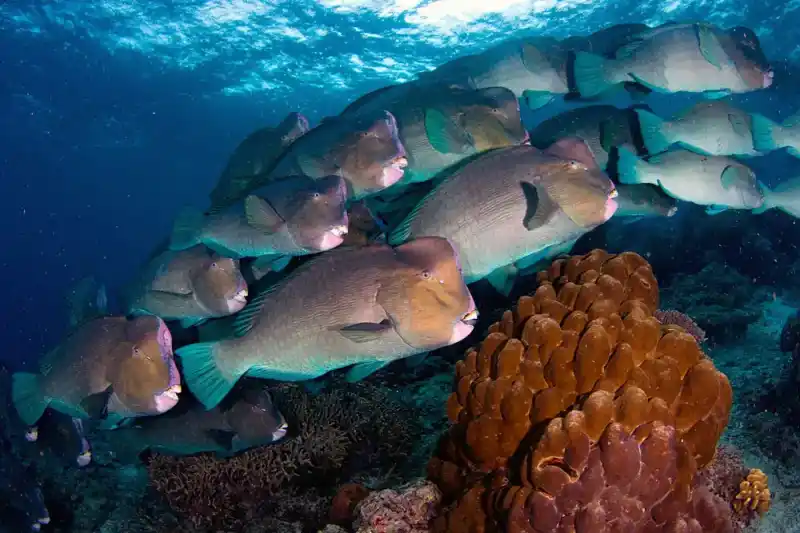
The largest parrotfish; prominent forehead growth; scrapes corals and algae; biological erosion and sand production; swims in groups and spawns in colonies.
Distribution and Habitat
Indo-Pacific tropical outer reef slopes and platforms in shallow to medium-shallow water; Red Sea to Micronesia/Great Barrier Reef.
Appearance
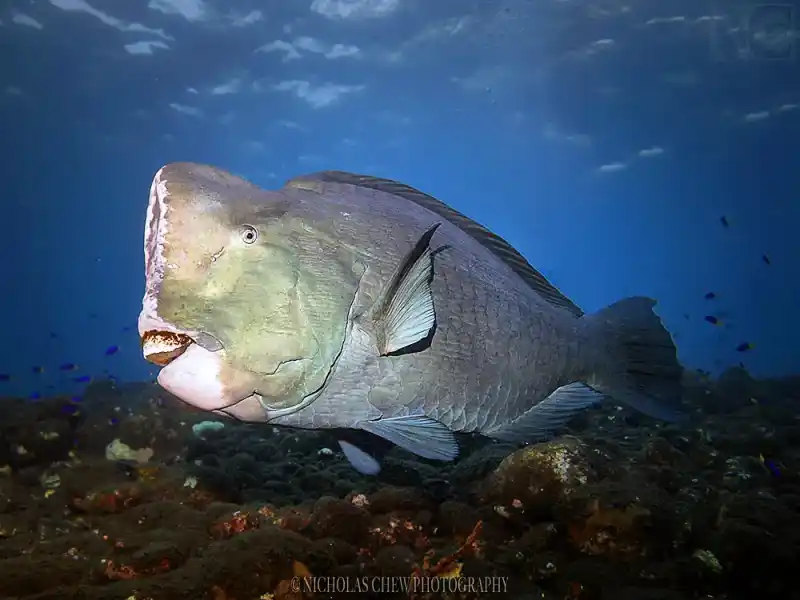
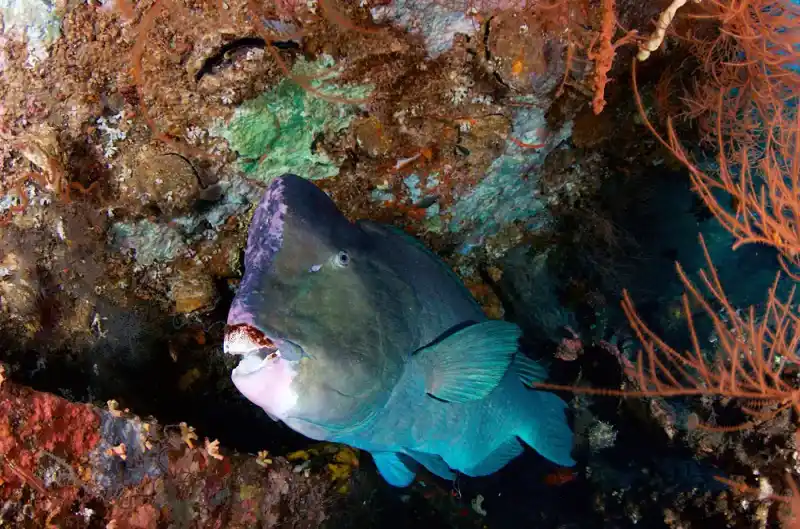
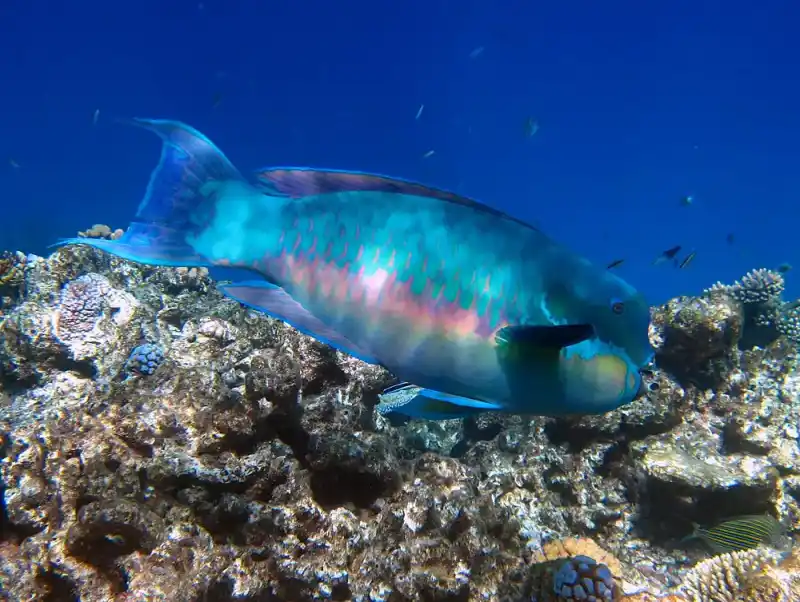
The forehead is raised, resembling a "bull's head"; the beak is thick and horny; the body color is grayish-green to bluish-gray; the tail fin is truncate/slightly concave; the scales are large.
Detailed introduction
The muricatum bumblebee parrotfish (also known as the bumblebee or bumblebee parrotfish ) is the largest parrotfish in the world, belonging to the order Labradoridae . Adults have a prominent hump on their heads. They feed by scraping and crushing corals and algae , making them important biological destroyers and sand producers , as well as key species for nutrient cycling and renewal in coral reefs.
Ecology and Biology
Diet: It mainly feeds on algae, algae and organisms on the surface of hard corals , and often chews on the coral skeleton to feed.
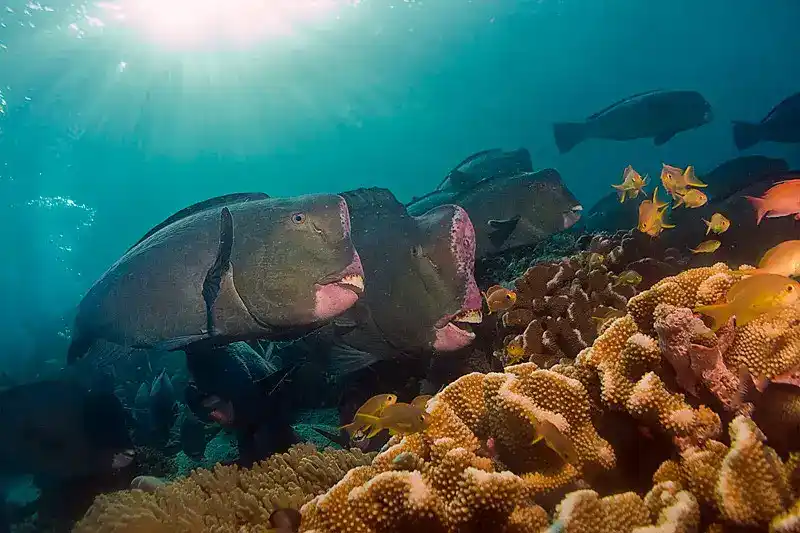
Behavior: They are often seen foraging in groups (dozens to hundreds) on the outer reef slopes and shallow reef platforms during the day ; at night they rest together on the reef body.
Reproduction: They form seasonal spawning colonies , releasing eggs and sperm in the open ocean; juveniles often inhabit relatively hidden seagrass/reef areas.
Life history: The slow-growing, late-maturity, and long-life K-type strategy, along with gregariousness and predictable habitat selection, makes it vulnerable to fishing.
Morphology and Recognition
They are large in size and thick in stature; adult fish have a large forehead tumor , which can be used for butting behavior within a group.
The mouth has a thick, horny beak (a characteristic of parrotfish), and a strong bite force; the body color is mostly grayish-green to bluish-gray , and juvenile fish have white spots/bands on their sides.
The tail fin is truncate or slightly concave; the scales are large; and there is little difference in body color between males and females.
Body size and lifespan
Body length: Commonly 80–120 cm , with a maximum of ~130 cm or more.
Weight: up to tens of kilograms (large individuals).
Lifespan: Can exceed several decades (depending on the region).
Distribution and Habitat
Widely distributed in tropical coral reefs of the Indo-Pacific (including the Red Sea to Micronesia/New Guinea/Great Barrier Reef , etc.), it prefers shallow to medium-shallow water areas of outer reef slopes, reef platforms and offshore reef bodies .
Conservation and Threats
Key threats: nocturnal speargun/dive fishing , concentrated fishing targeting spawning colonies , overfishing, and habitat degradation.
Management measures: It is recommended to implement fishing bans during the aggregation period , size/quantity restrictions , reef protection zones and key habitat protection; and to carry out community monitoring and co-management.
IUCN: Vulnerable (VU) according to multiple sources (subject to the latest authoritative assessment).
Frequently Asked Questions
Q1: Why are they called "sand producers"? They crush coral skeletons and expel fine sand, which can significantly contribute to reef sand/beach material over a long period of time.
Q2: Is it territorial or aggressive? Usually, it is not aggressive towards people when playing in groups ; however, there may be social/competitive behaviors such as headbutting within the group.
Q3: Why are they sensitive to fishing? They mature late, have a long lifespan, are predictable due to their colonies , and rest collectively at night, making them easy targets for spearguns or encirclement.
Q4: How to protect it? Establish marine protected areas , implement seasonal/period fishing bans and minimum catch sizes , and reduce nighttime speargun pressure.


