Basic Information
Scientific classification
- Chinese name: Japanese red stingray (Hemitrygon akajei|Old name Dasyatis akajei)
- Scientific name: Hemitrygon akajei (syn. Dasyatis akajei)
- Classification: Medium-sized fish
- Family: Dasyatidae Hemitrygon
Vital signs data
- Body length: Disc width commonly 40–60 cm; maximum ~100 cm
- Weight: Increases significantly with increasing disc width (large individual differences).
- Lifespan: Approximately 15–20 years (estimated)
Significant features
Nearshore benthic; non-placental viviparous and lacks uterine lactation; reddish-brown body color; venomous tail spines; nocturnal foraging for hard-shelled benthic organisms.
Distribution and Habitat
Northwest Pacific: Japan-Korean Peninsula-China coast and Taiwan; estuary-nearshore sandy-mud bottom/shell bed, 5–100 m.
Appearance
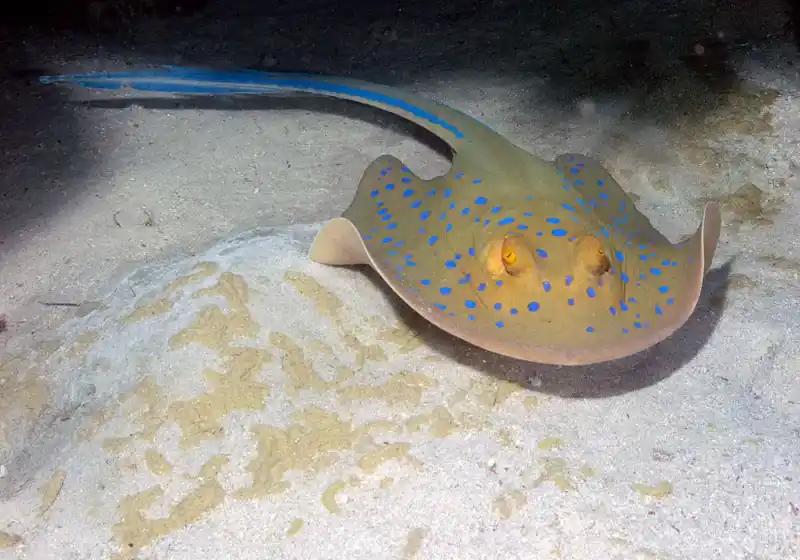
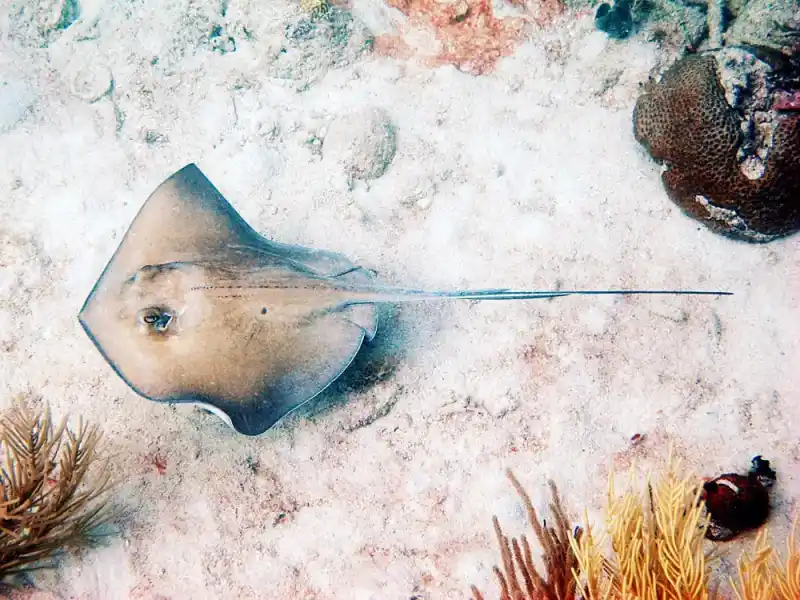
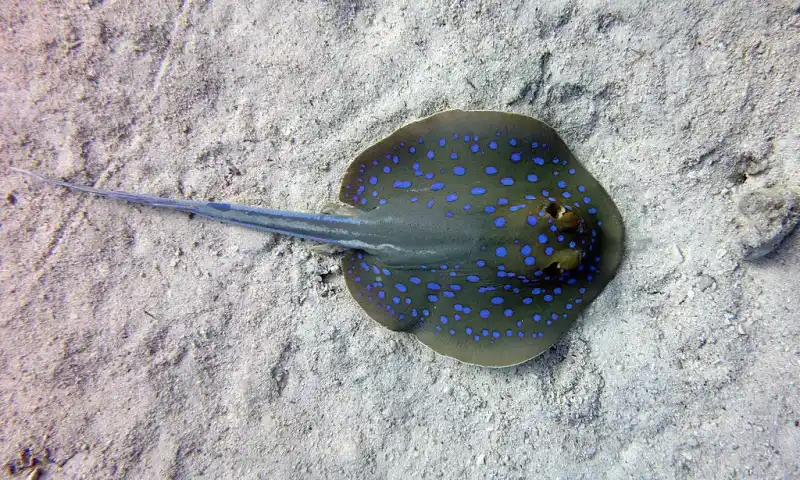
The body disc is nearly round and rhomboid; the back is reddish-brown and the belly is light-colored; the long tail has 1–2 tail spines and skin folds; the teeth are suitable for crushing hard shells.
Detailed introduction
The Japanese red stingray (also known as the red stingray , now often written as Hemitrygon akajei ; formerly known as Dasyatis akajei ) belongs to the family Dasyatidae and is a common nearshore stingray along the northwestern Pacific coast. It has a reddish-brown back and a venomous tail spine . It feeds on benthic invertebrates and small fish and reproduces viviparously (without a placenta, uterine lactation) .
Ecology and Biology
Diet: Shellfish, crustaceans (crab, shrimp), polychaetes and small bottom-dwelling fish.
Reproduction: Apasental viviparity, embryos rely on histotrophs ; approximately 2–10 offspring per litter (regional variation).
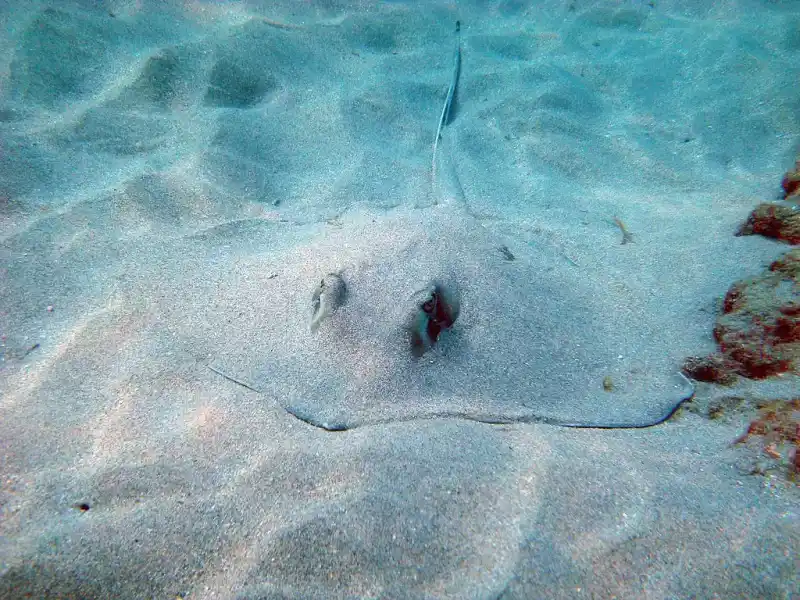
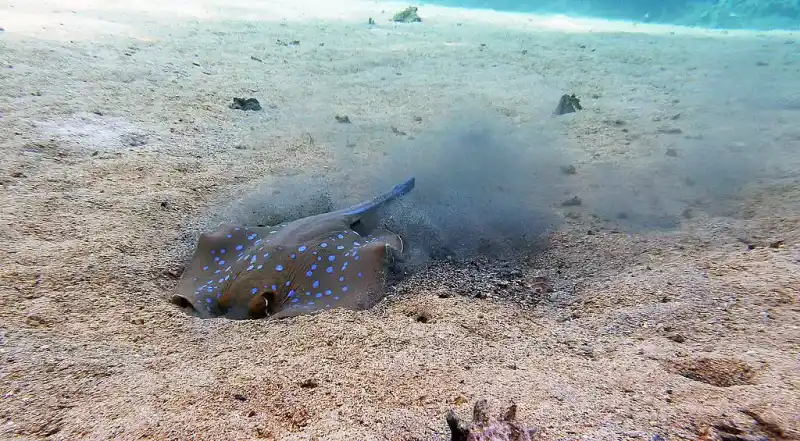
Behavior: During the day, it mostly buries itself in the sand and hides, while at night it forages in shallow seas; it is often active in the sandy and muddy bottoms of estuaries and nearshore areas.
Morphology and Recognition
The body disc is nearly round and rhomboid, with a relatively straight anterior edge; the back is reddish-brown to brownish-red , and the ventral side is light-colored.
The tail is slender and has 1–2 serrated tail spines (venomous); skin folds can be seen behind the tail spines.
The lower edge of the mouth has a row of teeth adapted to crush hard shells ; the male has a hook-like copulatory organ on the inner side of the pelvic fin.
Body size and lifespan
Disk width: Commonly 40–60 cm , up to ~100 cm .
Life expectancy: estimated at 15–20 years (regional/gender differences).
Distribution and Habitat
Distributed in the Northwest Pacific : Japan, Korean Peninsula, China (including the Yellow Sea, Bohai Sea, East China Sea ) and coastal waters of Taiwan; mostly found in shallow coastal waters and estuaries in sandy/muddy bottom/shell beds, generally at depths of 5–100 m (deeper areas have also been recorded).
Conservation and Human Interaction
Threats: bottom trawling and stationary fishing by-products and target fishing, habitat degradation and coastal pollution.
Management: It is recommended to implement body length/disc width restrictions, fishing bans during the breeding season, protection of key habitats , and improvement of fishing gear.
Safety tips: The tail spines are poisonous ; avoid stepping on or grasping them while wading or harvesting shellfish. If injured, seek medical attention as soon as possible (this is a science information tip, not medical advice).
IUCN: Vulnerable (VU) or regional decline based on multiple sources; subject to the latest authoritative assessment.
Frequently Asked Questions
Q1: How to distinguish it from the similar stingray? The Japanese red stingray has a more prominent reddish-brown back and its body disc is closer to a rhombus shape; it is necessary to combine the proportion of the body disc, the skin folds on the tail, and the row of teeth to make a judgment.
Q2: How dangerous is the tail spine? The tail spine has a piercing wound and venom glands , which can cause severe pain and secondary infection; avoid contact and wear protective shoes.
Q3: Will it enter freshwater? It is commonly found in brackish estuaries , but is mainly a marine species.
Q4: When is the breeding season? Mating and giving birth mostly occur during the warmer seasons , but this varies from region to region.


