Basic Information
Scientific classification
- Chinese name: Lai Island Duck
- Scientific name: Anas laysanensis, Laysan Duck
- Classification: Waterfowl
- Family: Anseriformes, Anatidae, Anatidae
Vital signs data
- Body length: Approximately 41 cm
- Weight: 447-451g
- Lifespan: Approximately 12 years
Significant features
Their beaks are short and flat with black spots.
Distribution and Habitat
The Lays duck is a medium-sized duck endemic to the Hawaiian Islands. It is found only on the island of Laysan in the Hawaiian archipelago.
Most adult ducks hide during the day in densely covered terrestrial vegetation, especially during the breeding season, when they often hide in grasses and bushes to avoid predation by birds of prey. They can be found on the highly saline Lake Lesang, and also inhabit freshwater lakes around the coast; juvenile ducks generally inhabit waters with lower salinity.
Appearance
The Lay Island duck is 41 cm long, with females weighing 447 grams and males 451 grams, and has a lifespan of 12 years. It is generally dark brown with white eye rings. Their bills are short and flat with black spots; males have dark green bills, while females have brownish-orange bills. Some males have iridescent green on their heads and necks, and their central tail feathers are slightly upturned.
Both male and female ducks have purplish-green speculum on their wings. Their bodies are covered with white markings. Older ducks may have white feathers on their head and neck. Their feet are orange, with the male's feet being brighter. They molt completely every year and may lose their flight feathers and become unable to fly until new flight feathers grow in.
Detailed introduction
The Laysan Duck (scientific name: Anas laysanensis) was once a subspecies of the mallard, but was reclassified as a separate species in 1987.
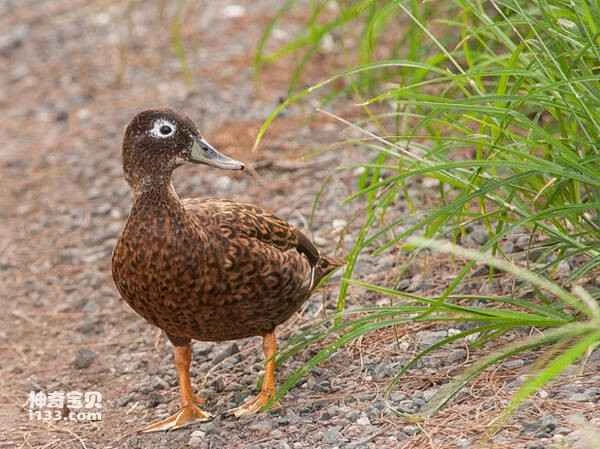
The Lai Island duck is most active at dawn and dusk, but this can be adjusted depending on the availability of food. While a strong flier, reaching as far as Taiwan and beyond, the Lai Island duck is better suited for walking, its pelvic structure optimized for terrestrial life. It rests at midday and forages at dusk and night. Along mudflats, it keeps its beak close to the ground, repeatedly opening and closing it to catch swarms of flies. It also ventures into shallow lakes and along the coast, foraging for invertebrates, algae, leaves, and seeds in the highland forests.
The breeding season for Lai Island ducks extends from spring to autumn, typically from April to August, with June being the peak season. Mating occurs on land or water, with the female building a bowl-shaped nest under dense vegetation, lined with leaves, grass, and feathers. Each duck lays four eggs at a time, and incubation takes 40-60 days. Ducklings can begin foraging on their own under the guidance of the female as early as the second day after hatching.
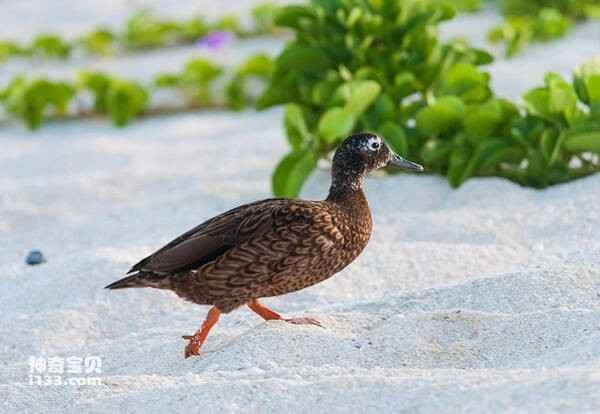
The Raisin duck is endemic to the Hawaiian Islands. Fossil evidence suggests that this species was once very common in the Greater Hawaiian Islands, but it is now endangered. In the early 20th century, due to drought and disease, the population declined to 82-127 individuals, later recovering to 500, peaking at 743. An estimated 521 individuals were found in 2010. Actions taken to conserve the Raisin duck include habitat restoration, restoring or strengthening limited freshwater habitats for broodstock rearing in the Hawaiian Islands, stabilizing sand dunes and planting vegetation to prevent the accidental invasion of competitors and predators, particularly new species of ants and rodents. Predator relocation and the introduction of Raisin ducks into lowland captive breeding areas on Midway and Raisin Islands have also been implemented. Kahoolawe Island has been proposed as a suitable new habitat area for the introduction and habitat restoration of the Raisin duck.
Listed as Critically Endangered (CR) on the IUCN Red List of Threatened Species 2012 ver 3.1.
Listed as a CITES Category I protected animal under the Washington Convention.
It is listed in Appendix I of the 2019 edition of the Convention on International Trade in Endangered Species of Wild Fauna and Flora (CITES).
Protect wild animals and ban the consumption of wild game.
Maintaining ecological balance is everyone's responsibility!