Basic Information
Scientific classification
- Chinese name: Fei Island Black Swift
- Scientific name: Apus sladeniae, Fernando Po Swift, Martinet de Fernando Po
- Classification: Climbing birds
- Family and Genus: Apotheales, Apodidae, Apothecium
Vital signs data
- Body length: 16-18 cm
- Weight: No verification information available.
- Lifespan: No verification data available.
Significant features
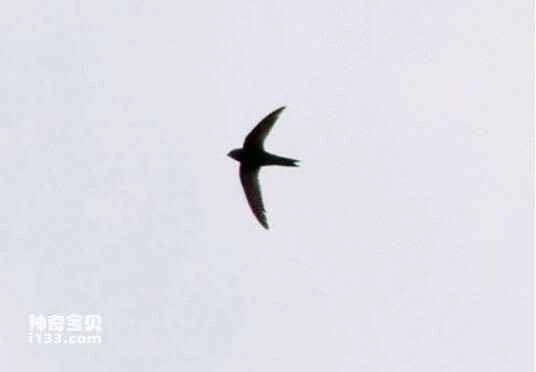
It has a short, forked tail and very long, swept wings, resembling a crescent or boomerang.
Distribution and Habitat
Breeding grounds: Cameroon;
Uncertainties exist in Angola and Equatorial Guinea;
Wandering: Nigeria.
Appearance
Measuring 16-18 cm in length, these large birds resemble grey swifts. Their plumage appears entirely blackish-brown, except for a small white or light grey patch on the chin, indistinguishable from a distance. They possess a short, forked tail and very long, swept wings, resembling crescent or boomerang shapes. This species is very similar to the common swift, but under optimal observation conditions, it can be distinguished by the contrast between its black back and paler secondary wing feathers. Their heavier bodies also endow them with distinctive flight maneuvers, including stable level flight and short glides.
Detailed introduction
The Fair Island Black Swift, scientifically known as *Apus sladeniae*, and also called Fernando Po Swift or Martinet de Fernando Po, was once a subspecies of the African Black Swift. The population size of this species has not been quantified; information is available from only 10 records. The rationale for this trend is that the population trend is unknown because the species is only known from a very limited number of records, and little is known about its ecology.
Listed in the IUCN Red List of Threatened Species 2016 ver3.1 – Data Deficient (DD).
Protect wild animals and ban the consumption of wild game.
Maintaining ecological balance is everyone's responsibility!


