
Basic Information
Scientific classification
- Chinese name: South African duck
- Scientific name: Hottentot Teal, Anas hottentota
- Classification: Waterfowl
- Family: Anseriformes, Anatidae, Anatidae
Vital signs data
- Body length: 30-35 cm
- Weight: Approximately 243g
- Lifespan: No verification data available.
Significant features
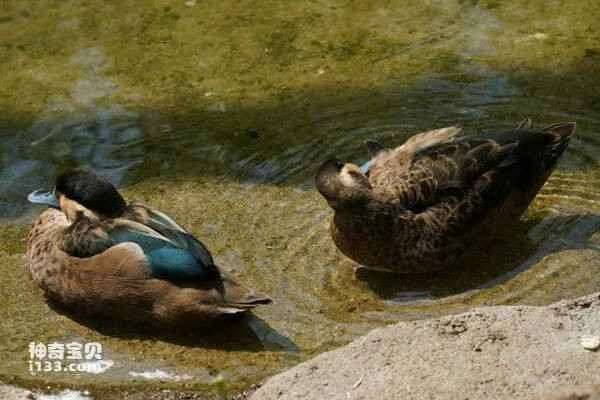
The male duck has a bluish-grey bill, and its colors are more vibrant and bright than those of the female. Its legs and feet are also bluish-grey.
Distribution and Habitat
Distributed in south-central Africa, including the southern Arabian Peninsula and the entire African continent south of the Sahara Desert (Tropic of Cancer). Also found in the Indian Ocean, including Madagascar and its surrounding islands.
They typically inhabit freshwater lakeshores, and also live in groups in rivers, lakes, reservoirs, bays, and coastal salt flats.
Appearance
The South African duck measures 30-35 cm in length and weighs 243 g. Adult males have a dark brown crown and nape, contrasting with pale yellow cheeks and throat. A large black patch is present on the cheek near the neck and back. The underparts—neck, chest, and abdomen—are yellow with small dark brown spots, while the sides are yellow. The back and tail are black. The primary flight feathers are dark brown with some blue and green hues. The secondary flight feathers are metallic greenish-black with white edges on the wingtips. The bill is bluish-grey, with the male's colors being more vibrant and bright than the female's. The legs and feet are greyish-blue, and the iris is dark brown.
Detailed introduction
The South African duck (scientific name: *Anas hottentota*, also known as the Hottentot Teal) typically lives in pairs or small groups, foraging in the early morning or evening. They frolic in groups along coastlines and in wetland vegetation. They mainly float on the water's surface, obtaining food underwater, primarily a plant-based diet, but sometimes also consuming animal matter. The ducks have webbed toes but rarely dive; their tails remain above water when swimming. They are adept at foraging, playing, and courtship in the water. They are clean animals, frequently preening their feathers both in the water and on land. Their diet consists mainly of roots, seeds, leaves, berries, and rice from marshes and lakes, but they also eat invertebrates and arthropods.
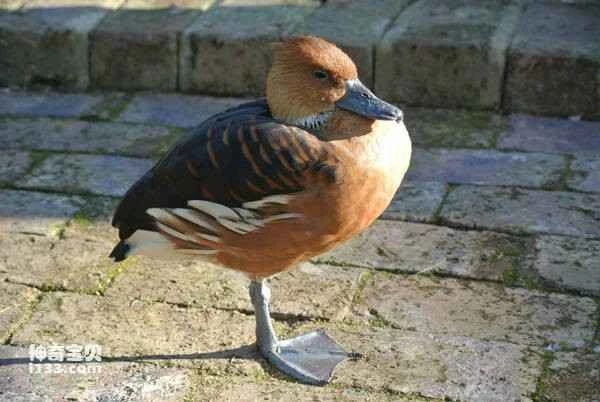
South African ducks breed in large flocks during the egg-laying season, pairing up in large groups. Due to their large size and range, the breeding season varies depending on the region and latitude. In South Africa, it is from January to April; in Malawi, it is from June to August; and in Kenya, it is from June to October. However, South African ducks can breed in any month of the year, provided that environmental and water conditions are favorable. Nests are hidden in riverside vegetation. They build a dome-shaped nest, using reed stems as the main structure and lining. The female lays 6 to 8 eggs, which incubate for 24 to 26 days. The ducklings grow rapidly and can fly after 5 weeks of incubation. The male duck sometimes helps to care for the ducklings.
Listed in the International Union for Conservation of Nature (IUCN) Red List of Birds, 2009 ver 3.1.
Protect wild animals and ban the consumption of wild game.
Maintaining ecological balance is everyone's responsibility!


