Basic Information
Scientific classification
- Chinese name: Grey Duck
- Scientific name: Anas gracilis, Grey Teal
- Classification: Waterfowl
- Family: Anseriformes, Anatidae, Anatidae
Vital signs data
- Body length: 37-47 cm
- Weight: 350-670g
- Lifespan: No verification data available.
Significant features
Distribution and Habitat
It is distributed in Australia, Indonesia, New Caledonia, New Zealand, Papua New Guinea, and Vanuatu.
Possibly extinct: Solomon Islands.
During the breeding season, they mainly inhabit open, undisturbed small to medium-sized lakes and various ponds with abundant aquatic plants. During the non-breeding season, they inhabit open large lakes, rivers, estuaries, harbors, sandbars, marshes, and coastal areas.
Appearance
The Grey Duck is 37-47 cm long with a wingspan of 60-67 cm. Males weigh 395-670 grams, and females weigh 350-602 grams. It is a brown duck with greyish-blue plumage. Sexes are similar. It has a large head, a short and slender neck, and most of its plumage has pale edges, appearing as indistinct scales or mottled patterns. The plumage is mottled with dark brown and black markings. White interspersed on the wings are accompanied by bronze-green speculum, which is clearly visible during flight. Both males and females are greyish-blue, with light grey cheeks, chin, and neck. However, the grey crown of the male is brighter and darker than that of the female. Although the sexes are similar in appearance, females are usually slightly smaller and their plumage is slightly paler. The female's crown is chestnut-blue, her neck is lighter, and her face is paler. Ducklings are lighter in plumage than adults, especially on the head.
Its iris is bright red, and its eyes are long and narrow; its beak is blue-gray.
Detailed introduction
The Grey Teal (scientific name: Anas gracilis) is a medium-sized waterfowl that was once classified as a subspecies of the Java Grey Teal. However, in 2008, BirdLife International reclassified it as a separate species.
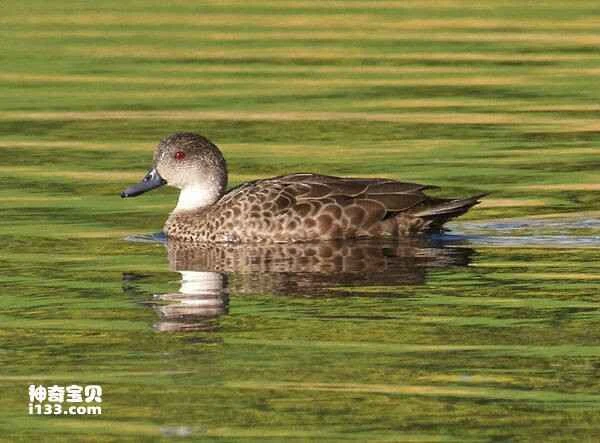
Grey ducks primarily inhabit the grassy areas of marshy regions near water. They mainly float on the water's surface, foraging underwater, primarily feeding on plants, but sometimes also consuming animal matter. Their toes are webbed, but they rarely dive; when swimming, their tails remain above water. They are adept at foraging, playing, and courtship in the water. They are clean animals, frequently preening their feathers both in the water and on land. Their diet consists mainly of algae, tender leaves and seeds of aquatic plants, grass seeds, and blades of grass. They also forage for rice and seedlings in farmland, and occasionally eat small invertebrates such as mollusks, crustaceans, and aquatic insects. Foraging times are mostly at dusk and dawn.
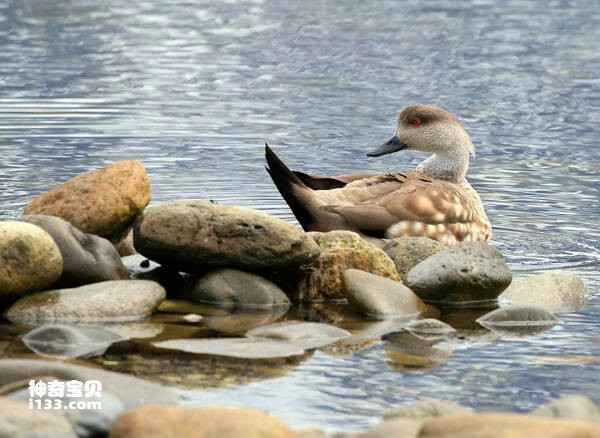
The breeding season for grey herons varies by region, typically from July to October, and from September to November in New Zealand. They nest on the ground in grassy areas along the banks of lakes, rivers, reservoirs, and ponds, or in reed beds or cattails. Their nesting environments are highly diverse. The nest is constructed from dry grass stems, cattails, and moss. It is a bowl-shaped nest built from plant stems, placed above the nearby water and concealed among aquatic plants. They lay about 7-8 eggs at a time, with an incubation period of 25-31 days. The chicks leave the nest at 55 days old and are usually incubated solely by the female. After hatching, the female continues to care for the chicks, who follow her in foraging. By the eighth week, the chicks' eyes turn red. They reach sexual maturity and are able to reproduce after one year. The eggs are a bright pale yellow.
Listed as Least Concern (LC) on the IUCN Red List of Threatened Species 2013 ver 3.1.
Protect wild animals and ban the consumption of wild game.
Maintaining ecological balance is everyone's responsibility!