Basic Information
Scientific classification
- Chinese name: Java Grey Duck
- Scientific name: Anas gibberifrons, Sunda Teal
- Classification: Waterfowl
- Family: Anseriformes, Anatidae, Anatidae
Vital signs data
- Body length: No verification information available.
- Weight: No verification information available.
- Lifespan: No verification data available.
Significant features
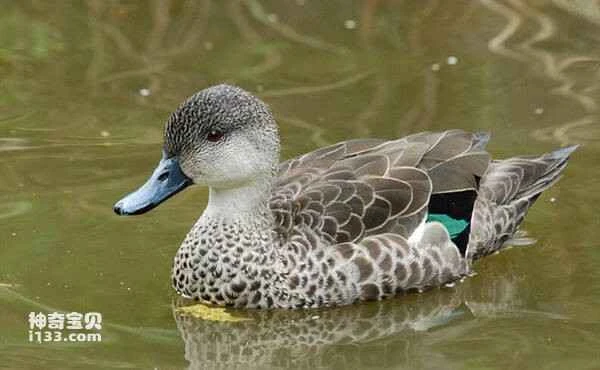
Iron-grey bill, brown duck with mottled feathers all over its body
Distribution and Habitat
Distributed in the Indochina Peninsula and southeastern coastal areas of China, including Myanmar, Vietnam, Laos, Cambodia, Thailand, and the southeastern coastal areas of China, Hong Kong, and Hainan Island. Pacific islands, including Taiwan, the Dongsha Islands, Xisha Islands, Zhongsha Islands, Nansha Islands, as well as the Philippines, Brunei, Malaysia, Singapore, Sumatra and Java in Indonesia, and Papua New Guinea. The Wallace Zone refers to the area east of the traditional Wallace Line (from the eastern waters of Mindanao through the Makassar Strait to the area between Bali and Lombok) and west of Papua New Guinea, including Sulawesi, Nusa Tenggara, the Southwest Islands, the Moluccas (Maluku Islands), and East Timor in Indonesia. Australia and New Zealand, including Australia, New Zealand, Tasmania, and their surrounding islands.
They typically inhabit freshwater lakeshores, but also live in groups in rivers, lakes, reservoirs, bays, and coastal salt flats.
Appearance
The Javanese Grey Duck is a mottled brown duck with a dark brown crest on its head, a white throat, and white and green shimmering on its wings. Sexes are similar. It has an arched forehead, bright red eyes, a grizzly bill, and black webbed feet.
Detailed introduction
The Javanese Grey Shelduck (scientific name: Anas gibberifrons), also known as Sunda Teal, has three subspecies.
Javanese Grey Ducks prefer to live in flocks during winter, mostly inhabiting the grassy areas of marshy regions near water. They mainly float on the water's surface, foraging underwater, primarily feeding on plants, but sometimes also consuming animal matter. Their toes are webbed, but they rarely dive; when swimming, their tails remain above water. They are adept at foraging, playing, and courtship in the water. They are clean animals, frequently preening their feathers both in the water and on land. Their diet consists mainly of roots, seeds, leaves, cardamom, and rice from marshy and lake areas, but they also eat invertebrates and arthropods.
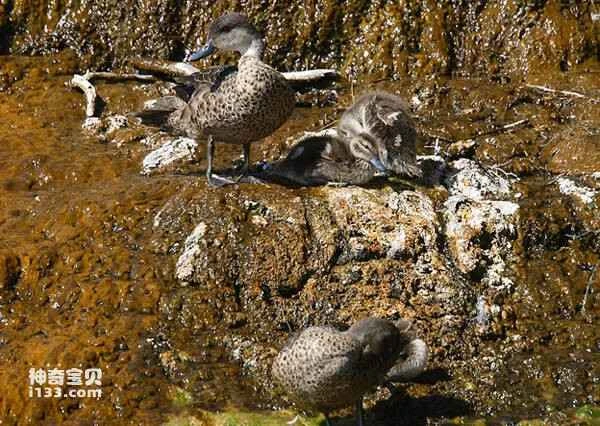
The Javanese Grey Shelduck breeds in winter, from July to October. They build a bowl-shaped nest using plant stems, placing it above nearby water and concealing it among reeds. Each nest contains approximately nine eggs. Incubation lasts 21 to 25 days. The chicks leave the nest at 49 days old and are usually incubated solely by the female. After hatching, the female continues to care for the chicks, who follow her in foraging. By the eighth week, the chicks' eyes turn red. They reach sexual maturity and are able to reproduce after one year.
Listed in the International Union for Conservation of Nature (IUCN) Red List of Birds, 2009 ver 3.1.
Protect wild animals and ban the consumption of wild game.
Maintaining ecological balance is everyone's responsibility!