Basic Information
Scientific classification
- Chinese name: White-headed Boat Duck
- Scientific name: Tachyeres leucocephalus, White-headed Steamerduck, Chubut Steamerduck, Chubut Steamer Duck, White-headed Steamer-duck
- Classification: Waterfowl
- Family and genus: Anseriformes, Anatidae, Shoalidae
Vital signs data
- Body length: 61-74 cm
- Weight: 2.95-3.8kg
- Lifespan: No verification data available.
Significant features
It is the only boat duck species endemic to Argentina.
Distribution and Habitat
The white-headed boat duck is the only boat duck species endemic to Argentina. It is distributed along the coastline in a relatively small number, mainly around Chubut Province, southern San Jorge and northern Santa Cruz.
Appearance
The White-headed Boat Duck measures 61-74 cm in length and weighs approximately 2.95-3.8 kg. It is a flightless duck. When floating on the water, its rounded wings glide and glide, resembling oars, hence the name "Boat Duck." The male has an orange bill with a black spot at the tip; a white head; a shiny copper-red patch on the breast; grayish-brown upper body and wings; and a white underbelly. The female has a dark gray bill mixed with black and yellow. The iris is brown, and the webbed legs are yellow. Juveniles have a sea-gray bill and black webbed legs.
Detailed introduction
The White-headed Steamerduck (scientific name: Tachyeres brachypterus), also known as the Chubut Steamerduck, Chubut Steamer Duck, or White-headed Steamer-duck, is a gregarious duck belonging to the Anatidae family.
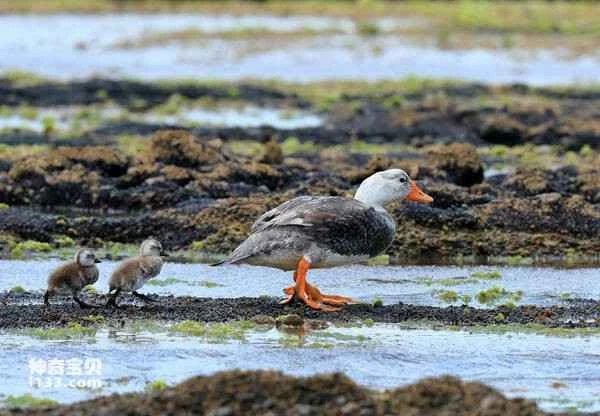
The white-headed boat duck inhabits steep cliffs, sandy beaches, saltwater lakes, and coastlines. Its diet consists mainly of crustaceans, mollusks, shrimp, and small fish. Small groups of a few to over 20 individuals are commonly seen foraging in shallow waters near the water's edge and on the surface. They typically forage in rock crevices, generally consuming larvae and pupae, aquatic animals, plant seeds, small fish, snails, and crabs.
White-headed boat ducks typically breed near the edges of lakes, rivers, ponds, and marshes, with the breeding season from September to October. Pairs tend to be relatively stable. Mating takes place in the water or on land. Nests are built in grassy or bushy areas near water, and sometimes in rock crevices or sandy slopes. The nest consists of a small amount of dry grass and a large amount of down feathers; the female lines the nest with plants and, after laying eggs, plucks a large amount of down feathers from her own body and places them inside. Each nest contains 5-10 eggs. Incubation begins once all eggs are laid, and is undertaken solely by the female, while the male guards the nest, calling loudly to warn of danger. The incubation period is 27-30 days. The ducklings are precocial, hatching with full down feathers and capable of swimming and diving. They reach sexual maturity at two years of age.
Listed as Near Threatened (NT) in the IUCN Red List of Threatened Species, 2009 ver 3.1.
Protect wild animals and ban the consumption of wild game.
Maintaining ecological balance is everyone's responsibility!