
Basic Information
Scientific classification
- Chinese name: Ginkgo toothed beaked whale
- Scientific name: Mesoplodon ginkgodens
- Order: Cetacea
- Family and genus: Mesobeaked whale family, genus Mesobeaked whale
Vital signs data
- Body length: Adults are typically about 4–5 meters long (this varies from record to record), with males generally slightly larger than females.
- Weight: Weight ranges from several hundred kilograms to about 1 ton, and is greatly affected by individual size and physical condition.
- Lifespan: It is estimated that they can live for decades (medium-beaked whales generally have long lifespans), but long-term individual tracking data for this species is lacking.
Significant features
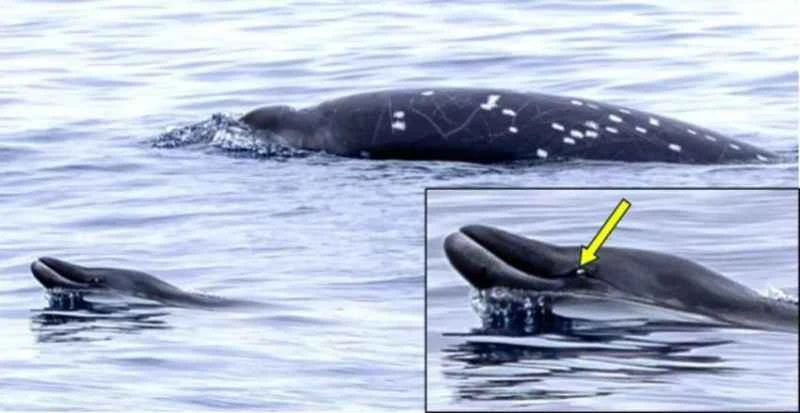
The beaked whale is an extremely rare species in the deep sea. Adult males have teeth on their lower jaw that are shaped like ginkgo leaves. They dive deep to hunt squid, and sightings in the wild are rare.
Distribution and Habitat
The warm temperate to tropical deep waters of the Indian Ocean and the western Pacific are often associated with deep-sea habitats such as seamounts, island chains, and the outer edge of continental slopes.
Appearance
It has a slender body and a relatively long snout. Its body color is dark gray to grayish-brown, with a lighter ventral side. Scratches and mottled marks are commonly seen on its body surface. Adult males have a pair of leaf-shaped protruding teeth on their lower jaw that are easily identifiable.
Detailed introduction
The Ginkgo-toothed Beaked Whale ( Mesoplodon ginkgodens ) is a highly mysterious deep-sea toothed whale belonging to the family Mesoplodontidae. They spend most of their time in deep waters far from the coast, are adept at long dives, and typically feed on deep-sea prey such as squid, making them rarely sighted at the surface. Much of our knowledge about this species comes from occasional stranding records, fishing encounters, and analogical deductions from other Mesoplodontidae whales.
The name "Ginkgo Teeth" comes from the morphology of the teeth of adult male beaked whales: most species in the genus Mesobaptorhynchus typically have a pair of exposed teeth in adult males, used for display and competition among individuals; the teeth of the Mesobaptorhynchus gnatus are uniquely shaped, often described as resembling ginkgo leaves or a fan, hence the name. The teeth of females and calves are often not exposed, making them even more difficult to distinguish from closely related species.
Classification and nomenclature
Mesoplodon, belonging to the class Mammalia, order Cetacea, suborder Odontoceti, family Ziphiidae, and genus Mesoplodon , is a group of whales with similar appearances. Classification and identification often rely on tooth position and shape, skull details, and genetic information, making this genus known as "one of the most difficult groups of whales to identify."
Appearance features
This species has a slender body and a streamlined head, with a relatively long but not overly sharp snout. Its body color is mostly dark gray to grayish-brown, with the ventral side usually being lighter. As it ages, abrasions, scratches, or patches of mottled marks often appear on its body surface, which is common in beaked whales and may result from interactions with its companions (including tooth marks left by male competition), prey capture, or friction with the environment.
The most distinctive feature is in adult males: they typically have a pair of teeth located further back in the lower jaw, which are fan-shaped or leaf-shaped and have been described as "ginkgo leaves." The teeth of females and juveniles are generally not clearly visible, making it difficult to accurately identify the species hierarchy with the naked eye in the wild.
Distribution range and habitat
Ginkgotooth beaked whales are mainly found in the warm temperate to tropical waters of the Indian and western Pacific Oceans, with records mostly from deep waters around island chains, near seamounts, and on the outer edge of continental slopes. They are typically highly associated with deep-sea environments, possibly preferring deeper open seas and relying on deep-sea squid and fish resources.
Due to the scarcity of observations, there is still a lack of sufficient data on whether there are relatively "permanent" small groups, seasonal migrations, or cluster structures in different sea areas.
Lifestyle Habits and Behaviors
Similar to other beaked whales, the Ginkgodon beaked whale is thought to live in small groups (usually around 2–7 individuals), moving discreetly with short periods at the surface and relatively long intervals between breaths. They are adept at deep diving, potentially descending to hundreds of meters or even deeper during a single feeding dive, using echolocation in the deep sea to locate prey.
These whales may be particularly sensitive to environmental disturbances, especially loud noise. Intermediate-beaked whales have been frequently cited in anomalous strandings linked to sonar or loud noise in various parts of the world; therefore, reducing noise pressure on critical deep-water habitats is considered a conservation priority.
feeding habits
They primarily feed on deep-sea squid and other cephalopods, but may also consume deep-sea fish and crustaceans. Mesoskeletal whales typically use echolocation to locate prey in the deep sea and then use strong suction to pull them in and finish their hunt.
Reproduction and life cycle
Reproductive information for this species is very limited, but it is generally assumed to be similar to that of most toothed whales: females have a gestation period of about one year or longer, usually giving birth to one calf per litter, with a long nursing and learning period, and a slow reproductive pace. Calves need to learn diving, foraging, and social behavior in the mother's care and in the group environment.
Their lifespan can reach several decades (intermediate beaked whales generally live quite long), but due to a lack of long-term individual tracking data, their specific lifespan and age of maturity remain uncertain.
Relationship with humans
The Ginkgotooth beaked whale primarily inhabits deep-sea areas and has limited direct contact with humans. Its main risks stem from indirect pressures: bycatch/entanglement by distant-water fisheries, ocean noise (military sonar, seismic exploration, and intensive shipping), accumulation of marine pollutants, and changes in prey composition due to climate change.
Protecting the status quo and threats
Due to limited sightings and monitoring data, assessments of the Ginkgo toothed beaked whale at the global level are often subject to high uncertainty (and may be classified as a data-deficient DD in some assessment systems). The most frequently discussed threats to this species include: deep-sea noise disturbance, fisheries interactions (bycatch and entanglement), plastic and chemical pollution, and the vulnerability of small or local populations to extreme events.
A more feasible approach to conservation is often “managing by habitat and risk source”: reducing high-noise activities in key deep-sea areas, improving fishery practices to reduce bycatch, strengthening scientific sampling and genetic identification of stranded individuals, and establishing long-term monitoring to gradually supplement population information.
Frequently Asked Questions
Q1: Why is the beaked whale called "Ginkgo Tooth"?
The adult male's lower jaw protruding teeth have a unique shape, often described as resembling ginkgo leaves or a fan, hence the name.
Q2: Why can't we see them almost anywhere?
They mostly live in deep waters of the open ocean, surface for short periods, move discreetly, and are adept at deep diving, so sightings in the wild are very rare.
Q3: What do they mainly eat?
They primarily feed on cephalopods such as deep-sea squid, but may also prey on deep-sea fish. They typically rely on echolocation to locate prey in the deep sea.
Q4: What are the main threats they face?
Frequently discussed risks include ocean noise (sonar/exploration/shipping), bycatch and entanglement in distant-water fisheries, plastic and chemical pollution, and management difficulties due to a lack of data.