Basic Information
Scientific classification
- Chinese name: Large-eared Bilberry
- Scientific name: Macrotis lagotis
- Classification: Mammals
- Family and genus: Phalaenopsis idae, Genus Phalaenopsis
Vital signs data
- Body length: Head and body length is usually about 29–55 cm, and tail length is about 20–29 cm; individual size varies with region and sex.
- Weight: Weight is mostly in the range of about 0.8–2.5 kg, and body condition will fluctuate with rainfall and food resources.
- Lifespan: In the wild, lifespan is usually several years, commonly around 5–7 years; it can be longer in areas with better conservation conditions.
Significant features
Australia's iconic burrowing marsupials, with large ears that help dissipate heat; their burrowing and digging behaviors improve the soil and provide shelter for other species, making them "engineer species" of desert ecosystems.
Distribution and Habitat
It now mainly survives in the desert/semi-arid areas of northern and western Australia, and reintroduction has been carried out in fenced protected areas and areas with strict predator control; it prefers sand dunes, swirling grass and shrubland and well-drained sandy loam.
Appearance
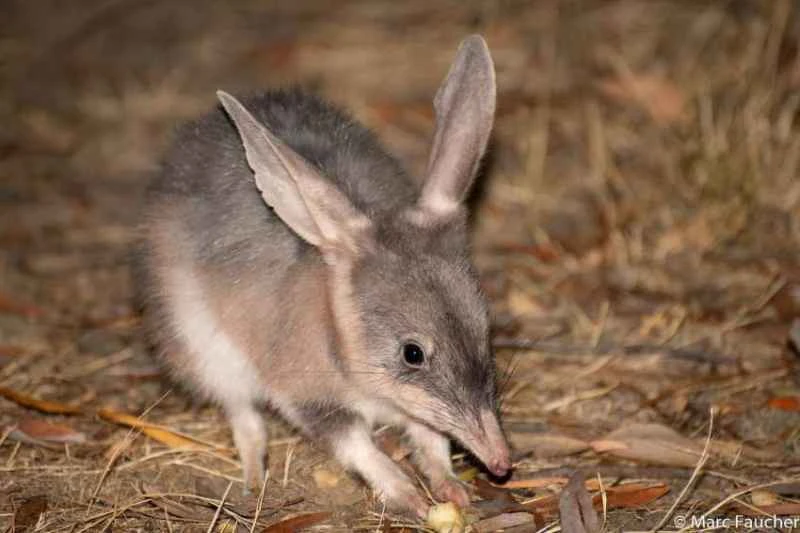
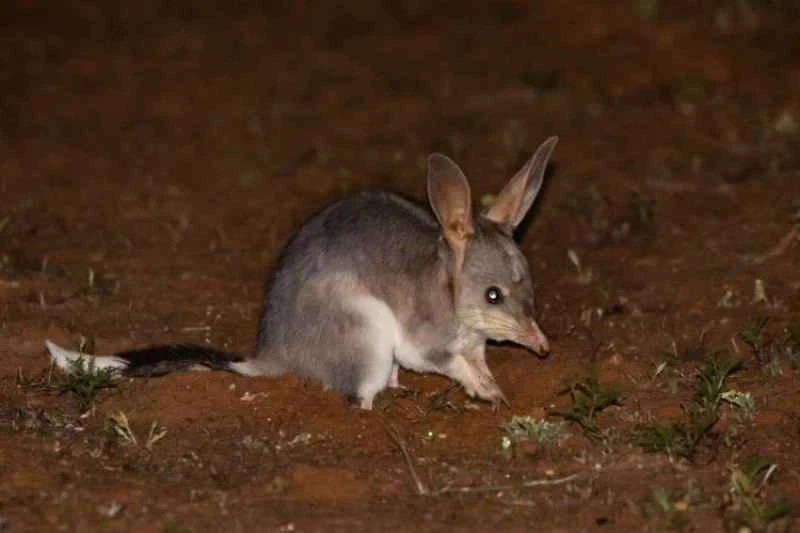
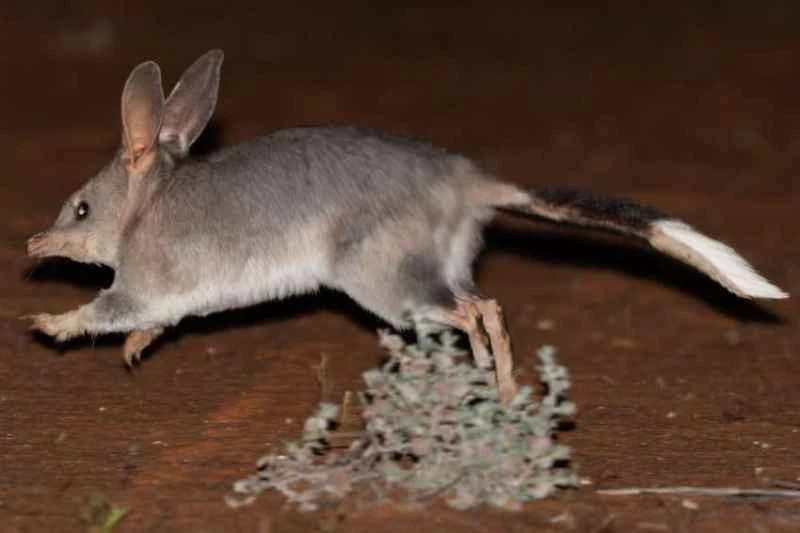
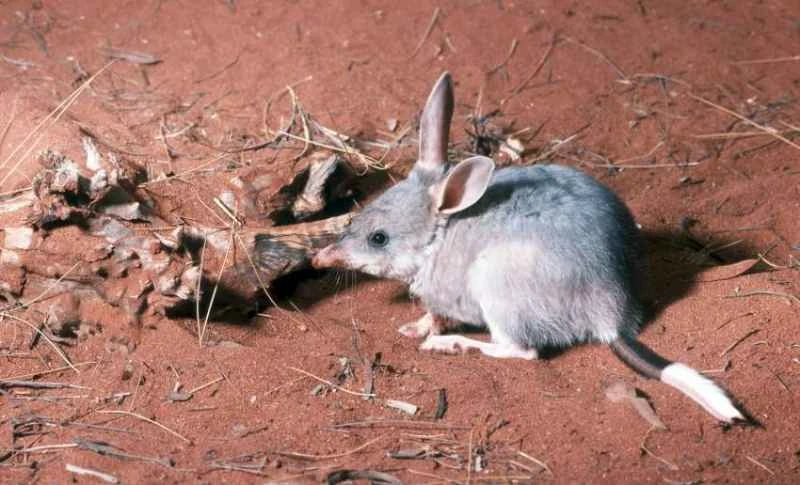
It has a slender body, a grayish-blue to grayish-brown back, and a milky-white belly; huge ears and a long, thin snout; strong forelimbs with sharp claws for digging holes; and a black and white tassel at the end of its tail.
Detailed introduction
The Greater Bilby ( Macrotis lagotis ) is one of Australia's most iconic native marsupials. Due to its large, long ears and resemblance to a long-eared rabbit, it is often called the "Rabbit-eared Bilby" in Chinese. It is a typical burrowing animal: using its strong forelimbs and sharp claws, it digs intricate burrow systems in the sand, hiding inside during the day to escape the heat and predators, and venturing out at night to forage. The burrows are not only its homes but also provide shelter for many small reptiles, invertebrates, and other mammals from extreme heat and predation. Therefore, the Greater Bilby is often considered a "key engineer species" in desert ecosystems.
Historically, the Great Bilberry was widely distributed in the Australian outback and semi-arid regions. However, in recent times, due to habitat degradation, invasive predators (foxes, wildcats), and changes in vegetation structure caused by invasive herbivores, its range has shrunk significantly. Today, it mainly survives in some areas of the north and west, with restoration and reintroduction projects underway in several protected areas and predator-free enclosures. Because it is sensitive to environmental changes and its reproductive capacity is affected by rainfall and food fluctuations, conservation efforts often require a combined strategy of habitat management, predator control, and monitoring.
Classification and nomenclature
The greater bilby belongs to the class Mammalia, order Diprotodontia, family Thylacomyidae, and genus Macrotis . "bilby" is the common name used in Australia; "greater" is used to distinguish it from smaller, more locally distributed closely related species (such as the dwarf bilby).
Appearance features
The greater bilby is medium to small in size, with a slender body. Its back is mostly grayish-blue or grayish-brown, while its belly is creamy-white. Its most striking feature is its two large ears, which enhance hearing and also help dissipate heat. It has a long, slender snout with a moist nose, ideal for sniffing out food at night; its large eyes provide excellent night vision.
Its forelimbs are muscular and have sharp claws, serving as "tools" for digging and foraging; its hind limbs are better suited for jumping. Its tail is relatively long, often with a black and white tassel at the tip, which helps with balance when running or turning.
Distribution range and habitat
The extant giant bilby is mainly distributed in parts of northern and western Australia, with wild populations still existing in some desert and semi-arid ecosystems. Meanwhile, several states are expanding its "safe distribution" by breeding and reintroducing it into fenced protected areas, islands, or areas under strict predator control.
It prefers well-drained, burrowing sandy or sandy loam environments, such as sand dunes, spinifex scrubland, savanna, and open scrubland. For it, the combination of "burrowing capability," "shade," and "sufficient food" is more crucial than a single vegetation type.
Lifestyle Habits and Behaviors
The greater bilby is primarily nocturnal, spending most of its day resting in burrows to escape the heat. Burrows often have multiple entrances and winding passageways, facilitating both ventilation and escape. Individuals are typically territorial, but their range may shrink when resources are plentiful; during droughts or when food is scarce, they may extend their nighttime foraging distances.
They respond significantly to fluctuations in rainfall and food availability: after rain, there are more invertebrates and new shoots, their physical condition improves, and they reproduce more actively; prolonged drought may reduce reproductive success and increase the risk of death.
feeding habits
The greater bilby is an omnivorous opportunist whose diet includes insect larvae (such as beetle larvae), ants, termites, spiders, and other invertebrates. It also consumes plant matter such as seeds, bulbs, roots, fungi, and tender shoots. It often obtains food underground by digging, and the small pits it leaves behind promote soil aeration, water retention, and seed germination.
Reproduction and life cycle
Reproduction is closely related to environmental conditions, and females may reproduce multiple times a year when resources are plentiful. Females typically give birth to 1–3 offspring per litter (1–2 are common). The offspring develop in the pouch before gradually leaving and learning to forage and avoid predators around the nest. Their lifespan in the wild is usually several years (commonly about 5–7 years), and may be longer in areas with better conservation conditions.
Relationship with humans
The Great Bilberry is one of Australia's "flagship species" for conservation, often used to represent the success of desert ecological restoration and invasive predator control. Their direct impact on agriculture and livestock is minimal, but their conflicts with humans stem more from land-use changes: overgrazing, land clearing, and road construction can damage burrowing environments or reduce shelter.
In many areas, Indigenous communities and ranger programs have been involved in monitoring and habitat management (including conventional burning management), providing crucial support for the recovery of bilbies and other native species.
Protecting the status quo and threats
The greater bilby is generally assessed as Vulnerable (VU) on a global scale. Major threats include: predation of juveniles and adults by invasive predators (foxes, wildcats); habitat degradation and changes in vegetation structure (impact from grazing, invasive herbivores such as hares); unsustainable fire patterns leading to reduced shelter; and prolonged droughts and food fluctuations caused by climate anomalies.
Common combinations of conservation measures include: predator control and enclosure refuge construction, habitat restoration and fire management, artificial breeding and reintroduction, and long-term monitoring and assessment. For this species, whose reproduction is strongly driven by the environment, sustained and systematic management is more critical than short-term "single-point rescues."
Frequently Asked Questions
Q1: What is the relationship between the Great Bilby and the Easter Bilby?
"Easter Bilby" is a cultural symbol used in Australia to replace the Easter Bunny. The main character is usually the bilby, and it is used to promote the protection of native species and reduce the impact of introduced rabbits.
Q2: Why do they need to dig holes?
Deserts and semi-arid regions experience large temperature differences between day and night, with hot days. Caves provide stable temperatures and safe shelter, helping them escape the heat, avoid predators, and raise their young.
Q3: What do bilbies mainly eat?
Insect larvae, termites, and other invertebrates are important food sources for them. They also eat seeds, roots, bulbs, fungi, and buds, making them omnivorous opportunists.
Q4: What is their biggest threat?
The most critical factor is invasive predators (foxes, wildcats). Other factors include habitat degradation, the impact of grazing and invasive herbivores, irrational fire patterns, and food fluctuations caused by prolonged drought.