
Basic Information
Scientific classification
- Chinese name: Thick-billed Toucan
- Scientific name: Thick-billed Toucan, Ramphastos sulfuratus
- Classification: Climbing birds
- Family and genus: Toucanidae, order Toucanidae, genus Toucan
Vital signs data
- Body length: Approximately 52 cm
- Weight: About 400g
- Lifespan: No verification data available.
Significant features
Distribution and Habitat
Thick-billed toucans are found in Belize, Colombia, Costa Rica, Guatemala, Honduras, Mexico, Nicaragua, Panama, and Venezuela.
Thick-billed toucans primarily inhabit lowland rainforests, sometimes appearing in open areas with sparse trees. They are rarely seen at altitudes above 1,700 meters.
Appearance
The Thick-billed Toucan is a medium-sized climbing bird, measuring 52 cm in length and weighing approximately 400 grams. Its appearance is somewhat similar to that of a hornbill. Its plumage is primarily dark blue-black, with a bright lemon-yellow breast, white rump, blue legs, and a bright red underside to its tail. A large, colorful bill is adorned with multicolored patches.
The nostrils of adult birds are hidden beneath the base of the beak. The beak is actually quite light, far less heavy than it appears. It is covered by a thin keratinous sheath, hollow inside with numerous fine bony struts arranged in an interlacing pattern. The thick-billed toucan has a long tongue, a distinctly serrated beak edge, a black stripe around the base of the beak, and no whiskers. The skin on the bare parts of the face and lower jaw is usually brightly colored. The eyes are black with a sky-blue ring around them.
Detailed introduction
The thick-billed toucan, scientifically known as *Ramphastos sulfuratus*, has two subspecies: (1. *Ramphastos sulfuratus brevicarinatus*; 2. *Ramphastos sulfuratus sulfuratus*.)

Thick-billed toucans typically live in small flocks of 6 to 12 individuals. When sleeping, they place their large beaks on their backs and hold their tails high, allowing them to occupy less space. These toucans forage in loose formations between trees. Their calls are hoarse and low-pitched, similar to the croaking of tree frogs. They are omnivorous, feeding on fruits, seeds, and insects, and sometimes raid the nests of smaller birds, eating the eggs and chicks. Eating these non-plant foods increases their protein intake. After swallowing fruit, toucans can regurgitate the seeds, spreading the parent plant over long distances, which is beneficial for plant propagation.
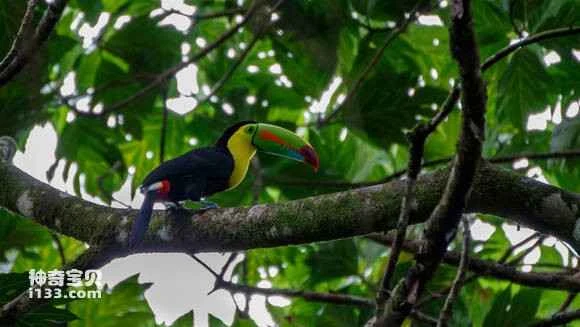
Thick-billed toucans are monogamous and highly territorial. They choose natural tree cavities with good wood for their nests, or old tree cavities dug by woodpeckers. The opening is just wide enough for the adult bird to squeeze in, and the cavities are 17 centimeters to 2 meters deep. If there are suitable burrows near the base of the tree trunk, they will also attract birds that usually nest high up to build their nests near the ground. They lay 2 to 4 eggs at a time, the smooth white eggs piled up in the unlined burrow. The incubation period is 16 to 20 days. The chicks hatch naked and take at least 3 weeks to open their eyes. Both parents feed them, and they remain in the nest for 8 to 9 weeks. After that, the chicks begin to live independently in foliage.
Listed as Least Concern (LC) on the IUCN Red List of Threatened Species 2012 ver 3.1.
It is listed in Appendix II of the 2019 edition of the Convention on International Trade in Endangered Species of Wild Fauna and Flora (CITES).
Protect wild animals and ban the consumption of wild game.
Maintaining ecological balance is everyone's responsibility!


