
Basic Information
Scientific classification
- Chinese name: Red-billed Toucan
- Scientific name: White-throated toucan (Ramphastos tucanus)
- Classification: Climbing birds
- Family and genus: Toucanidae, order Toucanidae, genus Toucan
Vital signs data
- Body length: 55-60 cm
- Weight: No verification information available.
- Lifespan: No verification data available.
Significant features
Distribution and Habitat
The red-billed toucan is found in South America (including Colombia, Venezuela, Guyana, Suriname, Ecuador, Peru, Bolivia, Paraguay, Brazil, Chile, Argentina, Uruguay, and the Falkland Islands).
The Red-billed Toucan primarily inhabits lowland rainforests, and sometimes appears in open areas with sparse trees. They are rarely seen at altitudes above 1,700 meters.
Appearance
The Red-billed Toucan is a medium-sized climbing bird, somewhat resembling a hornbill, measuring 55-60 cm in length. The male's beak is larger than the female's. The lower abdomen and tail are black, the throat and chest are white, and the vent and chest are red. The tail hood is yellow. The eyelids are blue, and the base of the beak has a yellow and blue ring, with a yellow stripe running across the center of the upper beak from the tip to the base. The nostrils of adults are hidden beneath the beak base. The beak is actually quite light, far less heavy than it appears. It has a thin keratinous sheath on the outside and is hollow inside, with numerous fine bony struts arranged in an interlaced pattern. The Red-billed Toucan has a long tongue, a distinctly serrated beak edge, and no barbels around the beak base. The skin on the face and exposed parts of the lower jaw are usually brightly colored.
Growth and Reproduction
Detailed introduction
The white-throated toucan (Ramphastos tucanus) has two subspecies: the nominate subspecies *R. t. tucanus* in the south and west, and the South American toucan (*R. t. cuvieri*) in the east and north. These two subspecies were initially considered distinct species, but because they differ only in beak color and cross-breed when close, they are classified as subspecies. The validity of the Bolivian subspecies *R. t. inca* has been questioned, and it may simply be a hybrid of the two subspecies.
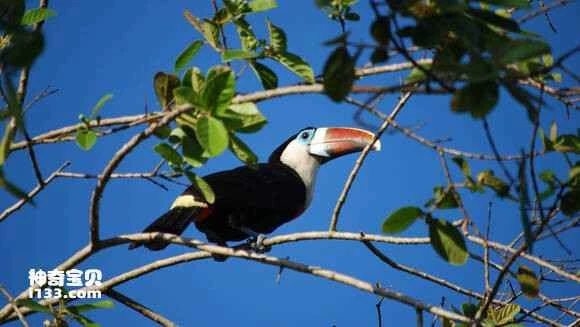
The red-billed toucan has a hoarse, low-pitched call. It is omnivorous, feeding on fruits, seeds, and insects, and sometimes raids nests of smaller birds, eating the eggs and chicks.
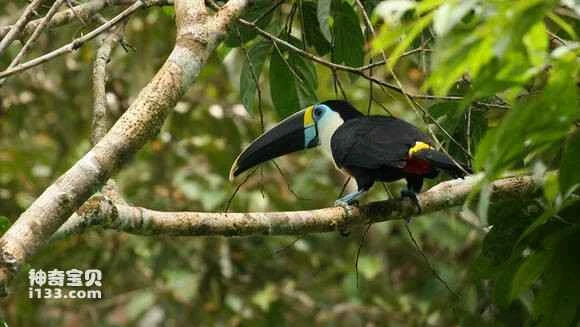
Listed as Vulnerable (VU) in the IUCN Red List of Threatened Species 2016 ver 3.1.
It is listed in Appendix II of the 2019 edition of the Convention on International Trade in Endangered Species of Wild Fauna and Flora (CITES).
Protect wild animals and ban the consumption of wild game.
Maintaining ecological balance is everyone's responsibility!


