Basic Information
Scientific classification
- Chinese name: Black-billed Toucan
- Scientific name: Ramphastos ambiguus, Black-mandibled Toucan, Yellow-throated toucan
- Classification: Climbing birds
- Family and genus: Toucanidae, order Toucanidae, genus Toucan
Vital signs data
- Body length: Approximately 60 centimeters
- Weight: No verification information available.
- Lifespan: No verification data available.
Significant features
Distribution and Habitat
The black-billed toucan is found in South America, including Colombia, Venezuela, Guyana, Suriname, Ecuador, Peru, Bolivia, Paraguay, Brazil, Chile, Argentina, Uruguay, and the Falkland Islands (also known as the Malvinas Islands).
The Black-billed Toucan primarily inhabits lowland rainforests, and sometimes appears in open areas with sparse trees. They are rarely seen at altitudes above 1,700 meters.
Appearance
The Black-billed Toucan is a medium-sized climbing bird, somewhat resembling a hornbill, reaching up to 60 cm in length. Its plumage is primarily black or chestnut-black, with lemon-yellow markings on the face, throat, and chest. The underside of its tail is bright red, and the bill is predominantly black with some yellow. In adults, the nostrils are hidden beneath the base of the beak. The beak is actually quite light, far less heavy than it appears. It is covered by a thin keratinous sheath, hollow inside, with numerous fine bony struts arranged in an interlacing pattern. The Black-billed Toucan has a long tongue, a distinctly serrated beak edge, and no bristles around the base of the beak. The skin on the bare parts of the face and lower jaw is usually brightly colored. The eyes are light-colored, with dark shadows in front of and behind the pupils, making them appear as narrow horizontal slits.
Detailed introduction
The Black-billed Toucan, scientifically known as Ramphastos ambiguus, is also called the Black-mandibled Toucan or Yellow-throated Toucan. Its specific habits are unknown.
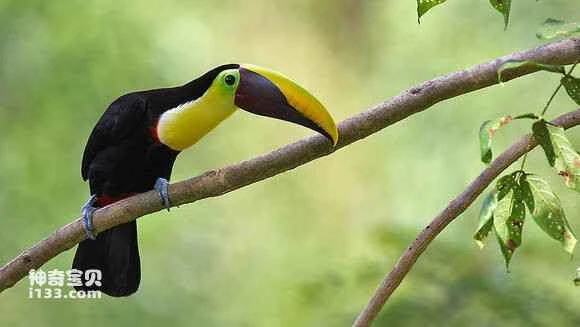
The black-billed toucan has a hoarse, low-pitched call. Omnivorous, it feeds on fruits, seeds, and insects, and sometimes raids nests, eating eggs and chicks. Its call ("Diohhi, ti-da, ti-da") sounds quite melodious from a distance.
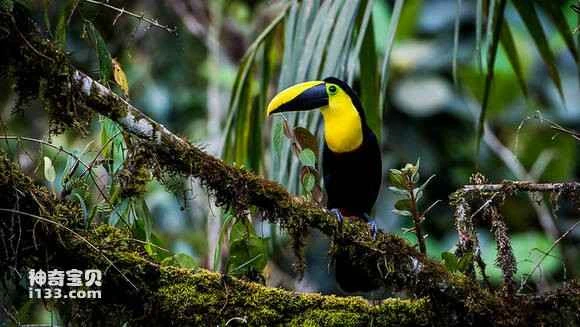
The Black-billed Toucan nests in tree cavities, preferring those made of good quality wood with an opening just wide enough for an adult to squeeze in, and a depth of 17 cm to 2 meters. If a suitable cavity is found near the base of a tree trunk, it will also attract birds that typically nest high up to build their nests closer to the ground. They lay 2 to 4 eggs at a time. The smooth, white eggs are laid in the unlined cavity and incubate for about 16 days. The hatchlings are completely naked and take at least 3 weeks to open their eyes. After hatching, the chicks need more than 50 days to establish themselves independently in foliage.
Protect wild animals and ban the consumption of wild game.
Maintaining ecological balance is everyone's responsibility!