
Basic Information
Scientific classification
- Chinese name: Guyana toucan
- Scientific name: Guiana Toucanet (Selenidera culik)
- Classification: Climbing birds
- Family and genus: Toucanidae, order Toucanidae, genus Toucan
Vital signs data
- Body length: 30-35 cm
- Weight: No verification information available.
- Lifespan: No verification data available.
Significant features
Distribution and Habitat
The Guyana toucan is distributed across South America (including Colombia, Venezuela, Guyana, Suriname, Ecuador, Peru, Bolivia, Paraguay, Brazil, Chile, Argentina, Uruguay, and the Falkland Islands).
The Guyana toucan is typically found at altitudes of 400–1,000 meters, primarily inhabiting lowland rainforests, and sometimes appearing in open areas with sparse trees nearby.
Appearance
The Guyana toucan is a climbing bird, measuring 30-35 cm in length. It is predominantly black, with a large bright chestnut-brown patch on its neck, and its belly is slightly lighter in color than its back. It has bare bluish-green skin around its eyes, red undertail coverts, and yellow ear coverts. The male has a full black crest. The female's plumage is paler than the male's, with the black areas appearing brown. Sexual differences are pronounced; chicks can be sexed by their plumage when they are about four weeks old.
The Guyana toucan has a relatively large beak compared to its body, but the beak is actually quite light, far less heavy than it appears. It is covered by a thin keratinous sheath and is hollow inside, with numerous fine bony struts arranged in an interlacing pattern. The tongue is long, the beak edge is distinctly serrated, and there are no bristles around the base of the beak. The skin on the bare parts of the face and lower jaw is usually brightly colored.
Detailed introduction
The Guyanese toucan, scientifically known as *Selenidera culik*, is a climbing bird.
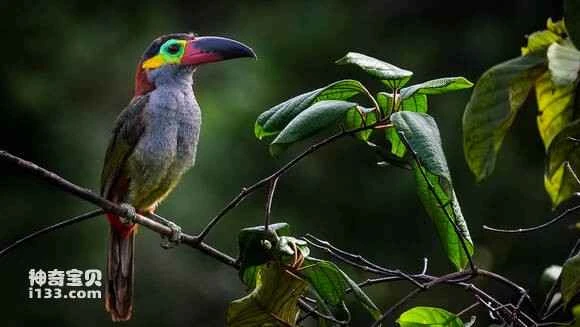
The Guyana toucan's call sounds like a frog's croak. Omnivorous, the Guyana toucan feeds on fruits, seeds, and insects, and is sometimes considered a pest in orchards.
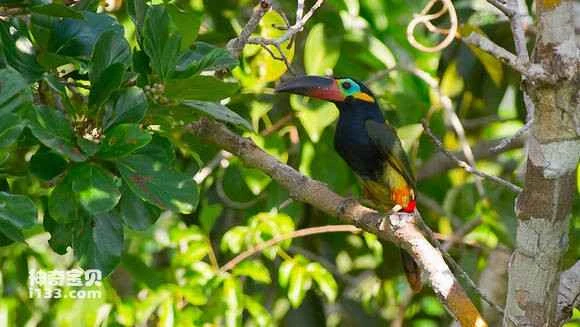
Guyana toucans typically choose trees with good wood to dig burrows, with the opening just wide enough for the adult bird to squeeze in, and the burrow depth ranging from 17 cm to 2 meters. If a suitable burrow is found near the base of the tree trunk, they usually choose that burrow first and then dig further. Burrowing is an important part of their breeding behavior. The nest has no lining; a clutch of 1-5 eggs is laid on sawdust or a rough layer of regurgitated seeds, which accumulates as nest building progresses. Incubation takes about 16 days; the chicks hatch naked and take at least 3 weeks to open their eyes. They leave the nest and fly away after 45 days, after which the young birds begin their independent lives, nesting in foliage.
Protect wild animals and ban the consumption of wild game.
Maintaining ecological balance is everyone's responsibility!


