Basic Information
Scientific classification
- Chinese name: Black-ringed sea slug (Black-ringed sea hare)
- Scientific name: Jorunna funebris
- Classification: Molluscs
- Family: Discodorididae Jorunna
Vital signs data
- Body length: Commonly 4–7 cm; Large individuals ~10 cm
- Weight: No standardized data available (for small nudibranchs)
- Lifespan: Several months – approximately 1–2 years
Significant features
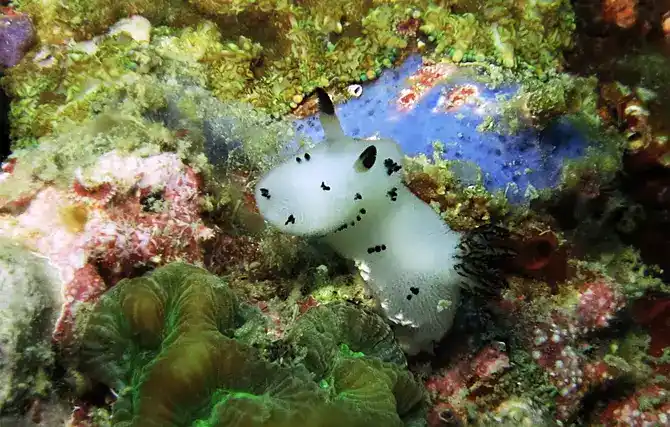
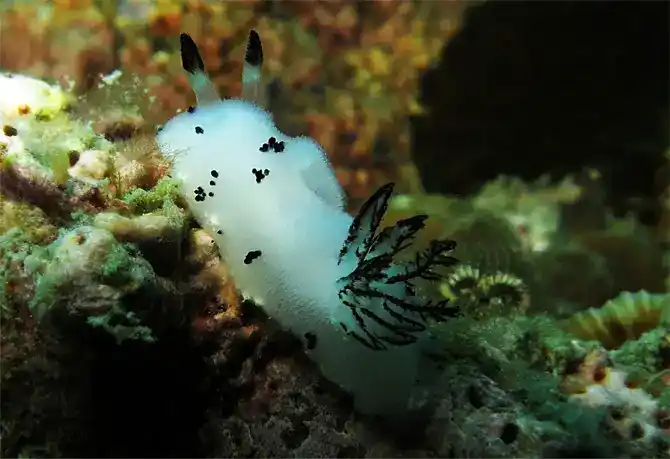
White with black rings; dark antennae and gills; densely covered with caryophyllidia on the back; feeds on sponges; hermaphroditic and lays ribbon-like egg bands.
Distribution and Habitat
Tropical Indo-Pacific coral reefs, reef slopes and lagoons, 1–25+ m, in areas rich in sponges.
Appearance
The body is oval and flattened, with a rough back; the black ring-shaped spots are obvious; the antennae and feathery gills are usually black.
Detailed introduction
The black-ringed sea slug ( Jorunna funebris ) is a well-known nudibranch belonging to the family Discodorididae within the order Doridina. Its body is covered with dense, bristle-like papillae (caryophyllidia) , and its white base color is marked with black ring-shaped spots . Its tentacles (horns) and gills are often dark, making it easily identifiable. It primarily feeds on sponges and is widely distributed in tropical Indo-Pacific coral reefs.
Ecology and Biology
Diet: Feeds on various sponges (often seen in literature in genera such as Haliclona ), and some individuals may have food-derived chemical defenses.
Behavior: It usually moves slowly on the reef surface to feed; when disturbed, it can secrete mucus and move away slowly.
Reproduction: Hermaphroditic , usually mating at the side of the body; lays ribbon-like eggs attached to the base.
Morphology and Recognition
The body is oval and slightly flattened, with a rough back covered with numerous caryophyllidia ; it has several to more than ten black rings/spots on a white background, and the antennae (rhinophores) and feathery gills are mostly black or dark brown. There are regional variations in the number and size of the rings and spots between individuals.
Body size and lifespan
Body length: Commonly 4–7 cm, larger individuals can reach ~10 cm.
Lifespan: mostly several months to 1–2 years (depending on environment and food).
Distribution and Habitat
Widely distributed in the tropical Indo-Pacific : from the Indian Ocean and Southeast Asia to islands and reefs in the western Pacific; often found on coral reefs, reef slopes and lagoons with sponge- rich substrates, at depths of 1–25+ m.
Ecological significance and threats
Ecological role: regulating sponge community composition; a highly recognizable species for underwater photography and citizen science monitoring.
Potential threats: habitat degradation, abnormal sea surface temperatures, and data collection disturbance.
IUCN: Global ratings are mostly unassessed (NE) ; this site treats them as NE.
Frequently Asked Questions
Q1: Are the black "rings" fixed? The number and size of the rings vary between individuals and regions; however, the overall characteristics of "white background + black rings + black antennae and gills" are stable.
Q2: Is it poisonous? It does not attack people unless provoked; it may acquire unpleasant/irritating chemicals as a defense mechanism by ingesting sponges, so please do not touch it.
Q3: How to distinguish it from similar species? Most species in the genus Jorunna are white with black spots, but this species is more typically characterized by clear black rings , a rough back, and a combination of dark antennae/gills.
Q4: Can they be seen during the day? Yes, but they mostly feed slowly in the shade or at the edge of sponges; they are more common at night.


