Basic Information
Scientific classification
- Chinese name: Scyphozoa (True Jellyfish - General Overview)
- Scientific name: Scyphozoa
- Classification: Echinoderms
- Family and Genus: Cnidaria Scyphozoa
Vital signs data
- Body length: Umbrella diameter ranges from a few centimeters to 1 m+ (varying greatly depending on the species).
- Weight: High water content colloidal body, with large variations in mass.
- Lifespan: Several months to several years; hydra can exist for many years.
Significant features
It mainly exists in the jellyfish stage; it preys on algae with nematocysts; it can live in symbiosis with algae; and it can cause seasonal outbreaks.
Distribution and Habitat
Global oceans: estuaries, coastal areas, open seas, and parts of the deep water mass.
Appearance
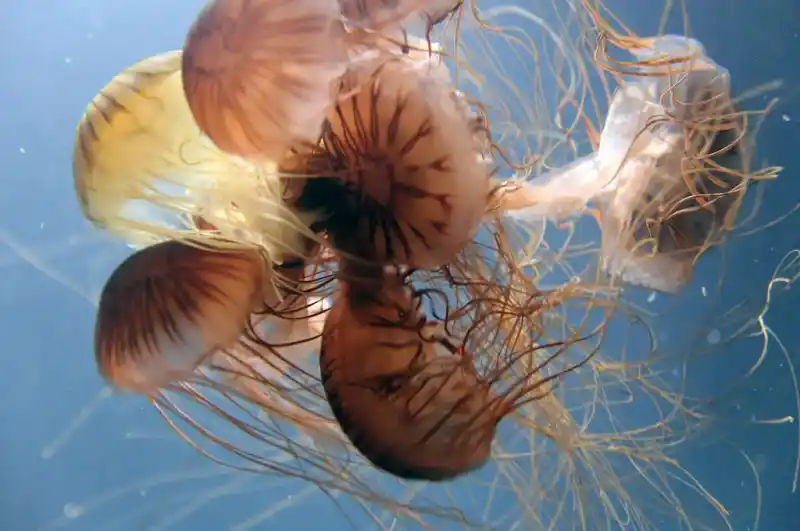
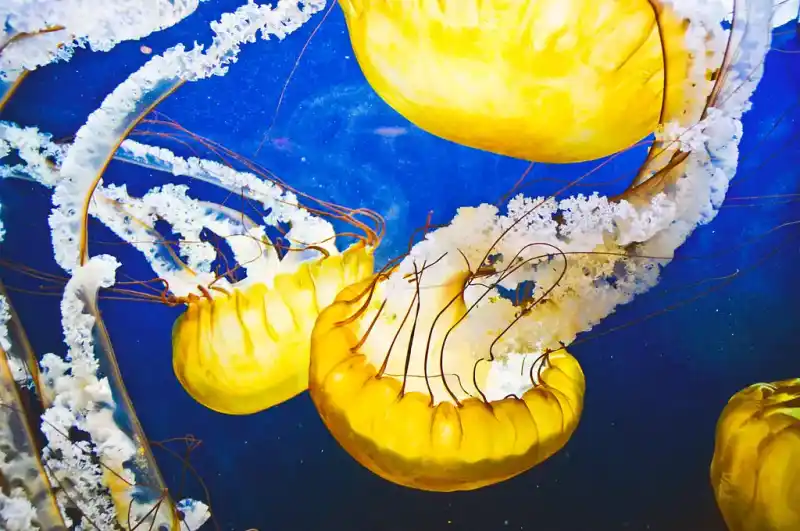
It has an umbrella-shaped, gelatinous structure with four radii; well-developed oral arms; and tentacles and sensory organs on the umbrella edge.
Detailed introduction
Scyphozoa, commonly known as " true jellyfish ," belong to the phylum Cnidaria. Their life cycle is mainly in the medusa stage (umbrella-shaped, planktonic adults) , often consisting of benthic polyps (small hydras, Scyphistomas) and strobilation to produce ephyra larvae , which eventually develop into adult jellyfish. Many species play important roles as planktonic predators and energy conduits in marine food webs.
Ecology and Biology
Feeding: Primarily feeds on zooplankton (copepods, arrow worms, fish eggs and larvae), but may also ingest micro-fish and aggregated organic particles (sea snow). Its tentacles and oral arms are covered with nematocysts to paralyze prey.
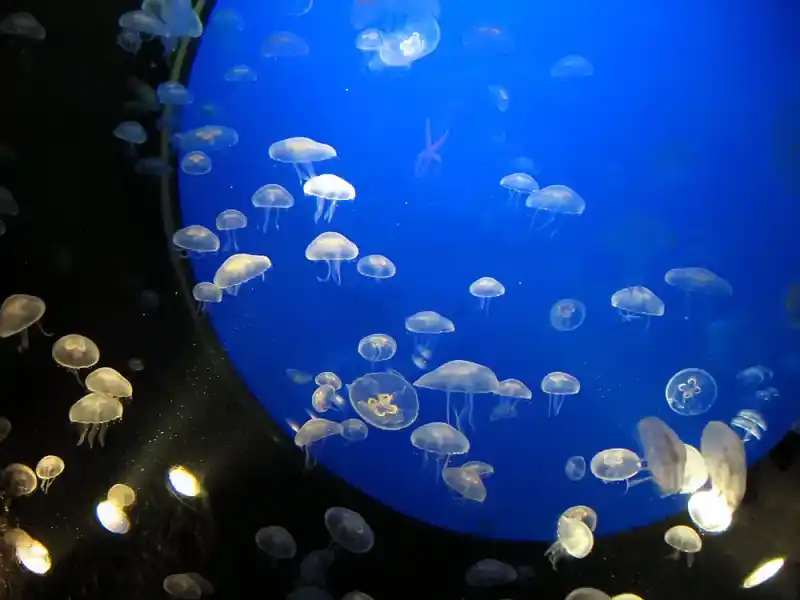
Movement and behavior: They move by pulsating through their umbrellas , and are also influenced by ocean currents; some species have seasonal outbreaks (jellyfish tides) .
Symbiosis: Some warm-water species live in symbiosis with zooxanthellae and obtain photosynthetic products (such as the golden jellyfish).
Reproduction: mostly dioecious; fertilized eggs develop into planktonic larvae, which land on the seabed to form polyps , and release the larvae ephyra through transverse fission .
Morphology and Recognition
Typical characteristics include an umbrella-shaped gelatinous body and a tetraradial symmetry tendency ; oral arms are present on the mouth margin , and tentacles and receptors (stabilizing sacs, photosensitive points) are often present on the umbrella margin. Body color varies from transparent to milky white, pink, yellow, brown, etc.; the body surface is thick with gelatinous material and has an extremely high water content.
Body size and lifespan
Body length/umbrella diameter: from a few centimeters to 1 m+ (e.g., the umbrella diameter of the lion's mane jellyfish can be enormous; there is a great deal of variation among different species).
Lifespan: In the wild, it is mostly several months to several years ; the hydra can survive for many years and bud periodically.
Distribution and Habitat
They are found in a wide range of oceans around the world, from nearshore estuaries and shallow coastal seas to open seas and deep, cold water masses; some species prefer eutrophic water masses or weakly tidal environments.
Ecological impact and human-sea interaction
Ecological roles: regulating zooplankton communities; serving as food for fish and turtles; and participating in carbon transport after death as "jellyfish snow".
Impacts on humans: Nematocysts can cause stings ; jellyfish tides may clog water intakes and affect fisheries and tourism.
IUCN: This is a class-level overview; conservation status needs to be assessed at the species level . This site's overview is treated as unassessed (NE) .
Frequently Asked Questions
Q1: What should I do if I get stung by a jellyfish? First, rinse with seawater, do not rub with fresh water ; remove any remaining tentacles; for some species, vinegar can be used to inhibit the release of nematocysts; seek medical attention if necessary (this is a science tip, not medical advice).
Q2: Can all jellyfish sting? The strength of the sting varies greatly; most only cause mild irritation, but you should avoid touching unknown species.
Q3: Why do jellyfish "burst into large groups"? It is related to changes in temperature, nutrients, ocean currents, predators, and human activities (such as fishing and nearshore engineering).
Q4: What is the relationship between hydra and hydra bodies? The life cycle of scyphozoa often includes a benthic hydra stage, during which the larvae ephyra are released through transverse splitting .