Basic Information
Scientific classification
- Chinese name: Tropical shelduck
- Scientific name: Puffinus bailloni, Tropical Shearwater
- Classification: Waterfowl
- Family and genus: Procellariiformes, Procellariiidae, Procellarii
Vital signs data
- Body length: Approximately 33 centimeters
- Weight: No verification information available.
- Lifespan: No verification data available.
Significant features
It flies very nimbly, often hovering over the water and dodging waves, flapping its wings rapidly and gliding for short periods.
Distribution and Habitat
Resident birds: American Samoa, British Indian Ocean Territory, Fiji, French Polynesia, Japan, Kiribati, Maldives, Micronesia, Nauru, Northern Mariana Islands, Conference, Samoa, Seychelles, Solomon Islands, Tonga and Vanuatu.
Breeding grounds: Palau.
Non-breeding grounds: Guam, India, Kenya, Mayotte, New Caledonia, Papua New Guinea, Somalia, and Tanzania.
Wandering: Australia, Israel, South Africa, and Sri Lanka.
Seasonal uncertainty: Cook Islands, French Southern Territories, Indonesia, Madagascar, Marshall Islands, Mauritius, Mozambique, Niue, Philippines, Pitcairn, Tokelau, Tuvalu, Outer Islands of the United States, Wallis and Futuna.
Appearance
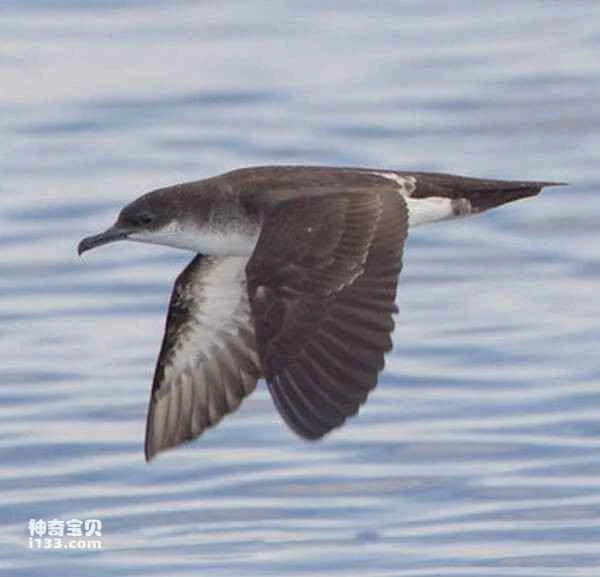
The tropical shearling is 33 cm in length and has a wingspan of 64-74 cm. It is a small seabird. The upperparts are uniformly dark brown, the underparts are white, with a darker coloration on the breast and sides of the neck. White extends from the ventral area to both sides, from the appendage-like throat to behind the eye area. The undertail coverts are brown, and the white on the underside of the wings is limited by a broad dark band. The tail is rounded, and the beak is thin, as the tubular portion is not clearly discernible. The beak is dark black to black, and the iris is black. The dark legs are webbed, and the sexes are similar.
Detailed introduction
The tropical shearwater (scientific name: Puffinus bailloni) has 5 subspecies.
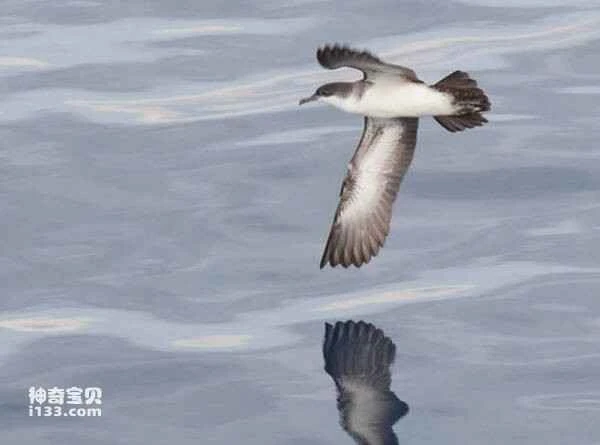
Tropical shearlings are usually resident birds, as they can often be observed 80-300 kilometers from their breeding grounds. Immature tropical shearlings may be more dispersed. Tropical shearlings are pelagic seabirds, so under normal circumstances, they can only be seen from the shore at dusk. In flight, tropical shearlings display wings perpendicular to their body axis; they are very agile, circling and dodging waves over the water, with rapid wing flapping and short glides.
Tropical petrels are silent at sea, but call out as they approach their habitat. Their calls consist of two syllables: a plaintive cry called "aoû" and a falling hissing sound called "kitrrêou," which the Anglo-Saxons interpret as "ke-whirrr-irrr."
Tropical shearlings feed on small fish, flying fish, cephalopods, small crustaceans, and squid. They hunt by circling above or below the water's surface, with most prey being caught at the surface. They also occasionally dive to chase fish, sometimes for several seconds, typically reaching depths of 15 meters, but sometimes up to 35 meters.
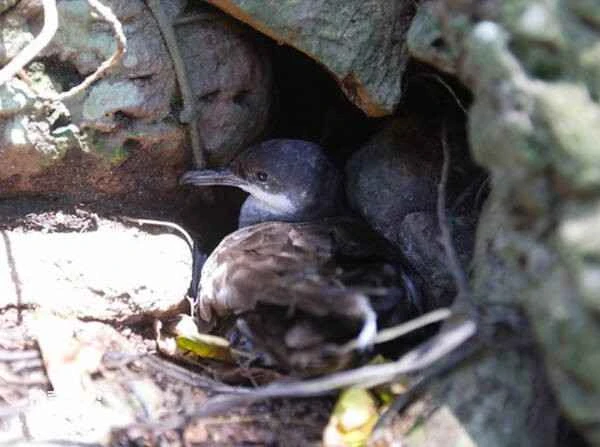
Tropical shelducks breed in the tropical Indo-Pacific region, with the breeding season varying depending on their distribution: they can breed year-round near the equator, but in summer they breed at higher altitudes. They breed on islands, islets, or coral reefs, nesting almost anywhere on cliffs and hillsides. These birds choose caves, rock crevices, or cavities in the ground to lay their eggs, usually in self-dug burrows 60-200 cm deep. They do not use vegetation inside the nest.
Females lay one white egg per clutch. Both parents incubate the egg for 50 days. At incubation, the fluffy chicks have gray upper bodies and white under bodies. They are fed by both parents. They leave the nest on average about 75 days after hatching (62-100 days), at which time they weigh about 250 grams. They reach sexual maturity at 8 years of age.
Several days after the adults leave, the chicks fly to the sea. They must face the world alone, without any flying experience. When their habitat is far from the sea, the chicks are often preyed upon by predators such as gulls, skuas, corvids, and birds of prey, and sometimes by introduced mammals (rats and cats). However, the species has a breeding success rate of up to 68%.
The total number of tropical petrel species has not yet been quantified. The central Pacific subspecies is estimated to have 1,000–10,000 pairs in the Line Islands and 10,000–100,000 pairs in the Phoenix Islands, while the nominate subspecies is estimated to have 3,000–5,000 pairs in Réunion and fewer than 100 pairs in Europa (reviewed by Brooke 2004). Nevertheless, it is believed that there are more breeding grounds on other islands in the Pacific.
In the Seychelles, where more than a third of the tropical petrel population resides, large numbers of birds become entangled in the seeds of the native wind-resistant tung tree. In severe cases, the petrels are prevented from flying and subsequently starve or become prey. The overall impact on the population and its reproductive success remains unclear (Safford and Hawkins 2013). The population on Reunion Island, representing approximately 5% of the global total, suffers from light pollution, resulting in about 300 chicks being unable to fly each year. This could limit the growth of the local population (Le Corre et al. 2002).
Listed as Least Concern (LC) in the IUCN Red List of Threatened Species 2018 ver3.1.
Protect wild animals and ban the consumption of wild game.
Maintaining ecological balance is everyone's responsibility!