Basic Information
Scientific classification
- Chinese name: Crested Hummingbird
- Scientific name: Lophornis ornatus, tufted coquette
- Classification: Climbing birds
- Family and genus: Apodiformes, Hummingbird family, Crested hummingbird
Vital signs data
- Body length: 6.6-8 cm (including tail length)
- Weight: Approximately 2.3g
- Lifespan: No verification data available.
Significant features
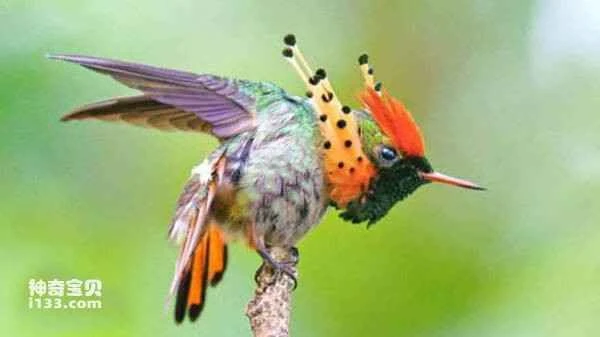
The crest and the prominent orange or red plumes on the cheeks are the main characteristics of this bird; the plumes have a metallic sheen when illuminated by sunlight.
Distribution and Habitat
Country of origin: Brazil, French Guiana, Guyana, Suriname, Trinidad and Tobago, Venezuela.
Their breeding grounds are distributed in eastern Venezuela, Trinidad, Guyana, and northern Brazil.
It inhabits the edges of damp forests, shrublands, tropical savannas, and cultivated areas such as gardens and plantations. It is commonly found in open fields.
Appearance
The male has a short, straight, red beak with a black tip. Several tufts of dark brown or orange feathers radiate outwards from the sides of the neck, speckled with black. The crest is dark brown or orange. The back is bronze-green, with white bands on the rump and flanks. The forehead and underwings are green. The tail feathers are reddish-brown with a metallic sheen.
The female lacks the dark brown or orange ornamental feathers on the sides of her neck, as well as the crest; this area is entirely green. The undersides of her feathers are reddish-brown. The belly is paler in color. The tail is bronze-green with dull markings, and the tip is white.
Male juveniles resemble females, but have a white throat with dark spots. Their rump is white; their forehead is slightly reddish. Nearly mature juveniles have fine plumes on their necks.
Adult birds have an average body length of 6.6-8cm (including tail length) and weigh approximately 2.3g.
Detailed introduction
The tufted coquette (scientific name: Lophornis ornatus) has no subspecies.
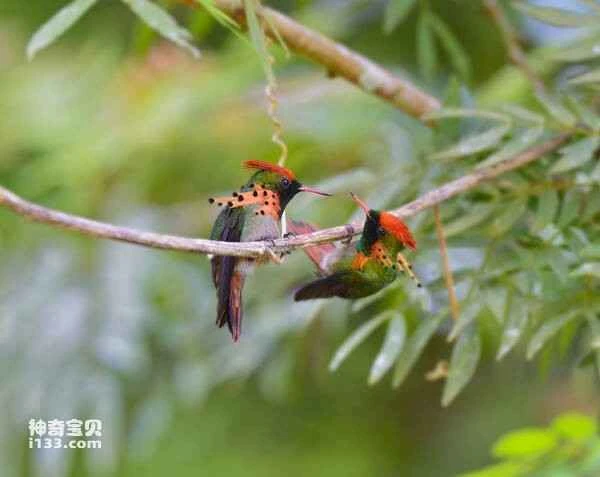
The crested hummingbird primarily feeds on the nectar of brightly colored, fragrant flowers found on trees, herbs, shrubs, and epiphytes. It favors nectar with high sugar content and can selectively guard high-energy flowers in a particular area. Hovering with its tail held high, it extends its long, straw-like tongue to collect nectar, licking up to 13 times per second. Occasionally, it will perch on a flower while feeding.
The crested hummingbird will visit local hummingbird feeders that provide sugar water, hovering or perching on the edge of water troughs or sprinklers to sip the sugar water. The crested hummingbird also preys on small spiders and insects to ensure a sufficient protein supply, especially during the breeding season, as this protein is essential for the normal growth of the chicks. It typically attacks flying insects, but those perched on branches or trapped in spider webs are not spared either. During the nesting season, females can catch up to 2,000 insects per day.
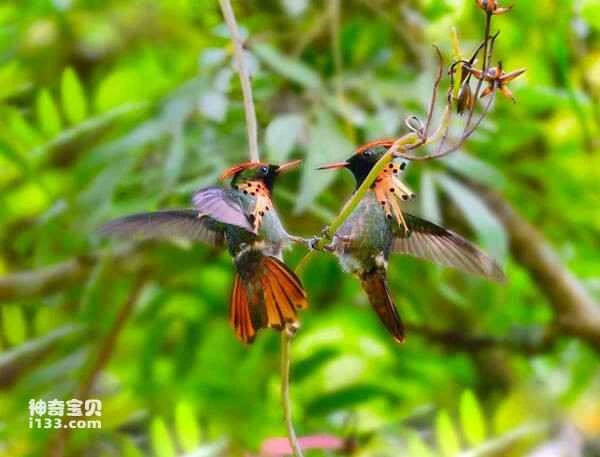
The male bird marks out its hunting territory, driving away other males and large insects (such as bumblebees and hawk moths) that intrude. They protect their territory through aerial flight and intimidation tactics. This bird makes localized and seasonal migrations within its native range.
The crested hummingbird is a solitary bird species that pairs during the breeding season. The male courts the female by flying in a "U" shape. After mating, the male immediately flies away. The male does not participate in selecting a nesting site or raising the offspring. The female builds the nest alone; it is cup-shaped and woven from plant fibers, camouflaged with moss. The entire nest is placed in a secluded thicket or small tree (about 2 meters above the ground in a branch fork). The nesting material is usually soft plant fibers, animal hair, and down, reinforced with spider silk and other adhesives to give the nest twice the elasticity, allowing ample space for the chicks to grow.
On average, each clutch contains 1-3 eggs (usually 2), which are white. The female incubates the eggs alone for 13-14 days. The male guards the nest area. Newly hatched chicks are unable to move due to their closed eyes. The female feeds them primarily with semi-digested insects, as nectar does not provide enough protein. The female uses her long beak to feed the chicks, allowing the food to go directly into their stomachs. Similar to other hummingbirds, the chicks are cared for by their parents for only 1-2 weeks, after which they are abandoned in the nest, where they must endure about 12 cold nights alone. The chicks are fully feathered and can leave the nest 19-20 days after hatching.
The global population of the crested hummingbird is not quantified, but it is a rare species in its native habitat (Stotz et al. 1996). Based on Amazon deforestation models, using a three-generation (12-year) timeframe as a parameter, it is estimated that its habitat decreased by approximately 3.2–4.2% and its population declined by nearly 25% during this period (Soares-Filho et al. 2006, Bird et al. 2011).
Listed as Least Concern (LC) on the IUCN Red List of Threatened Species, 2012 assessment.
Protect wild animals and ban the consumption of wild game.
Maintaining ecological balance is everyone's responsibility!