Basic Information
Scientific classification
- Chinese name: White-tailed Fairy Jade
- Scientific name: Tanysiptera sylvia, Buff-breasted paradise kingfisher
- Classification: Climbing birds
- Family and Genus: Order Coraciiformes, Family Kingfisher, Genus Kingfisher
Vital signs data
- Body length: 30-35 cm
- Weight: 43-74g
- Lifespan: No verification data available.
Significant features
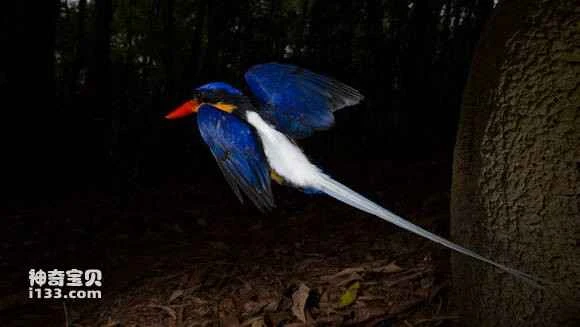
It is the only bird in the kingfisher family with a long, ribbon-like tail.
Distribution and Habitat
White-tailed fairy kingfishers are found along the northern coast of Australia and the island of New Guinea.
White-tailed fairy eagles are often found in lowland forests, ranging from hills up to 900 meters and even 1560 meters in altitude.
Appearance
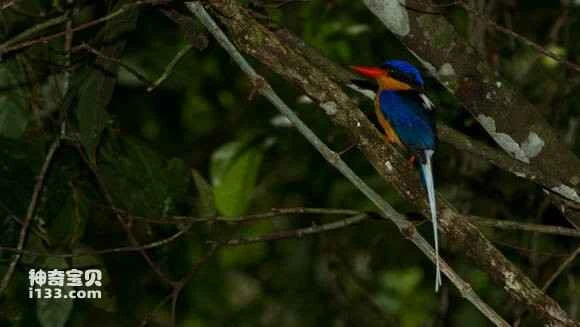
The White-tailed Fairy Kingfisher is 30-35 cm long and weighs 43-74 g; males and females are hermaphroditic. It has a black forehead and lores, black eye stripes, a bright blue crest and shoulders, and a black neck and upper body. Its upper body is black, belly is apricot-yellow, rump is white, beak is red, iris is dark brown, and legs are orange. It has two very long white tail feathers.
Detailed introduction
The white-tailed kingfisher, scientifically known as *Tanysiptera sylvia*, also called Buff-breasted paradise kingfisher, has four subspecies.
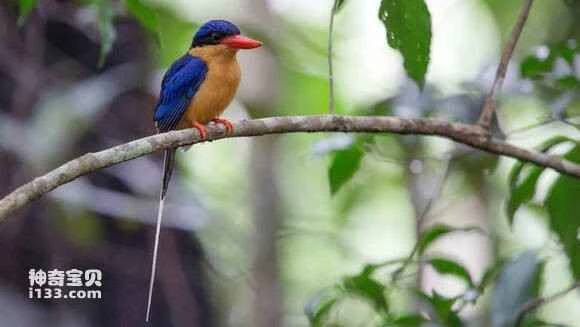
The White-tailed Kingfisher is a completely carnivorous kingfisher. Its hunting techniques are largely similar to other kingfisher species, but it also has its own unique characteristics. It often hides in the shade of trees near water, waiting to ambush fish and shrimp. When standing, its head remains almost still, while its tail sways intermittently. It spends most of its time foraging on the ground, digging in the soil with its beak to catch insects, including snails, beetles, grasshoppers, caterpillars, centipedes, and earthworms, as well as small reptiles such as lizards. Sometimes it gets its feathers very dirty.
The breeding season for the White-tailed Kingfisher varies by location. In the UK, it's May, June, and December; in Papua New Guinea, it's February; and in Queensland and New Britain, it's November, December, and January. In Australia and New Guinea, the White-tailed Kingfisher typically builds its nest in a tree cavity more than 5 meters above the ground. However, in Australia and New Guinea, it also builds nests in termite towers and in trees, but most commonly, it digs a 15-20 cm deep burrow in an earthen mound. The female lays three eggs, and both parents take turns incubating and raising the chicks together.
Listed as Least Concern in the IUCN Red List of Threatened Species (ver 3.1, 2008).
Protect wild animals and ban the consumption of wild game.
Maintaining ecological balance is everyone's responsibility!