Basic Information
Scientific classification
- Chinese name: Northern Snake-necked Turtle
- Scientific name: Chelodina rugosa
- Classification: Testudines
- Family and genus: *Typhonidae* (snake-necked turtle family), *Typhonium* (
Vital signs data
- Body length: Adults can reach a carapace length of about 30–36 cm, which is considered a medium to large long-necked freshwater turtle.
- Weight: Weight varies depending on size and sex, with most adults weighing several kilograms, and larger males and females being heavier.
- Lifespan: It is speculated to be a long-lived species, capable of living for decades in the wild, and typically takes several years or even more than ten years to reach sexual maturity.
Significant features
The long-necked freshwater turtle, endemic to the seasonal floodplains of northern Australia and southern New Guinea, is known for its extremely long neck and its rare "underwater egg-laying + delayed embryonic development" strategy, making it a representative species of tropical seasonal wetland ecosystems.
Distribution and Habitat
They are distributed in tropical floodplains, seasonal pools and slow-flowing rivers in northern Australia and southern New Guinea. They prefer large areas of shallow wetlands and marshy grasslands formed during the rainy season, while in the dry season they tend to concentrate in residual pools or burrow into soft mud to escape the heat and retain moisture.
Appearance
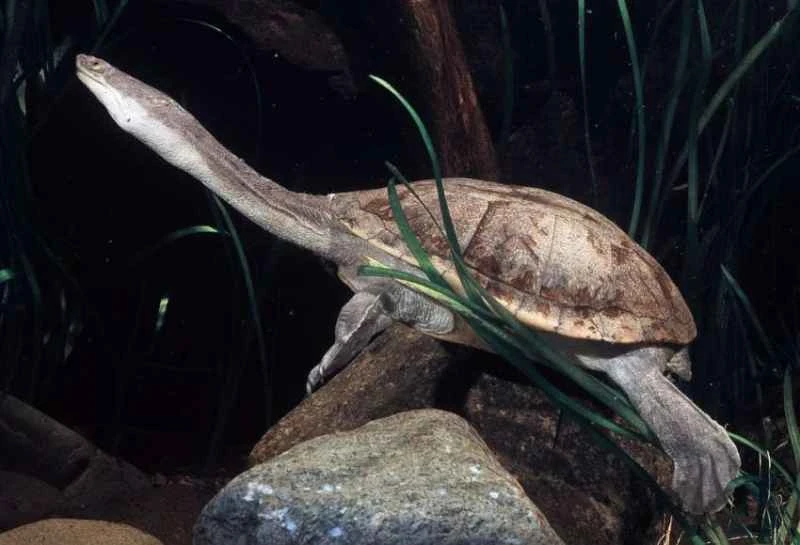
The carapace is slightly oval and arched, mostly olive brown, grayish brown, or dark brown in color, while the plastron is pale yellow or cream-colored, with some individuals having dark patches. The head is relatively small, but the snout is slightly pointed, and the neck is extremely long and thick, reaching the same length as or longer than the carapace when straight. The limbs are strong, with well-developed webbing between the toes, which is advantageous for swimming and digging in muddy and watery environments.
Detailed introduction
The Northern Snake-necked Turtle ( Chelodina rugosa ), also known as the Northern Long-necked Turtle, is a medium-sized freshwater turtle with an extremely long neck. Belonging to the genus Chelodina in the family Chelodinaidae, it is a typical representative species of the Australian snake-necked turtle. Native to the tropical regions of northern Australia and southern New Guinea, it typically inhabits seasonal floodplains, ponds, and slow-flowing waterways. One of the most famous characteristics of this species is its highly unique reproductive strategy of underwater egg-laying and delayed development, considered a rare and distinctive adaptation among reptiles.
Classification and nomenclature
The Northern Snake-necked Turtle belongs to the class Reptilia, order Testudines, family Chelidae, and genus Chelodina . The genus Chelodina includes various snake-necked turtles distributed in Australia, New Guinea, and other regions, all characterized by their long necks that can fold laterally. At the subgenus level, the Northern Snake-necked Turtle is often classified under the group *Chelodina* (* Chelodera *), also known as the "thick-necked snake-necked turtle," representing a distinctive, robust type of long-necked turtle. Due to historical confusion regarding nomenclature and type specimens, this species was long known by other scientific names such as *Chelodina oblonga* . However, recent molecular systematic studies have gradually confirmed *Chelodina rugosa* as the appropriate scientific name for the Northern Snake-necked Turtle.
Appearance features
The Northern Snake-necked Turtle is medium to large in size, with a slightly oval carapace that appears elongated from above and has a slightly arched surface. Adults typically reach 30–36 cm in carapace length, with an overall coloration mostly olive brown, grayish-brown, or dark brown, sometimes showing fine spots or irregular markings. The plastron is lighter in color, mostly pale yellow or cream, with some individuals exhibiting dark patches. The head is relatively small but the snout is slightly pointed. The most distinctive feature is its extremely long and robust neck, which, when stretched out, can be as long as or even longer than the carapace. The skin of the neck and limbs is mostly grayish-brown, covered with fine scales. The fore and hind limbs are strong, with well-developed webbing between the toes, which is advantageous for swimming in water and digging in soft mud.
Distribution range and habitat
The Northern Snake-necked Turtle is primarily distributed in the tropical regions of northern Australia, including northern Queensland, parts of the coastal floodplains of the Northern Territory, and seasonal wetland systems in northern Western Australia. It is also found in some lowland wetlands and slow-flowing waterways in southern New Guinea. This species is highly adapted to the highly seasonal tropical climate, preferring large floodplains, seasonal billows, slow-flowing river channels, and marshy grasslands formed during the rainy season. During the rainy season, large areas are flooded, providing abundant foraging and breeding grounds for the Northern Snake-necked Turtle; during the dry season, as water levels recede and the water bodies shrink, the turtles often concentrate in remaining billows or burrow into the mud to spend the dry period.
Lifestyle Habits and Behaviors
The Northern Snake-necked Turtle is a highly aquatic freshwater turtle, spending most of its time living and foraging in the water. They are typically more active in the cooler early morning and evening, swimming near the surface or floating to breathe; during the warmer days, they mostly rest underwater or among fallen or driftwood. When threatened, they quickly swim to deeper water or burrow into aquatic plants and mud to hide. As a side-necked turtle, they cannot retract their heads into their shell like the Hidden-necked Turtle; instead, they bend their long neck laterally, partially concealing it on one side of their carapace. Generally, the Northern Snake-necked Turtle is not aggressive towards humans and tends to flee rather than actively defend against bites.
feeding habits
Northern snake-necked turtles are primarily carnivorous, but also exhibit some omnivorous characteristics. They utilize their long necks and agile "ambush-and-hunt" hunting methods, ambushing or actively pursuing prey in the water. Their main diet includes small fish, fish fry, tadpoles, adult frogs, crustaceans, various aquatic invertebrates, and even juvenile aquatic vertebrates and small turtles. Some individuals will also peck at animal carcasses and organic debris in the water, acting as "cleaners" to some extent. Their long necks allow them to suddenly extend their necks to hunt while their bodies remain concealed, increasing their ambush success rate.
Reproduction and life cycle
The Northern Snake-necked Turtle is an oviparous species, and its reproductive strategy is extremely rare among all turtles. Females typically dig nests in soft mud or fine sand in shallow waters at the end of the rainy season or when water levels begin to stabilize. They then lay their eggs in a completely submerged environment, burying them several centimeters underwater in the mud. Studies show that these eggs enter a state of "temporary cessation of development" during prolonged submersion, with embryonic development almost ceasing but remaining viable. Once the dry season arrives, water levels drop, the nest emerges above the water, and accesses oxygen from the air, the embryos resume development. This "underwater egg-laying + delayed development" strategy is considered a high adaptation to tropical seasonal floodplains, allowing them to avoid the threats of fluctuating water levels during the rainy season and numerous predators in the water. Each nest typically contains around ten eggs, and the incubation time depends on the duration of the dry season and the nest temperature.
Relationship with humans
The Northern Snake-necked Turtle holds significant food and cultural value in the traditional Aboriginal cultures of parts of Northern Australia, where its unique underwater egg-laying behaviors are well-known. However, with the advancement of modern wetland development, water conservancy projects, and transportation infrastructure construction, they may face habitat loss, road damage, and nest destruction in some areas. On the other hand, the Northern Snake-necked Turtle is also well-known among international pet turtle enthusiasts, and excessive or illegal collection could potentially stress wild populations. Therefore, regulating collection, combating illegal trade, and strengthening wetland protection and public education are particularly important.
Protecting the status quo and threats
In early assessments of the IUCN Red List, the Northern Snake-necked Turtle, under the name * Chelodina oblonga* , was listed as "Near Threatened," while in some Australian state lists it is considered "Least Concern," reflecting an overall low to moderate threat level, although local populations and key habitats still face significant pressure. Major threats include: drainage, reclamation, or levee construction of tropical floodplain wetlands; alterations to natural flood rhythms by dams and canals; trampling and burrowing of riverbanks and nesting areas by large invasive mammals such as buffalo and wild boar; and extreme droughts and changes in rainfall patterns due to climate change. Currently, the focus of Northern Snake-necked Turtle conservation is on maintaining and restoring the natural floodplain wetland structure, limiting intensive grazing and mechanical disturbance in key breeding areas, and enhancing long-term protection of the turtle and its habitat through scientific monitoring and community involvement.
Frequently Asked Questions
Q1: Why is the Northern Snake-necked Turtle called the "Snake-necked Turtle"?
The most distinctive feature of this species is its extremely long neck, which, when stretched out, can be as long as or even longer than its carapace, resembling a slender "snake" attached to the front of the shell. Hence, it is figuratively called the "snake-neck turtle" or "long-necked turtle".
Q2: Do northern snake-necked turtles really lay their eggs underwater?
Yes, female Northern Snake-necked Turtles often dig nests in the soft mud of shallow waters and bury their eggs underwater before the floodwaters recede. The eggs enter a period of dormancy while submerged for an extended period, and embryonic development only resumes after the water level drops, the nest is exposed to the surface, and the eggs gain access to oxygen from the air. This is a highly unique adaptation strategy for seasonal wetlands.
Q3: Is the Northern Snake-necked Turtle suitable as a family pet?
Due to their complex ecological needs, large size and lifespan, and high requirements for water quality and space, coupled with strict protection regulations for native freshwater turtles in many regions, the Northern Snake-necked Turtle is not suitable as a common family pet. A more reasonable approach is to allow them to receive professional care and display in natural wetlands or compliant zoos and science education institutions.
Q4: What are the main threats to the Northern Snake-necked Turtle from human activities?
The primary threats come from habitat alteration and destruction, such as floodplains being converted into farmland, wetlands being drained or impounded by dikes, grazing livestock and wild boars trampling nesting areas, and road traffic causing adult and juvenile tortoises to be run over. Climate change, leading to extreme rainfall and exacerbated droughts, will also affect successful nest hatching and the survival rate of hatchlings.