Basic Information
Scientific classification
- Chinese name: Azure-headed snake
- Scientific name: Hoplocephalus bitorquatus
- Classification: Squamata
- Family and genus: Elapidae, genus *Broadhead snake*
Vital signs data
- Body length: Adults are generally about 60–90 cm in total length, which is a medium-sized arboreal venomous snake.
- Weight: Weight varies depending on individual size and nutritional status, with most adults weighing several hundred grams to about 1 kilogram.
- Lifespan: It is estimated that it can survive for more than ten years in the wild, and its lifespan may be even longer under captive conditions. Sexual maturity usually takes several years.
Significant features
A typical arboreal venomous snake found in the forests of eastern Australia, it has a pale head, a light-colored collar on the back of its neck outlined by a thin black band, and is known for its nocturnal nature, climbing ability, and predation on small arboreal animals such as tree frogs.
Distribution and Habitat
They mainly inhabit forests, sclerophyllous forests, and forest edge scrubland along the eastern coast of Australia, from the Cape York Peninsula to central New South Wales. They prefer mature stands with old trees, dead trees, abundant tree cavities, and peeling bark. They also use fallen trees, rock crevices, and fallen branches as hiding places. They are highly arboreal and mostly active at night.
Appearance
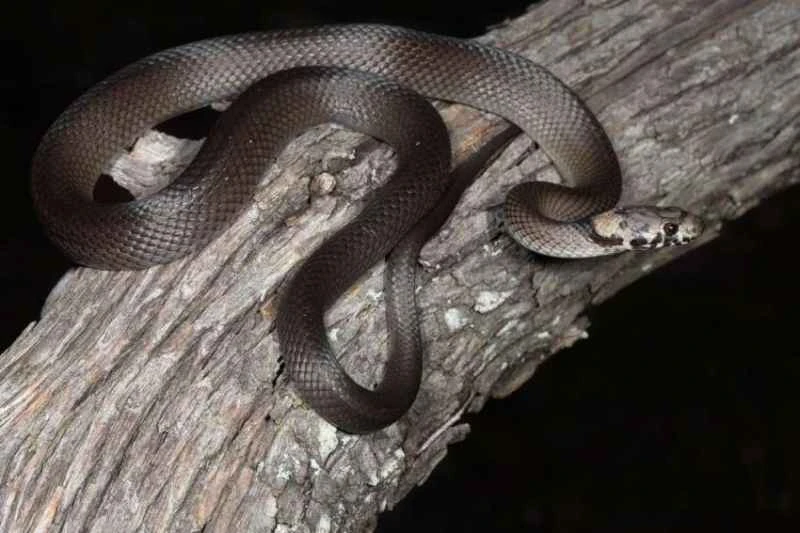
The body is slender, with a back that is mostly light brown, grayish-brown, or olive brown, and a belly that is cream to grayish-white. The head is lighter in color than the body, with a distinct light-colored neck ring at the back of the neck, surrounded by a narrow black border. The head is wide and clearly distinguishable from the neck. The eyes are medium-sized with round pupils, giving an overall visual impression of a pale head and a prominent neck ring.
Detailed introduction
The Pale-headed Snake ( Hoplocephalus bitorquatus ) is a medium-sized, highly venomous snake belonging to the genus Hoplocephalus in the family Elapidae. It is one of the arboreal venomous snakes endemic to the eastern coastal region of Australia. Like its relatives, the Helmeted Snake and the Stephens' Banded Snake, the Pale-headed Snake is adapted to moving among trees, often hiding in tree holes, behind loose bark, and in crevices of fallen logs. Its head is lighter in color than its body, and it has a conspicuous light-colored collar at the back of its neck, outlined by a narrow black edge, hence its name "Pale-headed Snake".
Classification and nomenclature
The Pale-headed Snake belongs to the class Reptilia, order Squamata, suborder Serpentes, family Elapidae, and genus Hoplocephalus . The genus Hoplocephalus currently includes only three Australian venomous snakes: the Pale-headed Snake, the Helmeted Snake, and the Stephens' Banded Snake, all arboreal venomous snakes endemic to eastern Australia. The Pale-headed Snake was first described in the 19th century and used several different scientific names, such as Alecto bitorquata , before being standardized as Hoplocephalus bitorquatus through systematic classification. Its common English name, Pale-headed Snake, directly refers to its pale head and light-colored rings around its neck.
Appearance features
The slender-bodied cobra is a medium-sized venomous snake. Adults typically reach 60–90 cm in length, with the longest individuals approaching 1 meter. The back is mostly light brown, grayish-brown, or olive-brown, with a relatively uniform color from back to tail, sometimes with slightly darker stripes along the spine. The belly is cream to grayish-white, occasionally with small dark spots. The most distinctive features are on the head and neck: the top of the head is lighter than the body, sometimes pale olive or gray, and there is a striking light-colored or milky-white collar at the nape of the neck, surrounded by a narrow black band, giving the appearance of a light-colored collar from a distance. The head is relatively wide, clearly distinguishable from the neck, and the eyes are medium-sized with round pupils, consistent with typical characteristics of Australian cobras.
Distribution range and habitat
The harpy is endemic to Australia, primarily distributed along the eastern coast, from the Cape York Peninsula in northern Queensland southward to the central coast of New South Wales (such as the Gosford area) and adjacent inland regions. Its typical habitats include moist or dry sclerophyllous forests, open woodlands, rainforest edges, and forest shrublands in coastal and hilly areas. Harpys are highly arboreal, often found in mature forests with many old trees, dead logs, tree cavities, and loose bark. They also utilize fallen logs, rock crevices, and fallen branches for concealment. Due to their high dependence on tree cavities and loose bark, excessive logging and clearing of deadwood significantly reduce the quality of suitable habitats.
Lifestyle Habits and Behaviors
The tarantula is primarily active at night or after dusk, and is a typical nocturnal and arboreal venomous snake. During the day, it mostly hides in tree holes, behind peeling bark, in rock crevices, or under fallen logs, only occasionally being seen moving in relatively shady environments. After nightfall, they slowly slither along tree trunks, branches, or bushes, searching for tree frogs and other small prey. In terms of temperament, tarantulas are generally timid and nervous: when startled, they tend to quickly hide in cover, but when cornered and unable to escape, they quickly adopt a defensive posture, raising their forebody in an S-shape and ready to bite. Once truly provoked, they have a strong desire to bite.
feeding habits
The primary diet of the arboreal serpent consists of various tree frogs and other amphibians that inhabit the forest canopy and trunk, thus it is often considered one of the "tree frog predators." They also prey on small lizards, geckos, and occasionally small mammals such as woodland mice. At night, using their camouflage and arboreal abilities, the arboreal serpent moves slowly among the branches or lies in wait on the trunk, launching a sudden attack when a tree frog approaches. It injects venom with its frontal fangs and quickly releases its jaws, waiting for its prey to be paralyzed or dead before swallowing it whole. In this way, the arboreal serpent plays a crucial role in controlling the population of small arboreal vertebrates in the forest ecosystem.
Reproduction and life cycle
The harpy serpent is a viviparous snake, like many other Australian cobras, it does not lay eggs but gives birth to fully developed young. Females typically mate during the warmer months, and after fertilization, the embryo develops inside the mother for several months, eventually giving birth to several to more than ten young snakes. Although the newborn juveniles are small, they already possess a complete fang and venom gland system, and their venom is quite potent; they should be considered high-risk venomous snakes, just like the adults. While there is limited long-term data on the lifespan of the harpy serpent in the wild, it is estimated that it can survive for more than ten years, and its lifespan may be even longer under captive conditions.
Relationship with humans
Jaw snakes primarily inhabit forests and forest edges, far from highly urbanized areas, thus direct contact with humans is relatively rare. However, they may occasionally be encountered near rural homes, farms, or roadsides in woodland areas. Because their venom is highly toxic, belonging to the Australian cobra family, a bite can lead to severe poisoning if not treated promptly. Fortunately, most jaw snakes will quickly flee upon seeing humans, only biting when cornered or accidentally stepped on. Australian law generally protects native snakes; the general public should not attempt to hunt or drive them away themselves, but should contact professional snake catchers.
Protecting the status quo and threats
The harpy krait is classified as "Least Concern" on the IUCN Red List, reflecting its wide distribution and continued presence in considerable numbers in many suitable habitats. However, in some areas, its habitat is being impacted by deforestation, habitat fragmentation, removal of old and dead trees, and frequent burning management, leading to a reduction in suitable tree cavities and forest structures. Furthermore, road traffic and indiscriminate culling due to fear of venomous snakes also put pressure on local populations. The key to protecting the harpy krait lies in maintaining the integrity of the eastern coastal forest and forest edge ecosystems, preserving old and dead trees to provide habitat and breeding structures, and reducing misunderstandings and fears about snakes through public education.
Frequently Asked Questions
Q1: How potent is the venom of the bald serpent?
The tarantula is a venomous snake belonging to the family Cobraidae in Australia. Its venom is highly toxic, enough to cause severe poisoning and even death in humans. Although bite records are not as frequent as those of common venomous snakes such as the brown snake, a bite should be treated as a medical emergency, requiring immediate pressure immobilization and medical attention.
Q2: Why is the arboreal snake called a "tree-dwelling venomous snake"?
The arboreal snake is highly dependent on trees for habitat and foraging, often hiding in tree holes, behind peeling bark, and among branches, hunting for prey such as tree frogs and lizards at night. Unlike many venomous snakes that are mainly terrestrial, it belongs to a distinctly arboreal group of Australian venomous snakes.
Q3: What should you do if you encounter a bluehead snake in the wild?
The most important thing is to remain calm and keep a safe distance from the snake. Do not try to drive it away, catch it, or swat it, and avoid cornering it. In most cases, harlequin snakes will leave on their own once they determine there is no threat. If found near a residence or campsite, contact a local professional snake catcher or wildlife rescue organization.
Q4: What role does the bluehead snake play in the ecosystem?
The tarantula is a mid-to-high-level predator in forest ecosystems, primarily feeding on tree frogs, small lizards, and small mammals, helping to regulate the populations of these small vertebrates and maintain food web balance. At the same time, it is also preyed upon by birds of prey, large snakes, and some mammals, thus contributing to forest biodiversity.