Basic Information
Scientific classification
- Chinese name: Green Cotton Duck
- Scientific name: Green Pygmy-goose, Green Pygmy Goose, Nettapus pulchellus
- Classification: Waterfowl
- Family and genus: Anseriformes, Anatidae, Cotton Duck
Vital signs data
- Body length: Approximately 33 centimeters
- Weight: No verification information available.
- Lifespan: No verification data available.
Significant features
It has a black cap on its head, dark green wings, and its underparts are covered with black and white fan-shaped ribbed feathers.
Distribution and Habitat
It is distributed in tropical Australia and southern New Guinea.
They inhabit rivers, lakes, and marshes with dense vegetation. They generally avoid being on the ground and are commonly found perching on branches hanging over the water.
Appearance
The Cottonwood Duck is 33 cm long and is a small duck. It has a black cap on its head, dark green wings, and its underparts are covered with black and white fan-shaped ribbed feathers. The male has a green neck, a dark head, and large white patches on its cheeks, while the female has eyelids and white eye stripes. Its beak is iron-grey, and its iris is black.
Detailed introduction
The Green Pygmy-goose (scientific name: Nettapus pulchellus), also known as the Green Pygmy Goose, is the smallest duck in the Anatidae family.
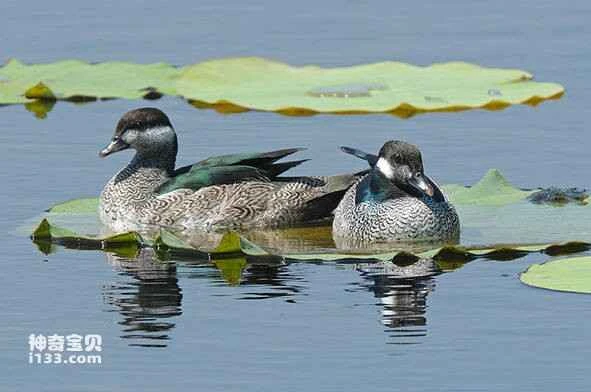
The cotton duck is an omnivorous animal, preferring rice and aquatic plants, and often diving into the water to forage for small fish, shrimp, and insects. Before breeding begins, they move in small groups. These ducklings usually nest in tree cavities, but when trees are scarce, they may also place their nests on the ground. Each nest typically contains 6-11 ivory-white eggs.
Listed in the International Union for Conservation of Nature (IUCN) Red List of Birds, 2009 ver 3.1.
Protect wild animals and ban the consumption of wild game.
Maintaining ecological balance is everyone's responsibility!