
Basic Information
Scientific classification
- Chinese name: Thick-billed Cotton Duck
- Scientific name: Nettapus auritus, African Pygmy-goose
- Classification: Waterfowl
- Family and genus: Anseriformes, Anatidae, Cotton Duck
Vital signs data
- Body length: Approximately 30 centimeters
- Weight: 260-285g
- Lifespan: No verification data available.
Significant features
It is the smallest duck in Africa
Distribution and Habitat
It is distributed in Angola, Benin, Botswana, Burkina Faso, Burundi, Cameroon, Central African Republic, Chad, Congo, Democratic Republic of Congo, Côte d'Ivoire, Djibouti, Equatorial Guinea, Eritrea, Ethiopia, Gabon, Gambia, Ghana, Guinea, Guinea-Bissau, Kenya, Liberia, Madagascar, Malawi, Mali, Mauritania, Mozambique, Namibia, Niger, Nigeria, Rwanda, Senegal, Sierra Leone, Somalia, South Africa, South Sudan, Sudan, Swaziland, United Republic of Tanzania, Togo, Uganda, Zambia, and Zimbabwe.
Migratory birds: Lesotho, São Tomé and Príncipe.
They inhabit rivers, lakes, ponds, and marshes with abundant vegetation, especially open waters rich in aquatic plants. They are sometimes found in small ponds and ditches near villages. They generally avoid being on land and are commonly seen perching on branches hanging over the water.
Appearance
The Cotton-billed Goose is about 30cm in length, with males weighing about 285g and females about 260g. Although called a goose, it is actually the smallest duck in Africa, exhibiting sexual dimorphism. The male has a white forehead, cheeks, and neck; a large green patch on the back of its head and neck; a broad white collar at the base of its neck; and blackish-green shoulders, back, and upper coverts with a metallic sheen. Its primary flight feathers are blackish-brown with white centers, forming a speculum; the secondary flight feathers are blackish-brown with white tips. The female has whitish-grey cheeks and a narrow black eye stripe. Both sexes have reddish-brown underparts; black irises; orange-red bills with black tips; and yellow legs.
Detailed introduction
The thick-billed cotton goose (scientific name: Nettapus auritus), also known as the African Pygmy-goose, has no subspecies.
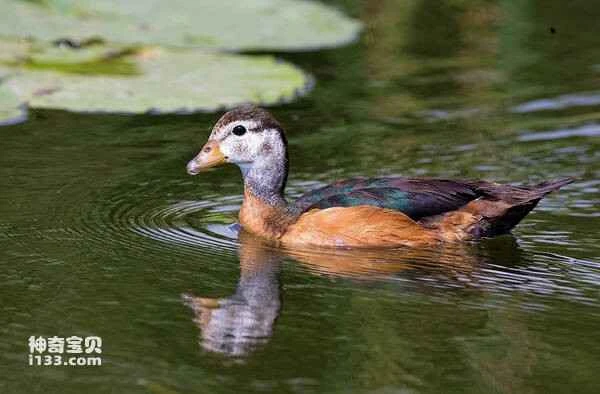
Thick-billed cotton dykes primarily feed on the tender shoots, leaves, and roots of aquatic and terrestrial plants, as well as aquatic insects, worms, snails, mollusks, crustaceans, and small fish. They forage during the day, usually at the surface and in shallow waters near the shore, rarely diving to hunt.

Thick-billed cottony gypsy move in small groups before breeding begins, and these ducklings typically nest in tree cavities. There are also reports of them nesting in chimneys. Each nest usually contains 6-11 ivory-white eggs. The incubation period is 23-26 days.
Listed as Least Concern (LC) on the IUCN Red List of Threatened Species 2012 ver3.1.
Protect wild animals and ban the consumption of wild game.
Maintaining ecological balance is everyone's responsibility!


